Digital Forensics Report: The Crime — Android Mobile Device Forensics of a Homicide Victim
Platform: CyberDefenders Challenge: The Crime Category: Endpoint Forensics Difficulty: Easy Tools: ALEAPP, DB Browser for SQLite, Linux Command Line Achievement: Proof of Completion
1. Executive Summary
Incident Type: Homicide Investigation / Mobile Device Forensics
Device: Android smartphone belonging to the victim
In this investigation, we are tasked with analyzing the mobile device of a homicide victim. Witness testimonies suggest the victim was heavily involved in trading, incurred massive debt, and exhibited unusual travel and communication patterns shortly before the incident. Our objective is to parse the Android file system using ALEAPP, reconstruct the victim’s activities from application data, SMS records, contact databases, and cached images, and document the digital evidence that connects the victim to key persons of interest, financial motive, and pre-incident travel plans.
Indicators of Compromise (IOCs)
| Type | Indicator | Description |
|---|---|---|
| Trading App Package | com.ticno.olymptrade | Primary trading application installed on the device |
| APK SHA256 | 4f168a77...e9df3c | Cryptographic hash of the base.apk installation file |
| Creditor Phone | +201172137258 | Phone number of the aggressive debt collector |
| Creditor Name | Shady Wahab | Contact saved in the victim’s address book |
| Debt Amount | 250,000 | Monetary value demanded in threatening SMS |
| Location (Sep 20) | The Nile Ritz-Carlton | Victim’s location per Google Maps snapshot |
| Booked Flight | Egypt Airlines → Las Vegas | Boarding pass found in /data/media/0/Download |
| Meeting Venue | The Mob Museum | Arranged via Discord with user rob1ns0n. |
| Discord Contact | rob1ns0n. | Friend the victim arranged to meet in Las Vegas |
MITRE ATT&CK Mapping Overview
| Tactic | Technique | ID |
|---|---|---|
| Collection | Data from Local System — SMS Database | T1005 |
| Collection | Data from Local System — Contacts Database | T1005 |
| Discovery | File and Directory Discovery — APK Enumeration | T1083 |
| Collection | Screen Capture — Android Recent Apps Snapshots | T1113 |
| Collection | Data from Information Repositories — Discord Chat Logs | T1213 |
2. Background: Key Android Forensic Artifacts
Before diving into the analysis, it is essential to understand the Android file system structure and the key artifact locations that make mobile forensics possible. Unlike Windows forensics where evidence is scattered across the registry, event logs, and prefetch files, Android centralizes most forensic evidence in SQLite databases and cached media files.
| Artifact | File System Location | Forensic Value |
|---|---|---|
| Installed APKs | /data/app/<package>/base.apk | Identifies all applications installed on the device; APK hashing enables integrity verification and malware detection |
| SMS Messages | /data/user_de/0/com.android.providers.telephony/databases/mmssms.db | Complete text message history — timestamps, sender/receiver, read status, message body |
| Contacts | /data/data/com.android.providers.contacts/databases/contacts2.db | Maps phone numbers to display names — critical for correlating anonymous numbers to known individuals |
| Recent Apps Snapshots | /data/system_ce/0/snapshots/<task_id>/ | Visual screenshots taken automatically when apps are backgrounded — preserves the exact screen state at a specific moment |
| Downloads | /data/media/0/Download/ | User-downloaded files: tickets, receipts, documents, images — often contains travel and financial evidence |
| Third-Party App Data | /data/data/<package>/databases/ | Each app maintains its own SQLite database — Discord, WhatsApp, Telegram all store chat history locally |
Why this matters: A single Android device can reconstruct a person’s complete digital life — who they talked to, what they said, where they were, what apps they used, and what they were looking at. The key forensic skill is knowing which databases to query and how to correlate data across them. ALEAPP (Android Logs Events And Protobuf Parser) automates much of this parsing, but understanding the underlying data model is essential for interpreting results correctly.
Tool Note — ALEAPP: ALEAPP is an open-source Android forensic parser that processes a full file system extraction and generates an HTML report with parsed artifacts organized by category (SMS, Contacts, Installed Apps, etc.). It supports hundreds of artifact types and is the standard tool for Android mobile forensics alongside Autopsy and Cellebrite.
3. Phase 1: Identifying the Trading Application (Question 1)
Objective: Identify the SHA256 hash of the trading application the victim primarily used.
Android applications are installed as .apk files, typically stored in the /data/app/ directory under their specific reverse-domain package name. By analyzing the installed applications via ALEAPP’s package parsing module or manual file system browsing, we identified a package named com.ticno.olymptrade — the Olymp Trade financial trading platform.
Why this finding matters for the investigation: The presence of a trading application on the victim’s phone corroborates the witness testimony about heavy trading involvement. Combined with the debt evidence we will uncover in Phase 2, this establishes the financial dimension of the case.
To verify the file and obtain its unique cryptographic signature, we navigated to the application’s directory in the extracted file system using the terminal and hashed the core installation file (base.apk) using the sha256sum utility.
Command Used:
1
sha256sum base.apk
Command Explanation:
sha256sum— Computes the SHA-256 cryptographic hash of a file, producing a unique 64-character hexadecimal string. Even a single byte change in the file would produce a completely different hash. This makes it the standard method for uniquely identifying and verifying the integrity of any file in digital forensics.
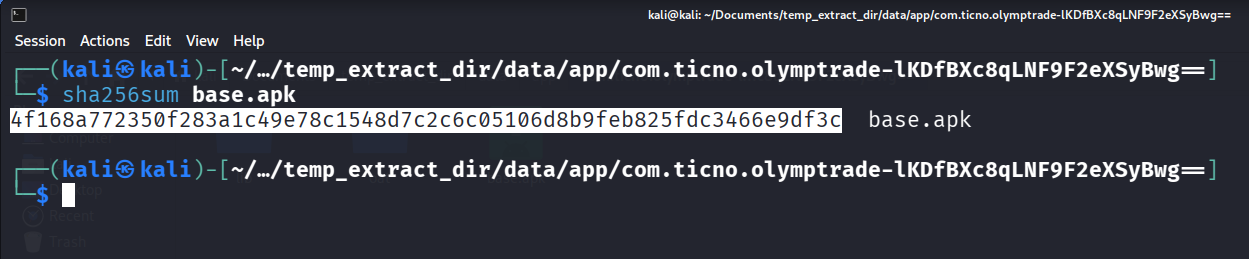
Analyst Note: Hashing application binaries is a fundamental forensic step. The SHA256 hash serves as a digital fingerprint — it can be submitted to VirusTotal or compared against known-good application hashes to verify integrity and rule out trojanized versions. If the hash does not match the official Olymp Trade APK, the victim may have been using a modified (potentially malicious) version of the app.
Answer Q1
What is the SHA256 hash of the trading application?
4f168a772350f283a1c49e78c1548d7c2c6c05106d8b9feb825fdc3466e9df3c
4. Phase 2: Financial Motive — SMS & Contact Analysis (Questions 2 & 3)
Objective: Determine the debt amount and identify the creditor threatening the victim.
Quantifying the Debt
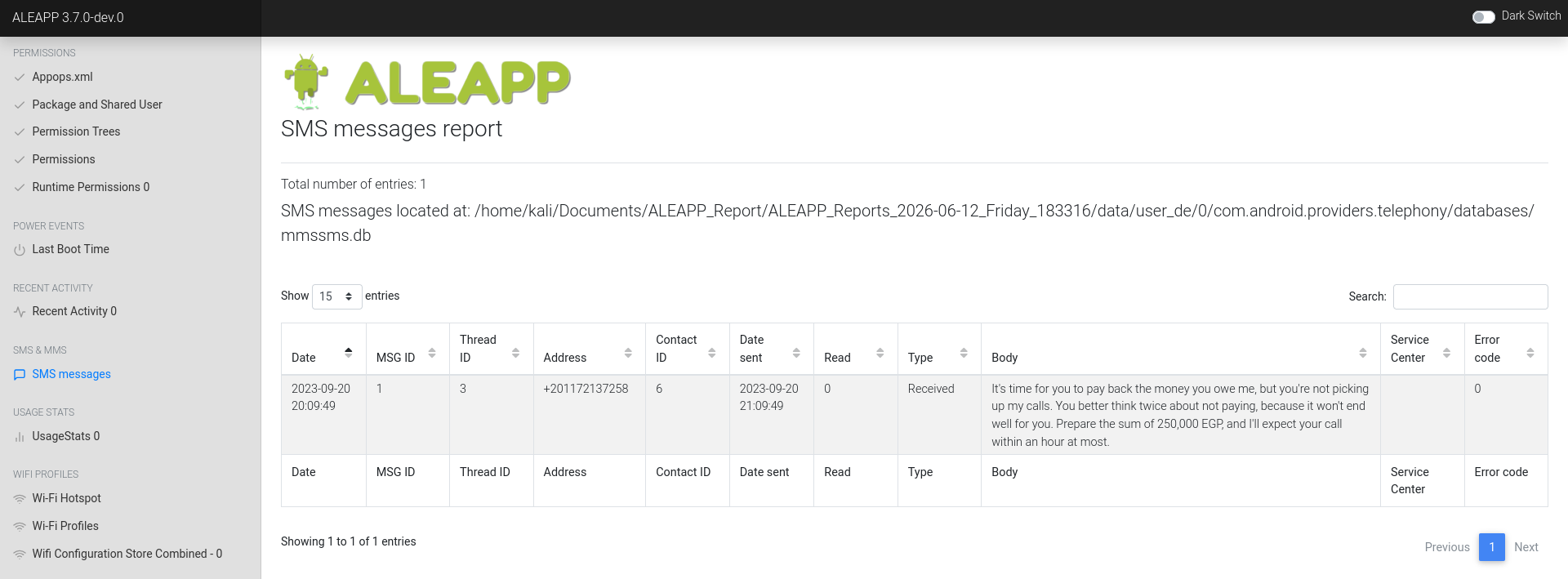
Native text messages (SMS) on Android are stored in the Telephony Provider database, specifically mmssms.db (usually located at /data/user_de/0/com.android.providers.telephony/databases/). This database contains every sent and received text message with timestamps, phone numbers, read/unread status, and the full message body.
Why SMS forensics is critical: In criminal investigations, SMS messages are often the most direct evidence of motive, threats, and relationships. Unlike encrypted messaging apps (Signal, WhatsApp), native SMS is stored unencrypted in a standard SQLite database, making it trivially accessible to forensic tools.
Using ALEAPP to parse the SMS logs, we examined messages matching the witness’s timeline of aggressive threatening communications. We located an unread, incoming message demanding repayment. The sender explicitly states the monetary value required — 250,000.
Identifying the Creditor: Cross-Database Correlation
In digital forensics, correlation across databases is the technique that transforms raw data into actionable intelligence. From the SMS analysis, we identified the threatening message originated from the phone number +201172137258. A phone number alone is useful, but a name attached to that number is transformative.
To map this number to a human identity, we analyzed the Android Contacts database (contacts2.db located at /data/data/com.android.providers.contacts/databases/). By querying this database using ALEAPP’s Contacts parsing module for that specific phone number, we found the display name the victim had saved for this individual: Shady Wahab.
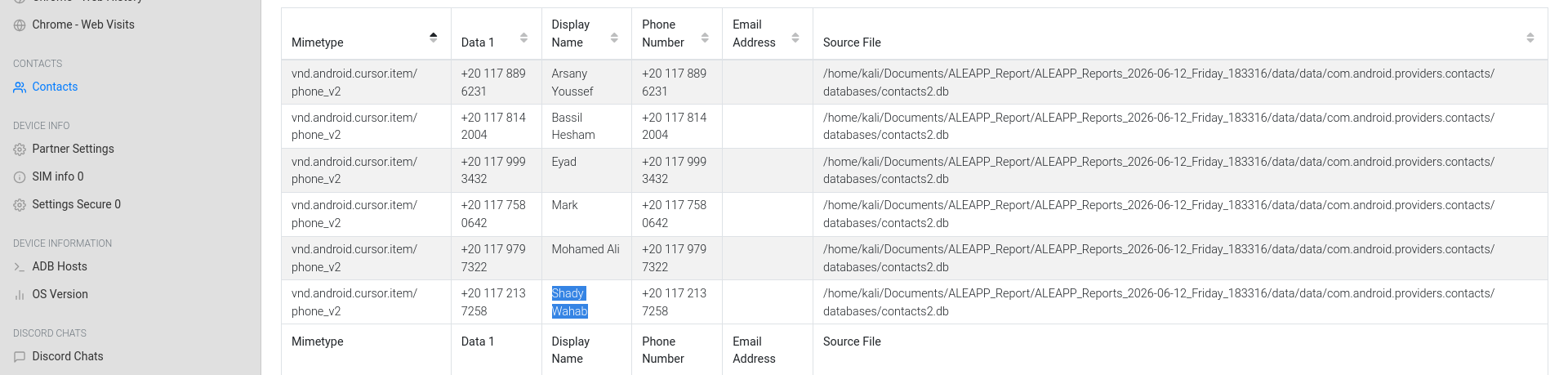
Why this correlation matters: The fact that the victim had this number saved under a name — not just stored as a raw phone number — proves a pre-existing personal relationship. The victim knew their creditor by name. This eliminates the possibility that the threats came from a random scammer or unknown entity, and directly supports the witness testimony about a personal debt.
Analyst Note: Cross-referencing phone numbers between the SMS database and the Contacts database is a standard forensic correlation technique. The contact name assigned by the victim themselves provides critical context — it confirms the victim knew the creditor personally, not just as an unknown caller.
Answer Q2
How much money does the victim owe?
250000
Answer Q3
What is the name of the person to whom the victim owes money?
Shady Wahab
5. Phase 3: Location Intelligence — Google Maps Snapshot (Question 4)
Objective: Determine where the victim was located when they departed their residence on September 20, 2023.
Understanding Recent Apps Snapshots
Android devices frequently take “snapshots” of an application’s screen right before the app is pushed to the background. These cached images are used to create the smooth visual transition in the “Recent Apps” menu and are stored in the device’s system directory.
Why snapshots are forensic goldmines: These images are highly valuable forensic artifacts because they preserve the exact state of an application at the moment the user switched away from it. Unlike GPS coordinates in location databases (which can be turned off), these visual snapshots capture what the user was actively viewing — including maps, conversations, and web pages — regardless of location service settings. The user has no control over their creation and is typically unaware they exist.
In ALEAPP, we examined the Application/Packages data for Google Maps (com.google.android.apps.maps). The system retained a snapshot image (6.jpg) taken on September 20. Viewing this image reveals the exact location the victim was viewing or navigating from on the map interface.
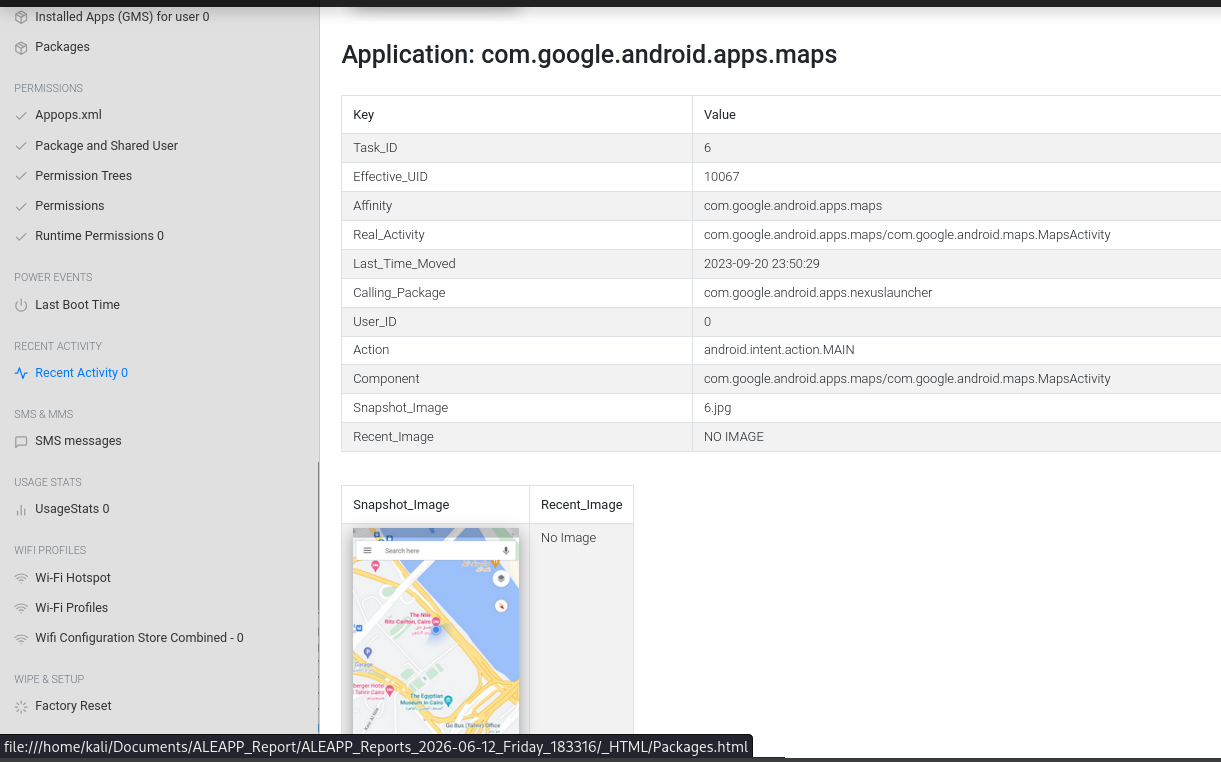
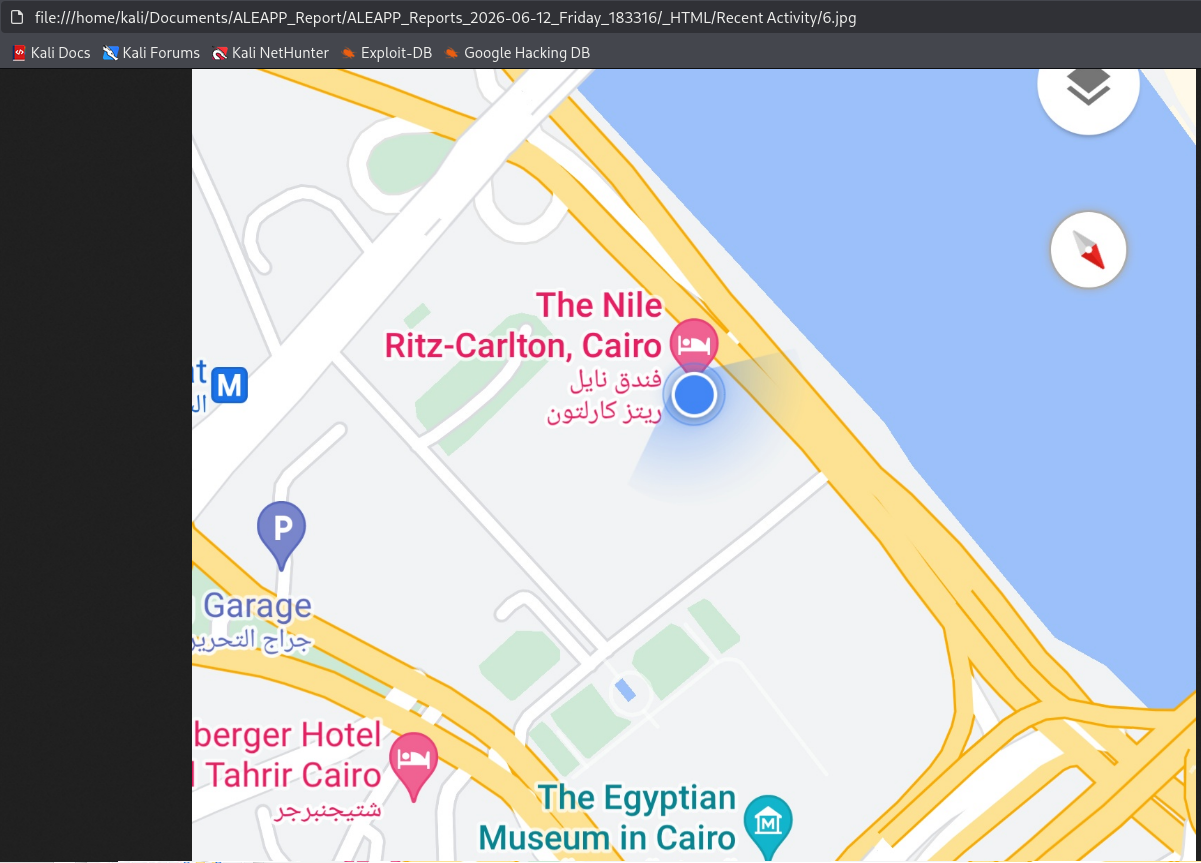
Why this is significant for the investigation: The victim was at a luxury five-star hotel on September 20 — while simultaneously owing 250,000 in debt. This contradiction between financial distress and luxury accommodation could indicate the victim was living beyond their means, or that they had a specific purpose for being at this location (a meeting, a transaction, or an attempt to flee).
Analyst Note: Recent Apps snapshots are an often-overlooked forensic goldmine. Unlike GPS coordinates in location databases (which can be turned off), these visual snapshots capture what the user was actively viewing — including maps, conversations, and web pages — regardless of location service settings. Always check the snapshots directory even when location services were disabled.
Answer Q4
Where was the victim located on September 20?
The Nile Ritz-Carlton
6. Phase 4: Travel Intelligence — Boarding Pass Recovery (Question 5)
Objective: Identify where the victim intended to travel based on a booked flight.
Flight tickets, boarding passes, and travel receipts are commonly downloaded to the device via browsers, email attachments, or messaging apps. These files typically land in the device’s user media storage — specifically the /data/media/0/Download directory.
Why the Download directory matters: This is the default location for all user-initiated downloads on Android. It is the forensic equivalent of a person’s desk drawer — it accumulates receipts, documents, images, and files that the user intentionally saved. Unlike app caches (which may be auto-purged), downloaded files persist until manually deleted.
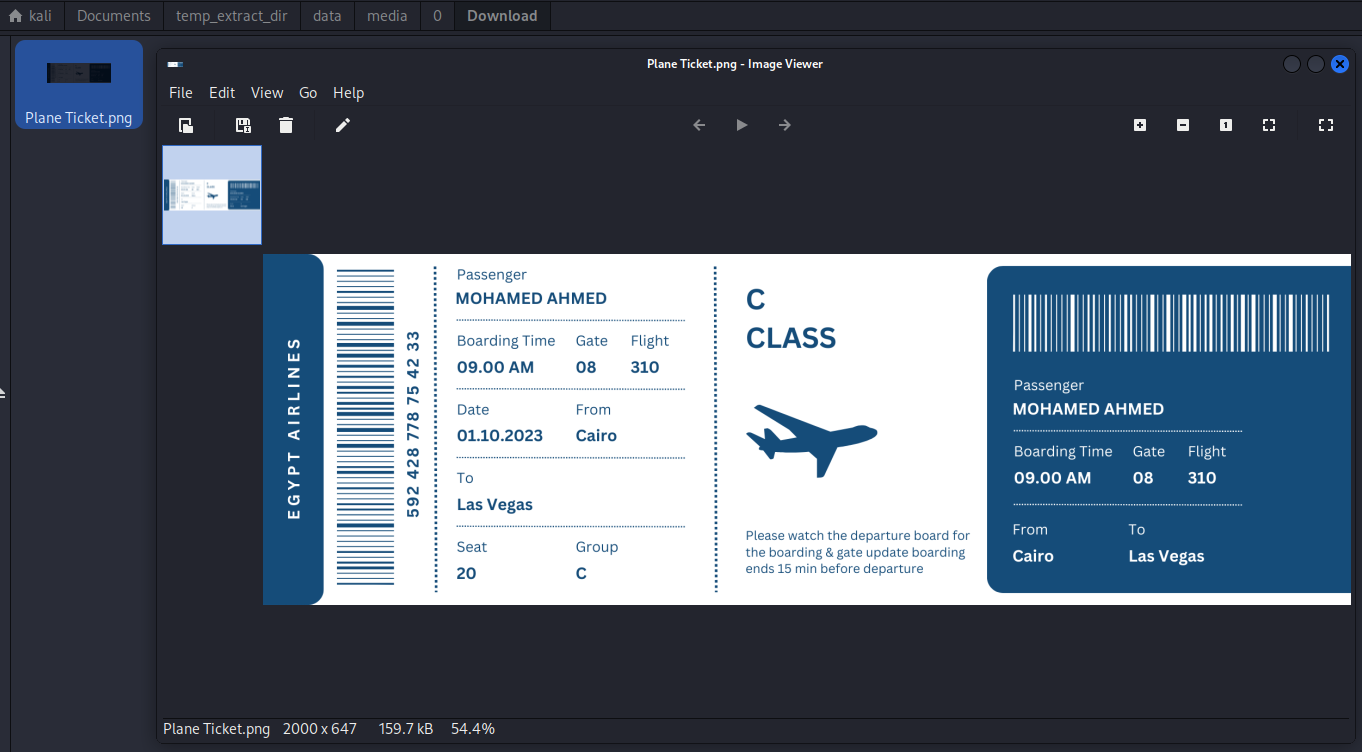
By manually traversing the extracted file system to the Download folder, we discovered an image file named Plane Ticket.png. Opening this image revealed a boarding pass for Egypt Airlines showing the destination city.
Answer Q5
Where did the victim intend to travel?
Las Vegas
7. Phase 5: Communication Intelligence — Discord Chat Analysis (Question 6)
Objective: Determine where the victim arranged to meet a friend via Discord.
Why Third-Party App Forensics Is Different
Third-party applications like Discord do not use the native Android SMS database. They maintain their own independent SQLite databases or cache files to store chat history locally on the device. This means SMS parsers will miss these communications entirely — a dedicated parser or manual database inspection is required.
Why this distinction matters: If an examiner only parses the native SMS and call logs, they will have an incomplete picture of the victim’s communications. In modern mobile forensics, the majority of interpersonal communication happens through third-party apps (Discord, WhatsApp, Telegram, Signal, Instagram DMs) — not native SMS. Failing to parse these databases creates critical intelligence gaps.
ALEAPP includes a dedicated parser for Discord chats. By reviewing the parsed Discord communications within the report, we identified a conversation between the victim and another user (rob1ns0n.) where they finalize their meetup plans, explicitly naming the venue: The Mob Museum in Las Vegas.
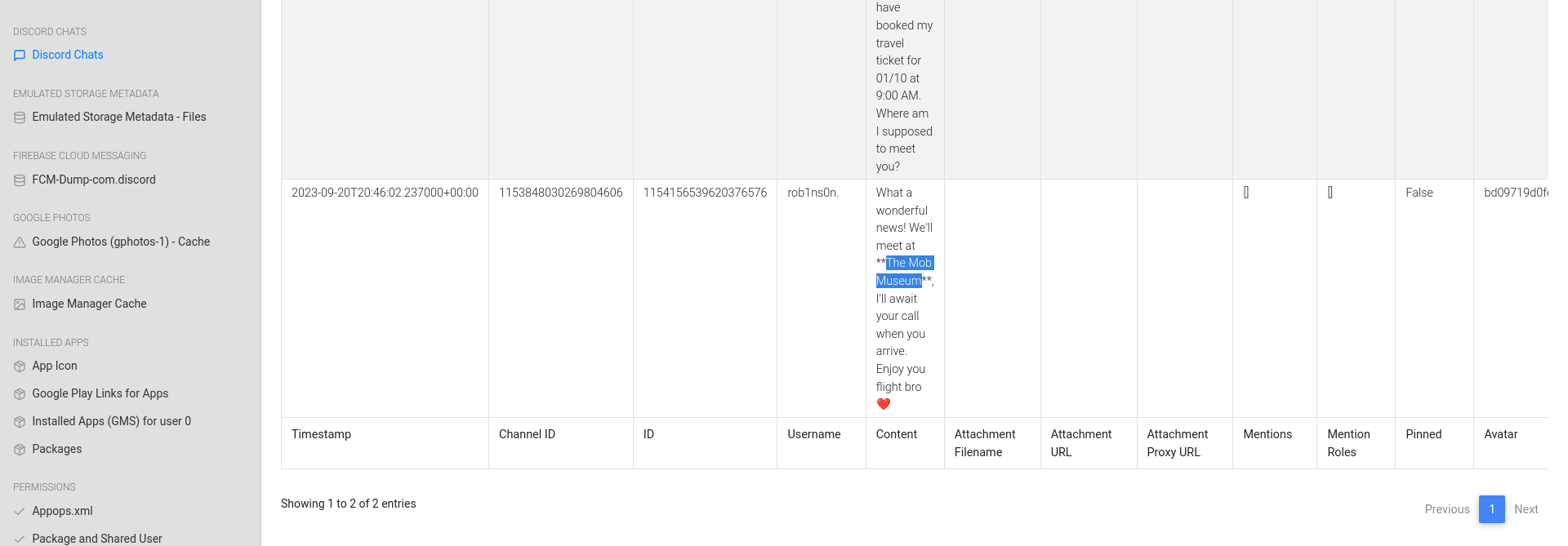
Analyst Note: The correlation between the booked flight (Las Vegas) and the Discord meetup location (The Mob Museum, Las Vegas) is significant. This establishes a clear chain: the victim planned to travel to Las Vegas specifically to meet this Discord contact, providing investigators with a secondary lead to pursue.
Answer Q6
Where did the victim arrange to meet a friend via Discord?
The Mob Museum
8. Reconstructed Investigation Timeline
Based on all artifacts recovered from the device, we can reconstruct the victim’s final activities and the investigative narrative that connects trading, debt, threats, and travel plans:
| Date | Artifact Source | Event | Investigative Significance |
|---|---|---|---|
| Pre-incident | Installed APKs (/data/app/) | Victim installs and actively uses Olymp Trade financial trading app | Corroborates witness testimony about heavy trading involvement |
| Pre-incident | SMS Database (mmssms.db) | Shady Wahab (+201172137258) sends threatening message demanding 250,000 repayment | Establishes financial motive — the victim was under aggressive pressure from a known creditor |
| Sep 20, 2023 | Recent Apps Snapshot (Google Maps) | Victim is at The Nile Ritz-Carlton, Cairo | Places victim at a luxury hotel despite severe debt — contradicts financial distress |
| Pre-departure | Download directory (/data/media/0/Download/) | Boarding pass recovered: Egypt Airlines → Las Vegas | Victim planned international travel — potential flight from creditors or a planned meeting |
| Pre-departure | Discord chat database | Conversation with rob1ns0n.: arranged to meet at The Mob Museum, Las Vegas | Confirms Las Vegas trip had a specific purpose — a planned in-person meeting |
| Post-incident | Physical evidence | Victim found deceased | All digital evidence now serves to reconstruct motive, relationships, and final movements |
Investigative Correlation: The timeline reveals a clear narrative arc: the victim accumulated debt through trading (Olymp Trade) → was threatened by their creditor (Shady Wahab, 250,000) → was at a luxury hotel despite being in debt (Nile Ritz-Carlton, Sep 20) → booked a flight to Las Vegas → planned to meet someone at The Mob Museum. Whether the victim was attempting to flee, meet someone who could help with the debt, or had other intentions — the digital evidence provides investigators with a complete picture of the victim’s final plans.
9. Conclusion
The Crime investigation demonstrates how Android mobile device forensics can reconstruct a victim’s final activities, financial relationships, and travel plans from native system artifacts and third-party application data. Key findings:
- Trading Activity: The victim used Olymp Trade (
com.ticno.olymptrade) — confirmed via APK hashing withsha256sum. - Financial Motive: SMS analysis revealed a 250,000 debt owed to Shady Wahab (
+201172137258), with threatening messages demanding repayment. - Location on Sep 20: Google Maps Recent Apps snapshot placed the victim at The Nile Ritz-Carlton in Cairo.
- Travel Plans: A boarding pass in the Download folder confirmed an Egypt Airlines flight to Las Vegas.
- Discord Meetup: Chat logs revealed a planned meeting with
rob1ns0n.at The Mob Museum in Las Vegas.
Key Takeaways for the SOC:
- ALEAPP is indispensable for Android forensics — it automates the parsing of hundreds of artifact types including SMS, contacts, app snapshots, and third-party chat databases, dramatically accelerating mobile investigations.
- Recent Apps snapshots are forensic goldmines — they preserve visual evidence of what the user was viewing at specific moments, even when location services are disabled or GPS data is unavailable.
- Third-party app databases require dedicated parsers — Discord, WhatsApp, Telegram, and Signal all store chat data in their own SQLite databases, not in the native SMS provider. Always parse application-specific databases to avoid intelligence gaps.
- Cross-database correlation is essential — linking phone numbers from SMS logs to the Contacts database transforms anonymous threats into named suspects with actionable investigative leads.
Analysis Date: June 13, 2026 Analyst: El OMARI Zakaria